Asiatic Lion Conservation and Habitat Translocation Challenges
Source:The Hindu ↗
ఇది ఎందుకు ముఖ్యం
Asiatic lions represent a critical flagship conservation species in India. Understanding the challenges of species translocation, habitat fragmentation, and genetic rescue provides vital perspective for India's broader wildlife management and biodiversity conservation framework under GS Paper III.
సారాంశం
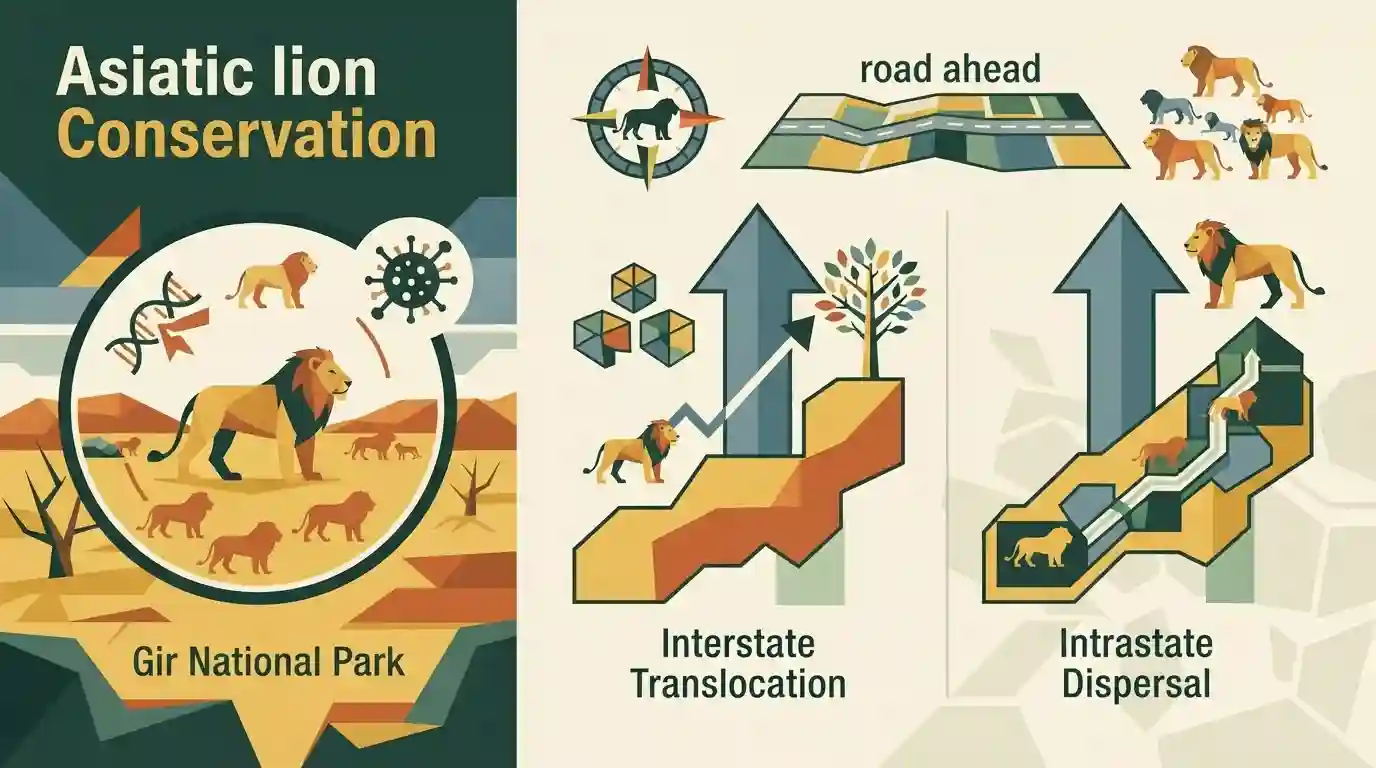
The article discusses the conservation challenges, strategic debates, and the road ahead for the Asiatic lion. Confined primarily to Gujarat's Gir landscape, the species faces risks of inbreeding and vulnerability to epidemics, reviving discussions around interstate translocation versus intra-state dispersal to secure its long-term survival.
ముఖ్య అంశాలు
- Asiatic lions are currently restricted to a single population in Gujarat's Gir National Park and surrounding areas, making them highly vulnerable to disease outbreaks and localized extinction.
- The long-standing debate and Supreme Court directive regarding the translocation of Asiatic lions to a second home (such as Kuno National Park in Madhya Pradesh) face administrative and political inertia.
- Alternative local dispersal within Gujarat, such as to Barda Wildlife Sanctuary, is being pursued, but experts debate whether this offers sufficient genetic diversity compared to an interstate translocation.
- Conservation strategies must balance local community co-existence, infrastructure mitigation (such as railway/road safety), and genetic dispersal.
ముఖ్యమైన పదాలు
Supreme Court of India

The apex judicial body in India that ruled on mandatory wildlife translocation of Asiatic lions to mitigate extinction risks from a single-site habitat concentration.
UPSC context
UPSC Paper II (Polity & Governance / Judiciary) and Paper III (Environment & Biodiversity). Tests judicial activism, wildlife governance, and federal disputes.
International Union for Conservation of Nature (IUCN)
The global authority on the conservation status of species, which classifies the Asiatic lion based on population size, geographic range, and fragmentation risks.
UPSC context
UPSC Paper III (Environment, Biodiversity & Climate Change). Tests species classification systems and international environmental conservation frameworks.
ప్రిలిమ్స్ ఉచ్చు
Asiatic lions are classified as Critically Endangered on the IUCN Red List because they exist in only one single geographic location.
Aspirants often assume Asiatic lions are listed as Critically Endangered on the IUCN Red List due to their extremely restricted single-site distribution, whereas their current status is Endangered following population recovery.
అనుసంధానమైన స్థిర భావనలు
What are the key conservation categories and legal protections for the Asiatic Lion in India?
- IUCN Status: IUCN Status is Endangered (Panthera leo leo), having recovered from a perilously low count of around 50 individuals early in the 20th century.
- WPA Schedule: Wildlife Protection Act is listed under Schedule I of India's Wildlife (Protection) Act, 1972, offering the highest degree of legal protection.
- CITES Listing: CITES Appendix is listed under Appendix I, prohibiting international commercial trade in specimens or derivatives.
అంతర-అంశ నమూనాలు
Wildlife Translocation vs Federal Polity
The refusal to relocate apex species across state boundaries highlights federal-state tensions in wildlife management, where sub-national political ownership often overrides apex court directives and conservation science.
Linear Infrastructure vs Wildlife Corridors
Efforts to establish secondary homes for endangered species directly intersect with infrastructure development, railway safety audits, and linear intrusion planning across protected forest corridors.

Asiatic lion translocation + IUCN status + Supreme Court directive history will likely be framed in a multi-statement Prelims question.
అనుసంధాన PYQలు · 2
అనుసంధాన PYQలు · 2
- 2017PrelimsGS1
Recently there was a proposal to translocate some of the lions from their natural habitat in Gujarat to which one of the following sites?
- 2024PrelimsGS1
Consider the following statements: 1. Lions do not have a particular breeding season. 2. Unlike most other big cats, cheetahs do not roar. 3. Unlike male lions, male leopards do not proclaim their territory by scent marking. Which of the statements given above are correct?
