Pedestrian Rights Essential for Inclusive Urban Planning
Source:The Hindu ↗
Why It Matters
It highlights a critical but often ignored aspect of urban planning—pedestrian rights. This is highly relevant for UPSC questions on sustainable urbanization, the socio-economic impacts of poor urban infrastructure, and the expanding interpretation of fundamental rights.
Summary
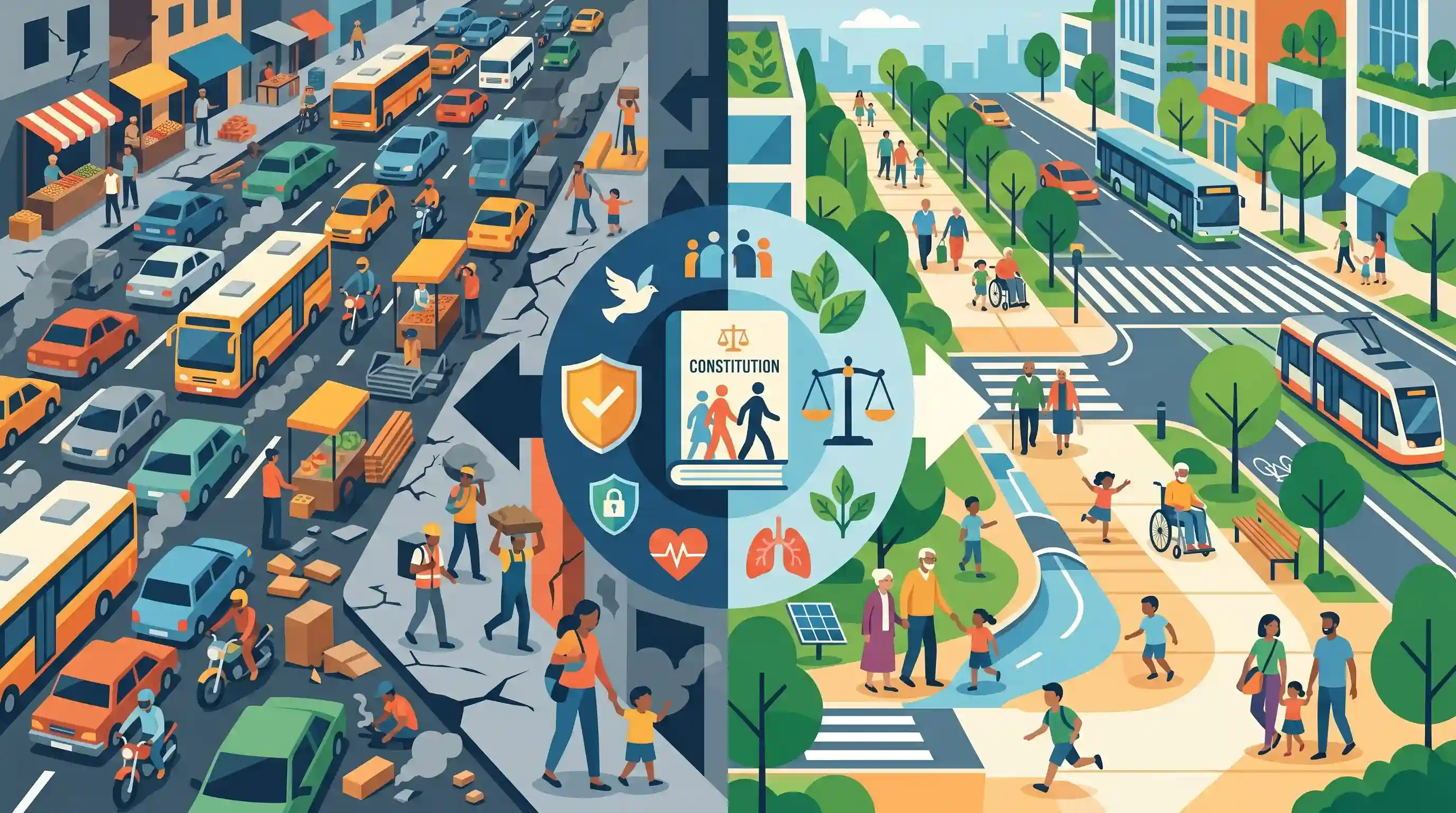
The article advocates for the 'right to walk' as a fundamental aspect of urban mobility and citizen rights. It critiques contemporary city planning in India for excessively favoring cars and motorized transport, effectively sidelining pedestrians through inadequate or encroached footpaths. Emphasizing that safe pedestrian infrastructure is a matter of distributive justice—as the urban poor rely heavily on walking—the piece calls for inclusive urban designs. Furthermore, it argues that safe walking conditions are integral to sustainable development, public health, and should be legally recognized as an extension of the Right to Life and Personal Liberty guaranteed under Article 21 of the Constitution.
Key Points
- Indian urban planning disproportionately prioritizes motorized vehicles over pedestrians, leading to absent or encroached footpaths and severe safety hazards.
- The lack of safe walking infrastructure disproportionately affects the urban poor and marginalized communities, raising concerns about distributive justice and equitable resource allocation in cities.
- Sustainable urban mobility requires a paradigm shift towards pedestrian-first infrastructure to reduce carbon emissions, improve public health, and ease traffic congestion.
- The 'Right to Walk' must be recognized as an essential component of the Right to Life under Article 21, obligating the state to guarantee safe and accessible public spaces.
Important Terms
Article 21 of the Constitution

Fundamental Right guaranteeing protection of life and personal liberty. Recent judicial interpretations recognize safe walking and pedestrian infrastructure as essential facets of this right to live with dignity.
UPSC context
GS-II (Fundamental Rights); tests understanding of judicial activism and the expansion of 'Right to Life' to include civic amenities.
Motor Vehicles Act
Principal legislation regulating Indian road transport and safety. SC directions now mandate states to frame rules under Sections 138(1A) and 210D specifically for pedestrian safety and design.
UPSC context
GS-II/III (Governance/Legislation); relevant for road safety policy and the legal framework for non-motorized transport.
Smart Cities Mission
A 2015 urban renewal initiative aiming to create sustainable, citizen-centric cities. It prioritizes 'smart mobility' and 'walkability' through improved footpaths and non-motorized transport (NMT) infrastructure.
UPSC context
GS-I/III (Urbanization/Infrastructure); tests knowledge of government schemes for sustainable urban development and inclusive mobility.
National Highways Authority of India (NHAI)
Statutory body under MoRTH responsible for developing and managing the National Highways network. It is mandated to audit pedestrian facilities and implement IRC safety standards.
UPSC context
GS-III (Infrastructure); focuses on institutional roles in national connectivity and the integration of safety standards in highway design.
Ministry of Road Transport and Highways (MoRTH)
Apex central body responsible for road policy, safety standards, and legislation. It oversees the implementation of Indian Roads Congress (IRC) guidelines for pedestrian-friendly infrastructure.
UPSC context
GS-II/III (Executive/Infrastructure); relevant for understanding the administrative structure and policy-making process for national transport safety.
Prelims Trap
The Right to Walk is explicitly guaranteed under Article 21 of the Constitution.
It is an implied right interpreted by the judiciary as part of the Right to Life and Dignity, not explicitly written in the Constitution.
Static Concepts Connected
How has the judiciary expanded the scope of Article 21?
- Judicial interpretation: Expanded beyond mere physical survival to include the right to live with human dignity (e.g., Maneka Gandhi case).
- Implied rights: Encompasses the right to livelihood, clean environment, privacy, health, and safe public spaces like unobstructed footpaths.
What are the core pillars of the National Urban Transport Policy (NUTP) 2006?
- Core philosophy: Focuses on the paradigm of 'moving people rather than vehicles' to ensure equitable allocation of road space.
- Non-Motorized Transport: Prioritizes non-motorized transport (NMT) like walking and cycling, alongside robust public transit systems, over private car ownership.
Cross-Topic Patterns
Article 21 meets urban governance
The intersection of fundamental rights with municipal duties (footpaths, safe roads) is a growing GS2 theme, highlighting judicial expansion into civic infrastructure and urban governance.
Distributive justice in urban design
Connects GS1 (Urbanization) with GS2 (Social Justice), showing how car-centric planning exacerbates inequality for the urban poor who heavily rely on non-motorized transport.

Prelims 2026 may test Punjab's 'Right to Walk' mandate alongside Article 21 implied rights and the core philosophy of NUTP 2006.
Linked PYQs · 4
Linked PYQs · 4
- 2019MainsGS1
How is efficient and affordable urban mass transport key to the rapid economic development of India?
- 2025MainsGS1
How does smart city in India, address the issues of urban poverty and distributive justice?
- 2023MainsGS2
“The Constitution of India is a living instrument with capabilities of enormous dynamism. It is a constitution made for a progressive society.” Illustrate with special reference to the expanding horizons of the right to life and personal liberty.
- 2016MainsGS1
With a brief background of quality of urban life in India, introduce the objectives and strategy of the 'Smart City Programme'.
