Constitutional Right to Protest and Police Power Limits
Source:The Hindu ↗
Why It Matters
The friction between state authority (police power) and individual liberty (peaceful dissent) is a central debate in Indian democracy. Understanding the constitutional limitations, legislative changes (BNSS/BNS), and judicial doctrines of proportionality is essential for GS2 Polity and GS4 Ethics questions on administrative discretion.
Summary
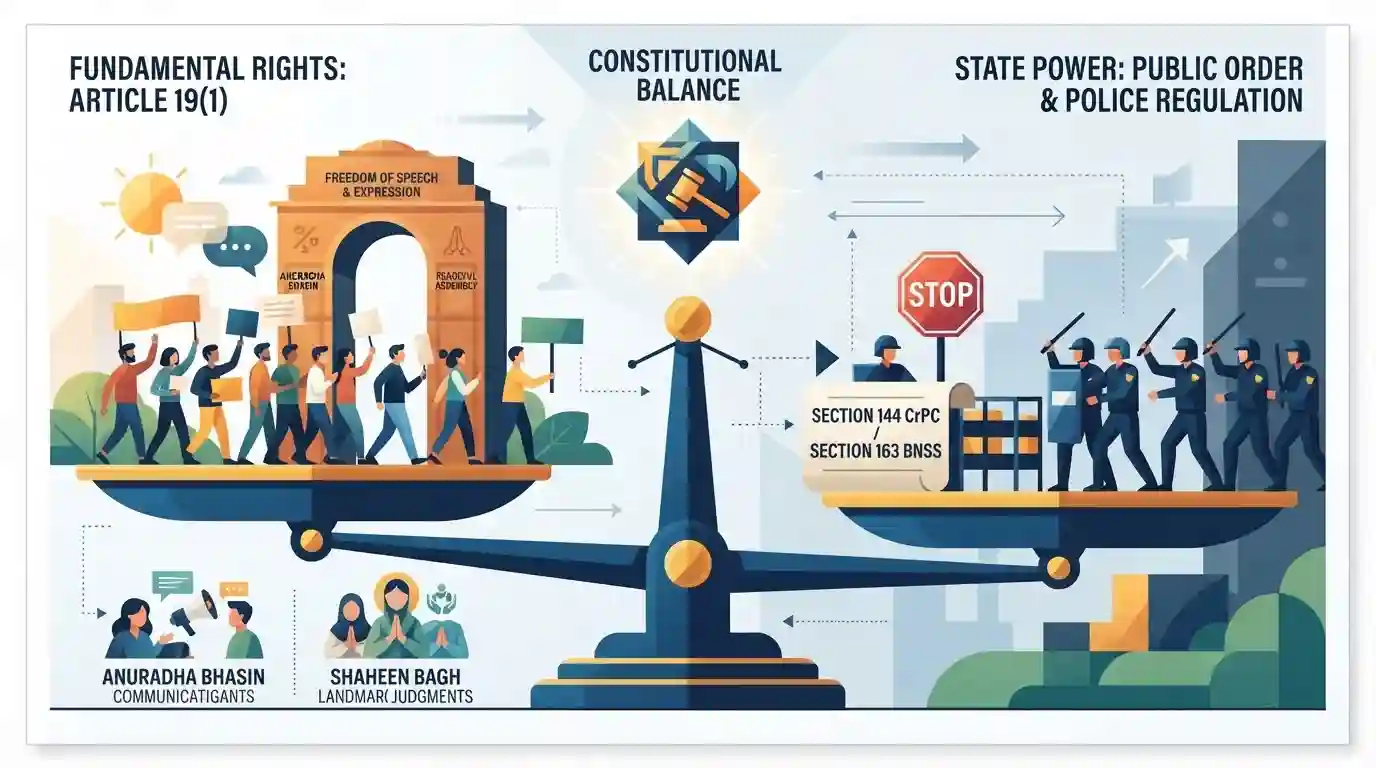
This article explores the delicate constitutional balance between the fundamental right to protest and the state's power to maintain public order through police regulation in India. It examines the constitutional locus of the right to protest under Article 19(1), the statutory powers granted to law enforcement (such as Section 144 of the CrPC/Section 163 of BNSS), and key judicial interventions (like the Anuradha Bhasin and Shaheen Bagh cases) that define, limit, and regulate the exercise of police authority to prevent arbitrariness and protect civil liberties.
Key Points
- The right to protest is an implicit constitutional right derived from the interplay between Article 19(1)(a) (freedom of speech and expression) and Article 19(1)(b) (right to assemble peaceably and without arms).
- These rights are not absolute and are subject to 'reasonable restrictions' under Articles 19(2) and 19(3) on grounds such as public order, sovereignty and integrity of India, and decency or morality.
- State power to regulate assembly is largely executed through Section 144 of the CrPC (now Section 163 of the Bharatiya Nagarik Suraksha Sanhita, 2023), allowing magistrates to issue preventive orders to curb potential public disorder.
- In the landmark Anuradha Bhasin vs Union of India (2020) case, the Supreme Court ruled that preventive measures like Section 144 cannot be used to suppress legitimate expression or democratic rights, establishing that any restriction must meet the test of proportionality.
- In the Amit Sahni vs Commissioner of Police (Shaheen Bagh Case, 2020), the SC balanced conflicting rights, holding that while peaceful protest is fundamental, protesters cannot occupy public ways indefinitely, disrupting the right to free movement of other citizens.
- The judiciary has consistently maintained that the role of the police is to facilitate peaceful assembly and maintain order, rather than using excessive or arbitrary force to suppress democratic dissent.
Important Terms
Constitution of India

The supreme legal document of India, establishing the political framework, government powers, and fundamental rights and duties of its citizens.
UPSC context
GS Paper II (Polity & Constitution); tests understanding of constitutionalism, fundamental rights, and the balance of powers among state organs.
Supreme Court of India
The highest judicial authority in India, serving as the final court of appeal, the guardian of the Constitution, and the ultimate protector of fundamental rights.
UPSC context
GS Paper II (Judiciary); tests comprehension of judicial review, writ jurisdiction under Article 32, and the separation of powers.
Bharatiya Nagarik Suraksha Sanhita (BNSS), 2023
The primary procedural law governing criminal investigations, arrest, and prosecution in India, which replaced the Code of Criminal Procedure (CrPC), 1973, effective July 1, 2024.
UPSC context
GS Paper II (Criminal Justice Reforms); tests knowledge of procedural modernizations, police powers, digital evidence, and safeguards against arbitrary state action.
Code of Criminal Procedure (CrPC), 1973
The historic procedural criminal law in India that regulated arrest, search, seizure, bail, and trials, superseded by the BNSS on July 1, 2024.
UPSC context
GS Paper II (Polity & Governance); tests historical understanding of criminal procedure, preventive detentions, and administrative measures like Section 144.
Bharatiya Nyaya Sanhita (BNS), 2023
India's primary substantive penal code defining offences and prescribing punishments, which replaced the colonial-era Indian Penal Code (IPC), 1860, on July 1, 2024.
UPSC context
GS Paper II (Criminal Justice System); tests awareness of codified reforms, new offences like terrorism, and the removal of colonial-era sedition laws.
Indian Penal Code (IPC)
The historical, colonial-era substantive criminal code enacted in 1860 that defined crimes and punishments in India until its replacement by the BNS in 2024.
UPSC context
GS Paper II (Criminal Law History); tests historical context of penal laws, rights limitations, and the evolution of substantive criminal justice.
Prelims Trap
Section 144 of the BNSS, 2023 empowers executive magistrates to issue prohibitory orders during public disorder.
Under the BNSS, 2023, old CrPC Section 144 (prohibitory orders) is now Section 163. Section 144 of the BNSS actually deals with the maintenance of family members.
Static Concepts Connected
What is the Doctrine of Proportionality under Article 19 review?
- Origin & Definition: A judicial standard ensuring administrative actions restrict fundamental rights only to the extent necessary to achieve a legitimate public purpose.
- Four-fold Test: Requires a legitimate state aim, rational connection, necessity (no less restrictive alternative), and balancing of social benefits versus individual harm.
What are the permissible restrictions on Freedom of Assembly under Article 19(3)?
- Two specific grounds: Unlike Article 19(2) (speech), assembly can only be restricted on two grounds: sovereignty and integrity of India, and public order.
- Exclusion of grounds: Decency, morality, and friendly relations with foreign states are NOT valid grounds for restricting the right to assemble peaceably.
Cross-Topic Patterns
Protest rights vs Economic efficiency
Indefinite highway blockades test the legal limit of peaceful dissent against the economic cost of disrupted supply chains, interstate commerce, and freedom of movement under Article 19(1)(d).
Police regulations and Federalism
While 'Public Order' and 'Police' are state list subjects, criminal procedure lies in the Concurrent List, allowing Central codes like the BNSS to standardise preventive police powers.

BNSS procedural shifts (Sec 163) combined with the Proportionality Test for assembly restrictions will likely feature in a 2026 Polity MCQ.
Linked PYQs · 3
Linked PYQs · 3
- 2014MainsGS2
What do you understand by the concept "freedom of speech and expression"? Does it cover hate speech also ? Why do the films in India stand on a slightly different plane from other forms of expression ? Discuss.
- 2022MainsGS2
“Right of movement and residence throughout the territory of India are freely available to the Indian citizens, but these rights are not absolute.” Comment.
- 2023PrelimsGS1
Which one of the following statements best reflects the Chief purpose of the 'Constitution' of a country?
