Right to disconnect and digital economy labor standards
Source:The Hindu ↗
Why It Matters
As remote work and digital communications redefine the workplace, the 'Right to Disconnect' has become a critical labor rights issue. It is highly relevant for UPSC aspirants across GS3 (labor reforms, changing nature of work), GS1 (societal impacts of the gig economy), and GS4 (corporate ethics and work culture).
Summary
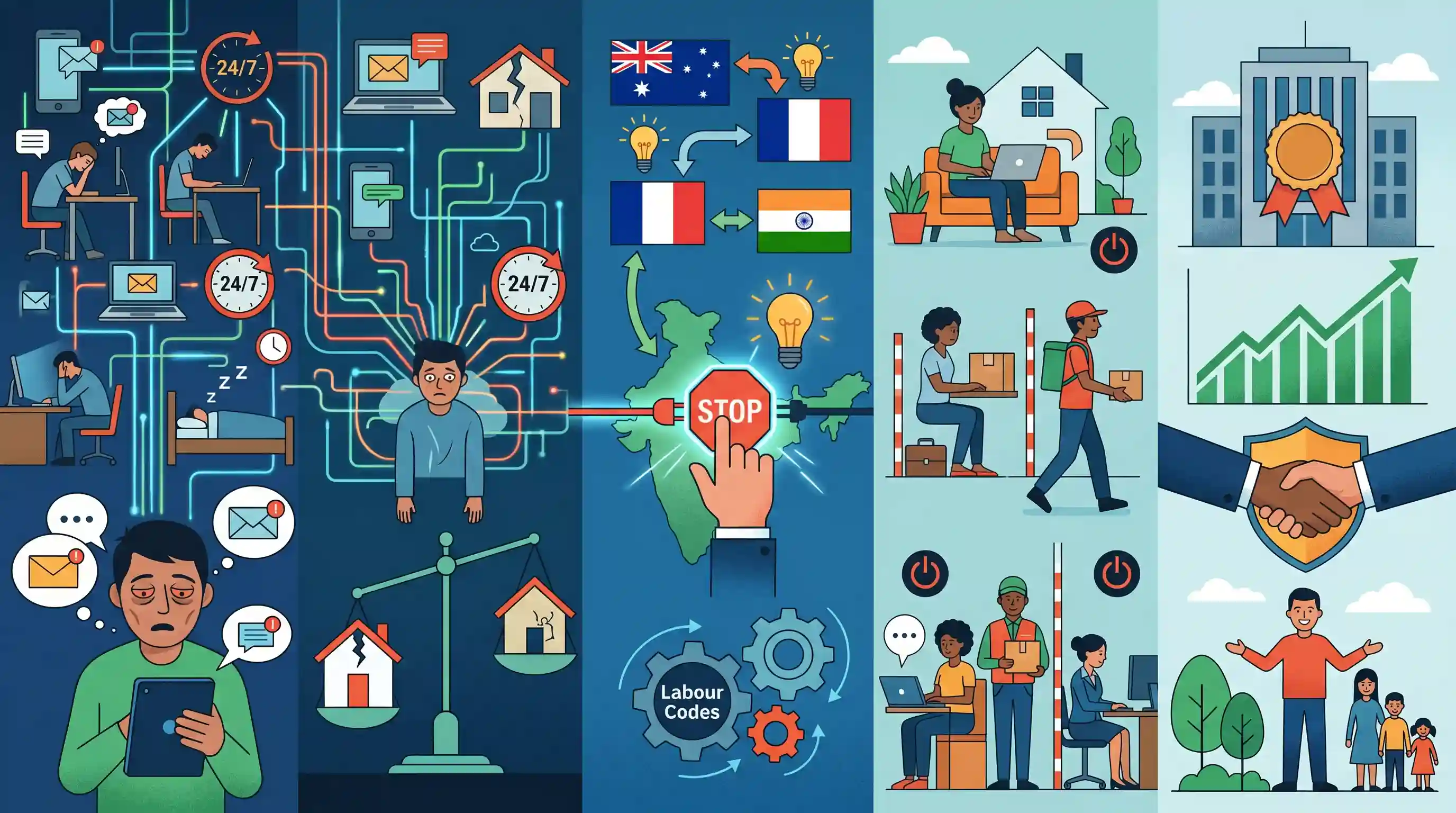
The article discusses the growing necessity of establishing a 'Right to Disconnect' in the modern, digitally interconnected 'always-on' economy. It highlights the detrimental impact of constant digital accessibility on employees' mental health, work-life balance, and overall well-being. Examining global precedents, such as recently passed legislation in Australia and France, the piece advocates for similar labor reforms in India. It stresses that current Indian labor laws and the proposed Labour Codes must urgently address the realities of remote work and the gig economy. Furthermore, it emphasizes the ethical responsibility of organizations to foster a healthy work culture that respects personal boundaries and prioritizes productivity over perpetual availability.
Key Points
- The 'always-on' work culture, exacerbated by digital connectivity and remote work, severely blurs the boundaries between professional and personal life, leading to employee burnout and mental health issues.
- Countries like France (the pioneer) and Australia have enacted 'Right to Disconnect' laws, granting workers the legal right to ignore work-related communications outside of official working hours without facing retaliation.
- In India, despite the introduction of the Right to Disconnect Bill as a Private Member's Bill in 2018, there is no formal legal framework protecting employees from after-hours digital intrusions.
- The rapid expansion of the gig economy and IT/ITeS sectors necessitates updating India's new Labour Codes to reflect modern digital realities and ensure occupational safety and health.
- Beyond legislation, there is a strong ethical imperative for organizations to voluntarily adopt policies that respect employees' personal time, thereby fostering a healthier, value-based work culture.
Important Terms
Right to Disconnect Bill, 2018

A private member's bill introduced in India to grant employees the legal right to ignore work-related communications outside official hours to reduce stress and improve work-life balance.
UPSC context
GS-II (Governance/Polity); tests knowledge of private member bills and labor welfare policies.
Labour Codes
The massive overhaul of 29 central labor laws into four consolidated codes—Wages, Industrial Relations, Social Security, and OSH—designed to simplify compliance and formalize the Indian workforce.
UPSC context
GS-III (Economy); central to topics on labor reforms, industrial growth, and ease of doing business.
Occupational Safety, Health and Working Conditions Code, 2020
A unified legal framework consolidating 13 laws to regulate health, safety, and welfare standards across sectors, including provisions for standard working hours and annual health check-ups.
UPSC context
GS-III (Labor Laws); tests understanding of worker safety and workplace health in the modern economy.
International Labour Organization (ILO)
A UN agency that establishes international labor standards. It identifies the 'right to disconnect' as essential for maintaining boundaries between professional and private life in the digital age.
UPSC context
GS-II (International Relations); important for global governance and international standard-setting bodies.
Prelims Trap
The Right to Disconnect is currently a statutory right under India's newly enacted Labour Codes.
India’s OSHWC Code 2020 regulates physical working hours but completely lacks explicit provisions for 'digital overtime' or a statutory right to disconnect.
Static Concepts Connected
What are the Constitutional provisions relating to humane working conditions in India?
- Article 21: Guarantees the Right to Life with Dignity, which judicial interpretation has expanded to include mental health and autonomy.
- Article 42: A Directive Principle that directs the State to make provision for securing just and humane conditions of work.
- Article 43: Directs the State to secure a living wage, decent standard of life, and full enjoyment of leisure for all workers.
How do India's new Labour Codes address modern work arrangements?
- Consolidation: Subsumed 29 central labor laws into four codes covering Wages, Industrial Relations, Social Security, and Occupational Safety.
- Gig Workers: The Social Security Code 2020 defines gig and platform workers for the first time, bringing them under a social security net.
- OSHWC Code 2020: The OSHWC Code caps daily physical working hours but currently ignores remote 'digital availability' and algorithmic management.
Cross-Topic Patterns
Privacy jurisprudence meets labor laws
The 'Right to Disconnect' extends the Right to Privacy (Puttaswamy judgment), limiting employer intrusion into personal space and curbing digital surveillance post-working hours.
Ethics of toxic productivity in GS4
Directly links to GS4 (Corporate Governance), addressing the power asymmetry between employers and employees, and the ethical mandate to prioritize mental health over forced presenteeism.

Expect a GS Mains question integrating gig worker vulnerabilities, Article 21/42, and the need to embed 'Right to Disconnect' in Labour Codes.
Linked PYQs · 3
Linked PYQs · 3
- 2024MainsGS3
Discuss the merits and demerits of the four 'Labour Codes' in the context of labour market reforms in India. What has been the progress so far in this regard?
- 2025MainsGS4
It is said that for an ethical work culture, there must be code of ethics in place in every organisation. To ensure value-based and compliance-based work culture, what suitable measures would you adopt in your work place?
- 2021MainsGS1
Examine the role of 'Gig Economy' in the process of empowerment of women in India.
