Reversing Brain Drain and Reforming India Scientific Ecosystem
Source:Indian Express ↗
Why It Matters
The challenge of reversing brain drain and boosting R&D expenditure is central to India's transition to a knowledge-based economy. It directly connects to GS2 (role of Indian diaspora, government policies) and GS3 (Science & Technology, indigenization of technology).
Summary
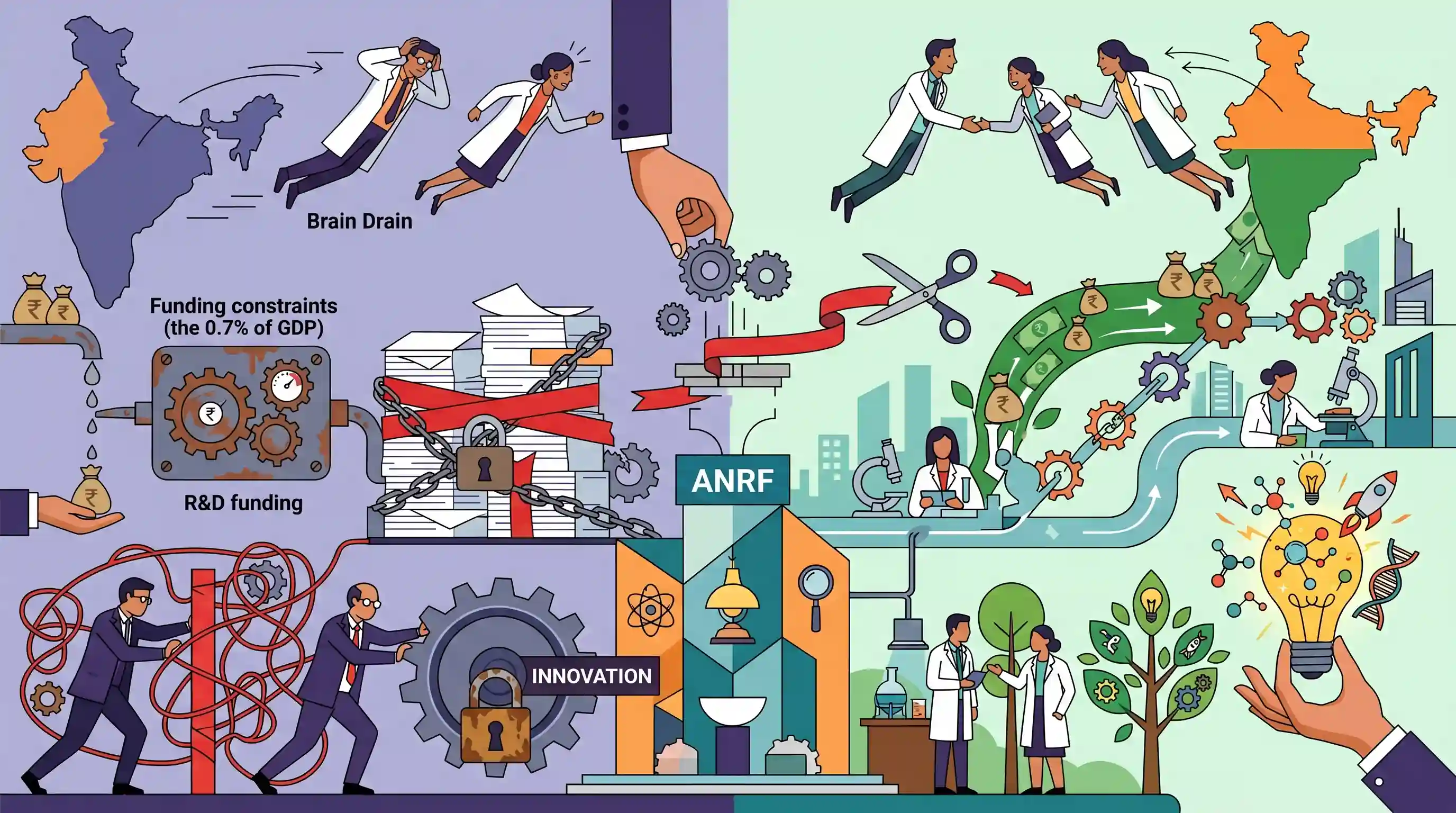
The article argues that genuine scientific reform in India requires structural changes aimed at reversing the 'brain drain' and bringing back its scientific diaspora. It highlights how inadequate research and development (R&D) funding, currently stuck at roughly 0.7% of GDP, combined with entrenched bureaucratic bottlenecks, stifles innovation. While the establishment of the Anusandhan National Research Foundation (ANRF) is a step in the right direction, realizing its potential requires reducing red tape, encouraging private sector participation, and fostering an ecosystem that genuinely promotes the 'ease of doing science'.
Key Points
- India's gross expenditure on R&D remains stagnant at around 0.65-0.7% of GDP, significantly lower than the global average and major economies, hindering domestic research capacity.
- Bureaucratic red tape, inflexible funding mechanisms, and administrative delays serve as major deterrents for Indian scientists abroad who consider returning home.
- The Anusandhan National Research Foundation (ANRF) offers a framework to democratize research funding, but its success depends on ensuring functional autonomy and attracting private sector investment.
- To achieve a true 'reverse brain drain', India must prioritize the 'ease of doing science' by ensuring academic freedom, modernizing infrastructure, and offering competitive compensation.
Important Terms
Anusandhan National Research Foundation (ANRF)

An apex statutory body established in 2023 to provide high-level strategic direction for scientific research, innovation, and entrepreneurship across natural sciences, humanities, and social sciences in India.
UPSC context
GS Paper 3 (Science and Technology); crucial for topics related to institutional frameworks and funding for research and innovation.
Anusandhan National Research Foundation Act (ANRF Act)
The 2023 legislation that created the ANRF, repealed the Science and Engineering Research Board (SERB) Act, 2008, and mandated a ₹50,000 crore budget over five years.
UPSC context
GS Paper 2 (Statutory Bodies) and GS Paper 3; tests understanding of legislative reforms in India's science policy.
Department of Science and Technology (DST)
The nodal agency under the Ministry of Science and Technology responsible for formulating S&T policies and serving as the administrative department for the ANRF.
UPSC context
GS Paper 3; essential for understanding the governance and coordination of India's scientific initiatives.
Gross Expenditure on R&D (GERD)
The total amount spent on research and development activities within a country; India's GERD currently stands at approximately 0.64% of its GDP.
UPSC context
GS Paper 3 (Economics/S&T); a key metric for evaluating India's global innovation standing and development goals.
Ease of Doing Science
A policy goal aimed at reducing bureaucratic red tape, simplifying financial rules, and accelerating procurement processes to allow researchers to focus on core scientific innovation.
UPSC context
GS Paper 2 (Governance) and GS Paper 3; addresses administrative bottlenecks and structural reforms in the R&D ecosystem.
Science and Engineering Research Board (SERB)
A statutory body established in 2008 to promote basic research in science and engineering, now subsumed into the ANRF to broaden the research scope.
UPSC context
GS Paper 3; relevant for history of research funding and transition to integrated institutional models.
Prelims Trap
"The ₹50,000 crore corpus of the ANRF is entirely funded by budgetary allocations from the Central Government."
False. The ANRF Act envisions that roughly 70% (₹36,000 crore) of its ₹50,000 crore corpus will be mobilized from the private sector and philanthropists.
Static Concepts Connected
What are the structural differences between ANRF and the erstwhile SERB?
- Leadership: ANRF is presided over by the Prime Minister, whereas SERB was headed by the Secretary of the Department of Science and Technology.
- Academic Scope: ANRF expands funding to include humanities and social sciences, whereas SERB was strictly limited to science and engineering disciplines.
- Funding Source: ANRF explicitly mandates raising the majority of its corpus from private industries, unlike SERB which was almost entirely government-funded.
How do the VAJRA and VAIBHAV schemes differ in targeting overseas scientists?
- VAJRA Scheme: Open to all overseas scientists (including foreign nationals) to undertake collaborative research in Indian public-funded institutions.
- VAIBHAV Fellowship: Specifically restricted to the Indian diaspora (NRIs, OCIs, PIOs) to foster short-term collaborations and long-term translational research outcomes.
Cross-Topic Patterns
Indian Diaspora: From Remittances to R&D
The shift from viewing the diaspora merely as a source of remittances to leveraging them for high-end intellectual property and 'brain gain' bridges GS2 (International Relations) and GS3 (Science & Tech).
CSR mandates intersecting with R&D funding
Amendments to the Companies Act allow Corporate Social Responsibility (CSR) funds to be directed to public-funded R&D incubators, which directly supports the ANRF's goal of mobilizing 70% private capital.

Expect a multi-statement 2026 Prelims question testing ANRF's funding structure (70% private) and the PM's role as ex-officio President.
Linked PYQs · 4
Linked PYQs · 4
- 2023MainsGS2
Indian diaspora has scaled new heights in the West. Describe its economic and political benefits for India.
- 2020MainsGS2
Indian diaspora has a decisive role to play in the politics and economy of America and European Countries'. Comment with examples.
- 2015PrelimsGS1
Which of the following statements is/are correct regarding National Innovation Foundation-India (NIF)? 1. NIF is an autonomous body of the Department of Science and Technology under the Central Government. 2. NIF is an initiative to strengthen the highly advanced scientific research in India's premier scientific institutions in collaboration with highly advanced foreign scientific institutions. Select the correct answer using the code given below.
- 2019PrelimsGS1
Atal Innovation Mission is set up under the
