RBI Dividend Transfers and Central Bank Fiscal Role Implications
Source:The Hindu ↗
Why It Matters
Understanding the interface between monetary authorities and fiscal policy is vital for assessing macroeconomic stability, central bank autonomy, and fiscal deficit management in India.
Summary
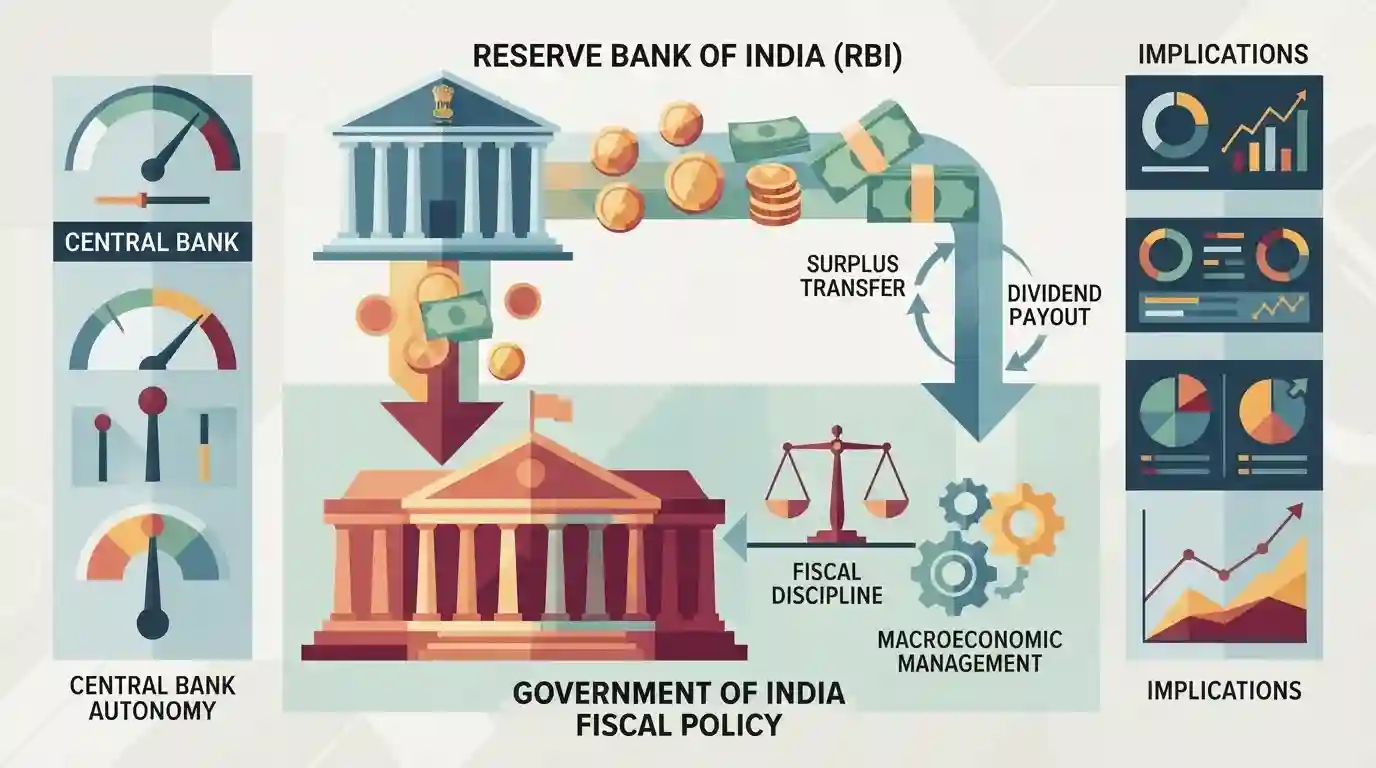
The article examines the expanding fiscal role of the Reserve Bank of India (RBI), particularly through its surplus transfers and dividends to the central government, analyzing the implications for central bank autonomy, fiscal discipline, and macroeconomic management in India.
Key Points
- The Reserve Bank of India (RBI) is playing an increasingly critical fiscal role, notably through massive dividend transfers to the government, helping plug fiscal deficits.
- Central bank surplus transfers impact the sovereign's fiscal space, raising debates on central bank autonomy and fiscal-monetary coordination.
- The evolving dynamics between monetary policy management and fiscal support shape India's macroeconomic stability and long-term inflation targeting.
- Structural shifts in non-tax revenues highlight the growing reliance of the Union government on RBI's financial buffers during periods of economic stress.
Important Terms
Reserve Bank of India (RBI)

The central banking institution of India established under the RBI Act 1934, responsible for regulating the monetary policy, issuing currency, managing foreign exchange, and acting as a banker to the government.
UPSC context
UPSC GS Paper III (Indian Economy & Planning, Monetary Policy) — tests understanding of central banking functions, regulatory roles, and institutional autonomy.
FRBM Act
An Act passed in 2003 to institutionalize financial discipline, reduce fiscal deficit, and achieve macroeconomic stability by setting statutory limits on government borrowing and debt accumulation.
UPSC context
UPSC GS Paper III (Fiscal Policy, Budgeting, and Government Finances) — tests knowledge of fiscal consolidation targets, deficits, and economic management.
RBI Act
The legislation enacted in 1934 that governs the constitution, functions, and powers of the Reserve Bank of India, including provisions for surplus transfer to the central government.
UPSC context
UPSC GS Paper III (Indian Economy) — important for questions on statutory frameworks of financial regulators and central bank-government relations.
Static Concepts Connected
What are the key recommendations of the Bimal Jalan Committee on RBI's Economic Capital Framework?
- Risk Buffer Range: Recommended maintaining a Contingency Risk Buffer (CRB) between 5.5% and 6.5% of the RBI's total balance sheet.
- Realized Equity: Stipulated that realized equity should be maintained within a specific band to absorb financial market shocks without eroding capital.
- Rules-based Transfer: Advocated for a transparent, rules-based economic capital framework determining surplus transfer to the government.
Cross-Topic Patterns
RBI Surplus Transfers vs. FRBM Glide Path
RBI dividend transfers ease immediate fiscal deficit pressures, directly interacting with FRBM Act glide paths and public debt management strategies during economic stress.

Expect a statement-based question linking RBI's Economic Capital Framework (Bimal Jalan Committee) to central bank autonomy and fiscal deficit.
Linked PYQs · 3
Linked PYQs · 3
- 2025MainsGS3
Explain how the Fiscal Health Index (FHI) can be used as a tool for assessing the fiscal performance of states in India. In what way would it encourage the states to adopt prudent and sustainable fiscal policies?
- 2025MainsGS2
Examine the evolving pattern of Centre-State financial relations in the context of planned development in India. How far have the recent reforms impacted the fiscal federalism in India?
- 2019MainsGS3
Do you agree with the view that steady GDP growth and low inflation have left the Indian economy in good shape? Give reasons in support of your arguments.
