Global leadership in science and India research ecosystem gaps
Source:The Hindu ↗
Why It Matters
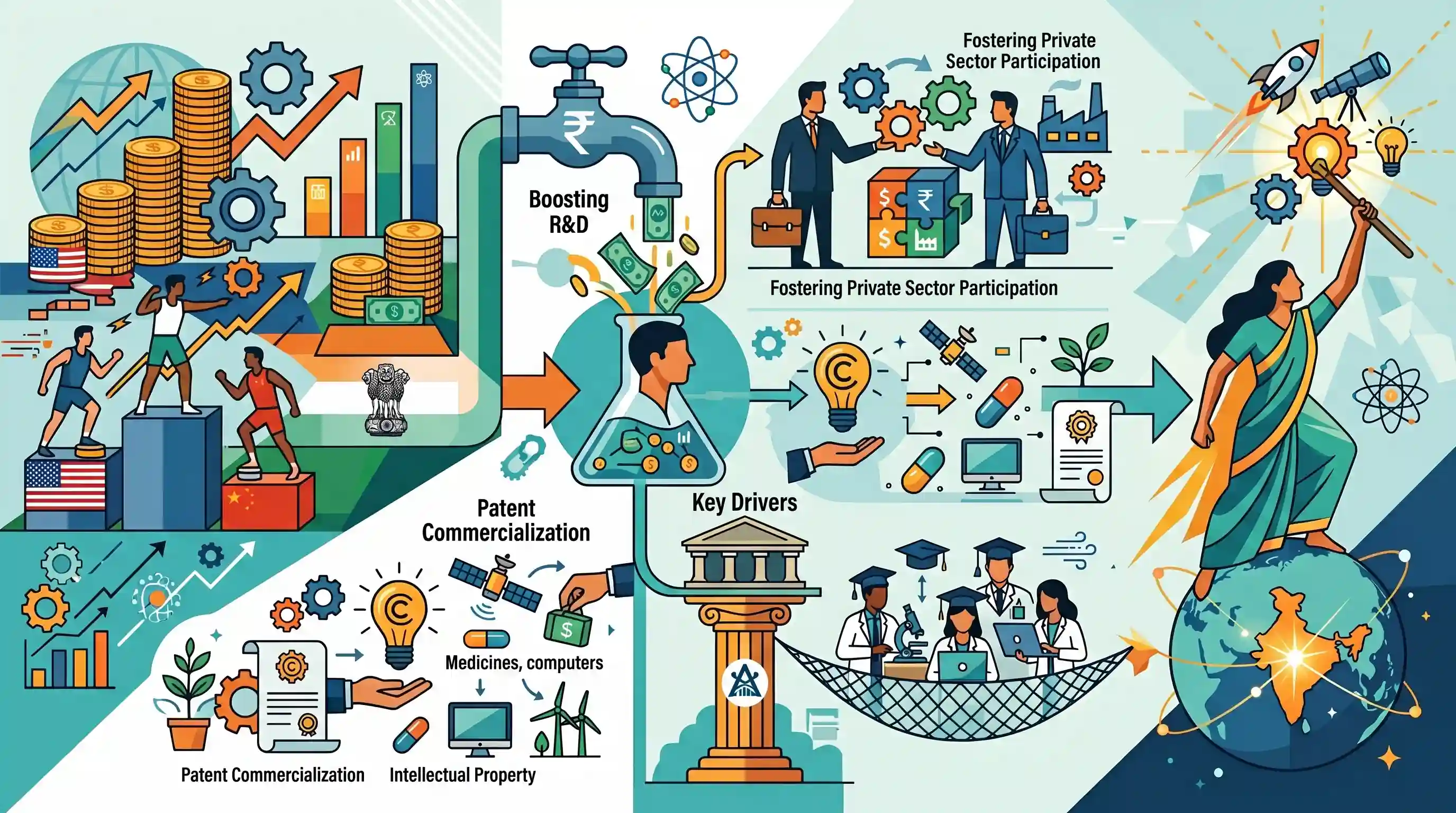
Global leadership in science is directly tied to economic growth and national security. For UPSC aspirants, understanding the bottlenecks in India's R&D ecosystem—such as low private sector funding, poor patent commercialization, and the mandate of the new ANRF—is critical for answering GS3 questions on technology indigenization and innovation policy.
Summary
The article analyzes the intense global competition for leadership in science and technology, highlighting the significant disparity in research and development (R&D) investments between leading nations (like the US and China) and India. It underscores the critical need for India to boost its R&D expenditure, foster greater private sector participation, and improve the commercialization of patents. Strengthening institutional frameworks such as the Anusandhan National Research Foundation (ANRF) and retaining STEM talent are highlighted as essential steps for India to emerge as a global scientific powerhouse and achieve true technological self-reliance.
Key Points
- Global leaders such as the US and China invest upwards of 2-3% of their GDP into Research and Development (R&D), securing dominance in critical and emerging technologies.
- India's Gross Expenditure on R&D (GERD) remains stagnant at around 0.64% to 0.7% of its GDP, heavily reliant on public funding with insufficient private sector participation.
- Despite an increase in patent filings in India, the commercialization of these patents remains low due to weak academia-industry linkages and market integration hurdles.
- The Anusandhan National Research Foundation (ANRF) is a crucial institutional step to bridge funding gaps, encouraging collaborative ecosystems among universities, research bodies, and private industries.
- Retaining top STEM talent and incentivizing substantive innovation in premier research institutes are essential to transition from theoretical research to applied, market-ready technologies.
Important Terms
Anusandhan National Research Foundation (ANRF)

An apex body established in 2023 to provide strategic direction for scientific research, innovation, and entrepreneurship, fostering collaboration between industry, academia, and government.
UPSC context
GS Paper 3: Science & Technology; critical for discussing institutional reforms and funding mechanisms in Indian research.
Anusandhan National Research Foundation Act, 2023
The legislation that established the ANRF and repealed the Science and Engineering Research Board (SERB) Act, 2008, aiming to create a robust national research ecosystem.
UPSC context
GS Paper 2: Government Policies and Interventions; GS Paper 3: Indigenization of technology.
World Intellectual Property Organization (WIPO)
A specialized United Nations agency that serves as a global forum for intellectual property services, policy, and cooperation, and publishes the Global Innovation Index.
UPSC context
GS Paper 2: International Organizations; GS Paper 3: Intellectual Property Rights (IPR).
Gross Expenditure on Research and Development (GERD)
The total spending on research and development activities within a country, including public, private, and academic contributions, often expressed as a percentage of GDP.
UPSC context
GS Paper 3: Indian Economy and S&T; used to analyze India's R&D gap compared to global leaders.
Global Innovation Index (GII)
An annual ranking of countries' innovation capacity and success, co-published by WIPO, serving as a benchmark for evaluating national innovation ecosystems.
UPSC context
GS Paper 3: Science & Technology; relevant for tracking India's global standing in innovation and patents.
Science and Engineering Research Board (SERB)
A statutory body established in 2008 to support basic research in science and engineering; its functions were subsumed by the ANRF in 2023.
UPSC context
GS Paper 3: S&T institutions; important for understanding the evolution of India's research funding landscape.
Prelims Trap
India's private sector is the primary driver of Gross Expenditure on R&D (GERD), similar to advanced economies.
Unlike advanced economies where the private sector funds >70% of R&D, India has an inverted structure. The government funds ~64% of GERD, with private industry contributing only ~36%.
Static Concepts Connected
What are the key features of the Anusandhan National Research Foundation (ANRF)?
- Apex Body: Established by the ANRF Act 2023, it replaces the Science and Engineering Research Board (SERB) to act as India's apex R&D body.
- Funding Model: Envisages a ₹50,000 crore budget over 5 years, targeting ~72% (₹36,000 crore) to be sourced from the private sector/non-government sources.
- Top Leadership: The Prime Minister is the ex-officio President of the Governing Board, with S&T and Education Ministers as Vice-Presidents.
Why is India's patent commercialization low despite high filing rates?
- Academia-Industry Gap: A severe disconnect between university-level theoretical research and applied, market-ready industry requirements restricts the lab-to-market pipeline.
- Valley of Death: Absence of robust venture capital ecosystems tailored for deep-tech and hardware, causing innovations to fail in the prototyping phase.
Cross-Topic Patterns
R&D Deficit + Middle-Income Trap
India's failure to raise GERD above 1% of GDP and commercialize its patents directly threatens its ability to escape the middle-income trap and transition to a knowledge-driven economy.
ANRF + NEP 2020 Integration
ANRF directly operationalizes the National Education Policy (NEP) 2020 mandate to seed and foster a robust research culture across historically underfunded State Universities and colleges.

Expect a 2026 Prelims question contrasting India's historically public-heavy R&D funding with ANRF's mandate to source 72% privately.
Linked PYQs · 2
Linked PYQs · 2
- 2024MainsGS3
What is the present world scenario of intellectual property rights with respect to life materials? Although, India is second in the world to file patents, still only a few have been commercialized. Explain the reasons behind this less commercialization.
- 2015MainsGS3
What are the areas of prohibitive labour that can be sustainably managed by robots ? Discuss the initiatives that can propel research in premier research institutes for substantive and gainful innovation.
