Digital Public Infrastructure and Macroeconomic Stability in India
Source:The Hindu ↗
Why It Matters
Understanding the structural drivers of India's economic growth is crucial for GS Paper 3. It provides candidates with a nuanced perspective on how digital infrastructure, financial sector health, and capital expenditure interlink to foster sustainable and inclusive economic development.
Summary
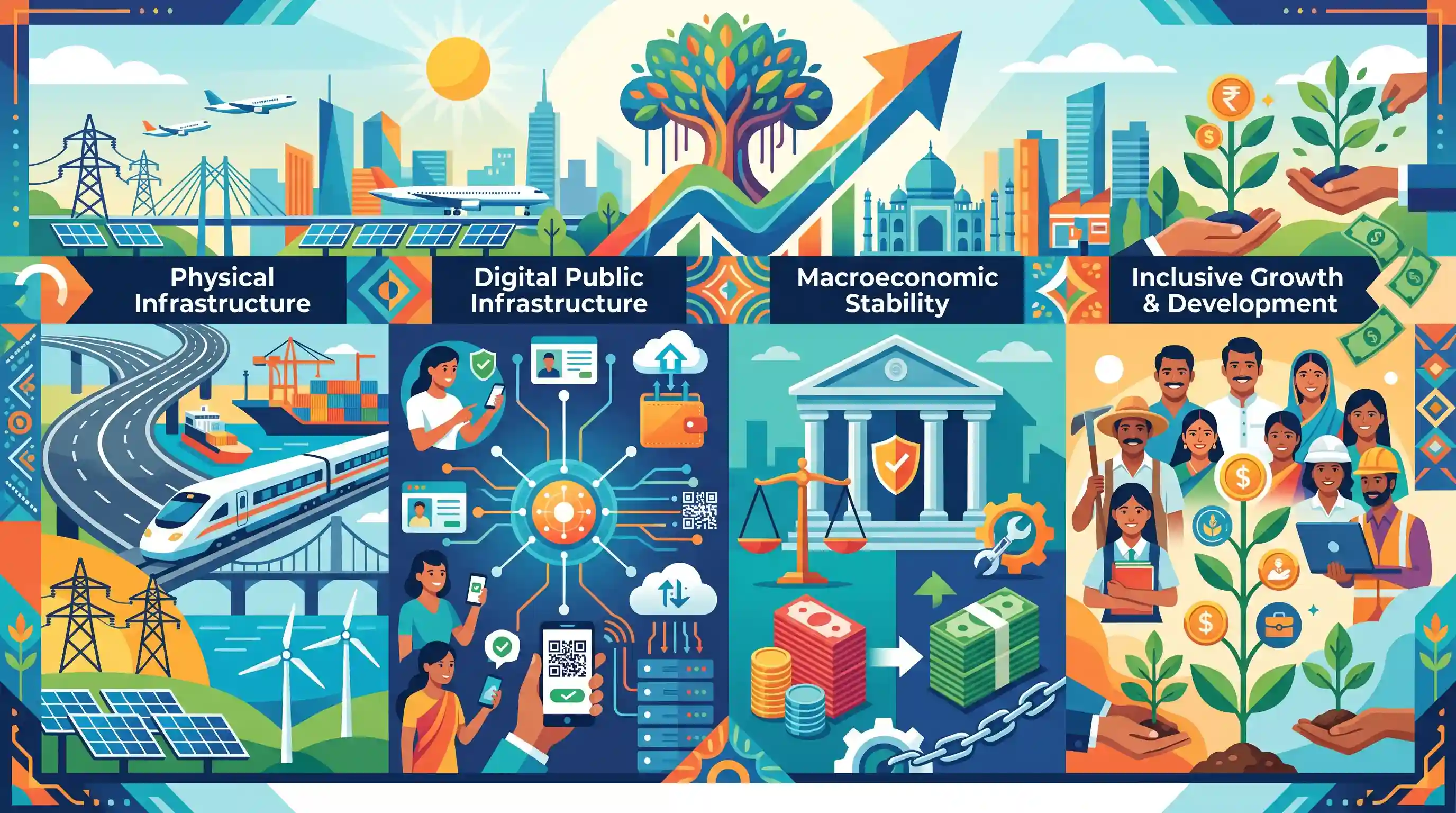
The article analyzes the underlying structural and macroeconomic factors that are propelling India's economic trajectory. It argues that while headline growth rates capture attention, the 'quiet foundations'—such as the massive rollout of Digital Public Infrastructure (DPI), significant capital expenditure on physical infrastructure, and the stabilization of the financial sector—are the true drivers of the next growth phase. By resolving past banking crises and formalizing the economy, India has created a resilient environment capable of attracting investment and sustaining long-term, inclusive development, provided it continues to focus on human capital and job creation.
Key Points
- Structural reforms and sustained investments in physical and digital infrastructure have laid the groundwork for India's next phase of economic growth.
- The development of Digital Public Infrastructure (DPI) has significantly contributed to formalizing the economy, enhancing financial inclusion, and streamlining welfare delivery.
- Macroeconomic stability, achieved through fiscal prudence and the resolution of the twin-balance sheet problem in the banking sector, provides a resilient base for private investment.
- To capitalize on these foundations, future policies must focus on boosting manufacturing, enhancing human capital, and ensuring inclusive development amidst global economic headwinds.
Important Terms
Digital Public Infrastructure (DPI)

Open, interoperable digital systems (identity, payments, data exchange) that enable efficient delivery of public and private services at a societal scale, serving as the "digital commons" for economic activity.
UPSC context
GS-3: Infrastructure and E-governance. Tests understanding of digital governance models and India's leadership in global digital public goods.
Unified Payments Interface (UPI)
A real-time, mobile-based payment system developed by NPCI that facilitates instant inter-bank peer-to-peer and person-to-merchant transactions, acting as a core pillar of India's digital economy.
UPSC context
GS-3: Indian Economy & Mobilization of Resources. Tests knowledge of fintech's role in financial inclusion and economic formalization.
Capital Expenditure (Capex)
Government spending aimed at creating or upgrading long-term productive assets like infrastructure (roads, railways). It is prioritized for its high multiplier effect and ability to "crowd-in" private investment.
UPSC context
GS-3: Government Budgeting. Tests fiscal policy's impact on long-term growth and the distinction between asset creation and consumption spending.
Twin Balance Sheet Problem
A situation of simultaneous financial distress where corporates are overleveraged with high debt and banks are burdened with high Non-Performing Assets (NPAs), hindering credit flow and investment.
UPSC context
GS-3: Banking Sector & Mobilization of Resources. Tests knowledge of banking crises and strategies for financial sector stabilization.
Reserve Bank of India (RBI)
India's central bank responsible for formulating monetary policy, issuing currency, and regulating the banking system to maintain price stability and ensure the overall health of the financial sector.
UPSC context
GS-3: Indian Economy (Monetary Policy). Tests understanding of inflation targeting, banking supervision, and macroeconomic stability.
Formalization of the Economy
The transition of businesses and labor from the unregulated informal sector to the formal sector through digital footprints (UPI), tax registration (GST), and legal compliance frameworks.
UPSC context
GS-3: Indian Economy & Growth. Tests knowledge of structural reforms and their impact on productivity and tax buoyancy.
Inclusive Growth
Economic growth that creates equitable opportunities for all sections of society, ensuring that the benefits of development reach diverse income groups and geographical regions.
UPSC context
GS-3: Inclusive Growth. Tests conceptual clarity on sustainable development and reducing socio-economic disparities.
Prelims Trap
"The Twin Balance Sheet problem refers to India's simultaneous high Fiscal Deficit and Current Account Deficit."
This describes the Twin Deficit problem. The Twin Balance Sheet problem specifically denotes overleveraged corporate debt alongside high bank Non-Performing Assets (NPAs).
Static Concepts Connected
What are the three foundational layers of India's Digital Public Infrastructure (India Stack)?
- Identity Layer: Aadhaar provides a unique, biometric-based digital identity for nationwide authentication and targeting.
- Payments Layer: UPI and the Aadhaar Enabled Payment System (AePS) allow interoperable, real-time financial transfers.
- Data Layer: Data Empowerment and Protection Architecture (DEPA) and Account Aggregators enable secure, consent-based user data sharing.
What is the 'Twin Balance Sheet' (TBS) problem and its evolution?
- TBS Basics: The simultaneous financial stress of high Non-Performing Assets (NPAs) in commercial banks and over-leveraged corporate balance sheets.
- Four Balance Sheet: The Economic Survey later termed the expansion to include stress in Non-Banking Financial Companies (NBFCs) and the real estate sector.
- Resolution Mechanisms: Addressed through the Insolvency and Bankruptcy Code (IBC), bank recapitalization (Indradhanush), and the establishment of a Bad Bank (NARCL).
Cross-Topic Patterns
DPI + Direct Benefit Transfers (DBT)
Digital Public Infrastructure is not just a tech marvel but a governance tool, plugging welfare leakages through DBT and directly impacting GS2 poverty and social justice outcomes.
Capex + Crowding In + Fiscal Consolidation
High government capital expenditure creates a multiplier effect, crowding in private investment while concurrently managing the fiscal glide path to ensure long-term macroeconomic stability.

Expect a 2026 GS3 Mains question evaluating how DPI and the resolution of the Twin Balance Sheet problem have catalyzed formalization.
Linked PYQs · 2
Linked PYQs · 2
- 2021MainsGS3
“Investment in infrastructure is essential for more rapid and inclusive economic growth.” Discuss in the light of India's experience.
- 2023MainsGS3
What is the status of digitalization in the Indian economy? Examine the problems faced in this regard and suggest improvements.
