India Research and Development Ecosystem Challenges and Financing
Source:The Hindu ↗
આ શા માટે મહત્વનું છે
Critically evaluates India's research and development ecosystem, funding patterns, and structural challenges, which is directly relevant to GS3 syllabus topics on science & technology achievements, indigenization, and mobilization of resources for research.
સારાંશ
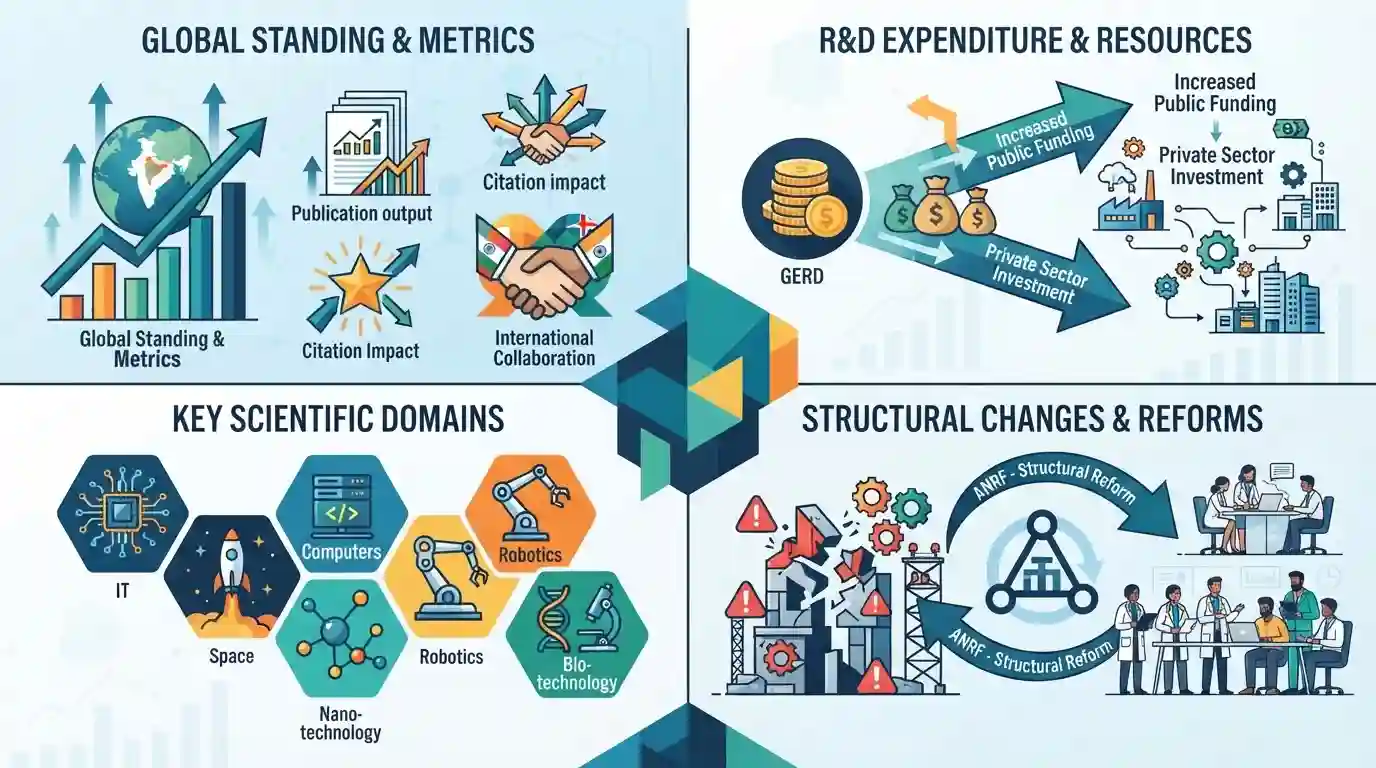
The article examines India's current standing in the global scientific and research landscape, analyzing metrics such as publication output, citation impact, Gross Expenditure on R&D (GERD), private sector participation, and institutional bottlenecks. It highlights the structural changes needed, including enhanced funding, stronger industry-academia collaboration, and structural reforms through mechanisms like the ANRF, to transition India into a true science superpower.
મુખ્ય મુદ્દા
- India has made notable strides in total scientific publication volume and ranking globally, but lags behind in citation impact, quality metrics, and high-end core research output.
- Gross Expenditure on R&D (GERD) in India remains relatively low as a percentage of GDP compared to major science superpowers, hovering around 0.64%, with a disproportionate share coming from the government rather than the private sector.
- Translational research, commercialization of innovations, and robust industry-academia linkages continue to face systemic roadblocks.
- The operationalization of initiatives like the Anusandhan National Research Foundation (ANRF) aims to decentralize funding, boost private sector contribution, and strengthen research ecosystems in universities and colleges.
મહત્વપૂર્ણ શબ્દો
Anusandhan National Research Foundation (ANRF)

An apex statutory body established under the ANRF Act, 2023, to fund, coordinate, and promote scientific research, innovation, and industry-academia collaboration across India's universities and research institutions.
UPSC context
GS Paper III (Science & Technology): Tests institutional frameworks for R&D funding, policy implementation, and scientific research promotion.
Anusandhan National Research Foundation Act
Legislation enacted in 2023 that repealed the Science and Engineering Research Board (SERB) Act to establish the ANRF, aiming to seed, grow, and promote R&D across academic and research institutions.
UPSC context
GS Paper III (Science & Technology): Tests legislative measures, institutional reforms, and legal backing for scientific research governance.
Department of Science and Technology
A major department under the Ministry of Science and Technology responsible for formulating national policies, promoting new areas of science, and providing administrative support to apex research bodies like the ANRF.
UPSC context
GS Paper III (Science & Technology): Tests institutional mechanisms, administrative structures, and government initiatives for scientific advancement.
પ્રિલિમ્સ ટ્રેપ
India's private sector drives the bulk of research and development expenditure, matching global innovation powerhouses like the US and South Korea.
Aspirants often assume India's private sector contributes the majority of R&D funding, mirroring Western nations, whereas in India, the government contributes the disproportionate share of total GERD.
સંલગ્ન સ્થિર ખ્યાલો
What is the mandate and institutional framework of the Anusandhan National Research Foundation (ANRF)?
- Legislative Origin: Established via the ANRF Act, 2023, replacing the Science and Engineering Research Board (SERB).
- Primary Mandate: Aims to provide high-level strategic direction to scientific research and foster a culture of research in universities and colleges.
- Funding Mechanism: Designed to mobilize private sector contributions and non-government sources to boost overall Gross Expenditure on R&D (GERD).
આંતર-વિષય પેટર્ન
GERD vs Fiscal Deficit: R&D Financing Dilemma
India's low GERD and over-reliance on public funding reflect structural fiscal challenges in balancing welfare expenditures with capital investments in high-tech R&D sectors.
IPR Regimes and Translational Research Bottlenecks
Bridging the lab-to-market gap requires stronger IPR frameworks, tech transfer offices, and collaborative ecosystems between state universities and domestic industries.

ANRF mandate, GERD composition (public vs private share), and structural lags in citation impact are high-yield Prelims/Mains targets.
સંલગ્ન PYQ · 1
સંલગ્ન PYQ · 1
- 2024MainsGS3
What is the present world scenario of intellectual property rights with respect to life materials? Although, India is second in the world to file patents, still only a few have been commercialized. Explain the reasons behind this less commercialization.
