Quantum Computing Bottlenecks and the Challenge of Environmental Noise
Source:The Hindu ↗
Why It Matters
Quantum technology is a frontier area of strategic and economic importance for India. UPSC has consistently tested the basic building blocks of quantum technology (like qubits in Prelims 2022) and major policies (like the National Quantum Mission in Prelims 2026). Conceptual clarity on physical vs. logical qubits and the technological bottleneck of 'noise' helps write analytical Mains answers on why quantum supremacy remains a long-term goal.
Summary
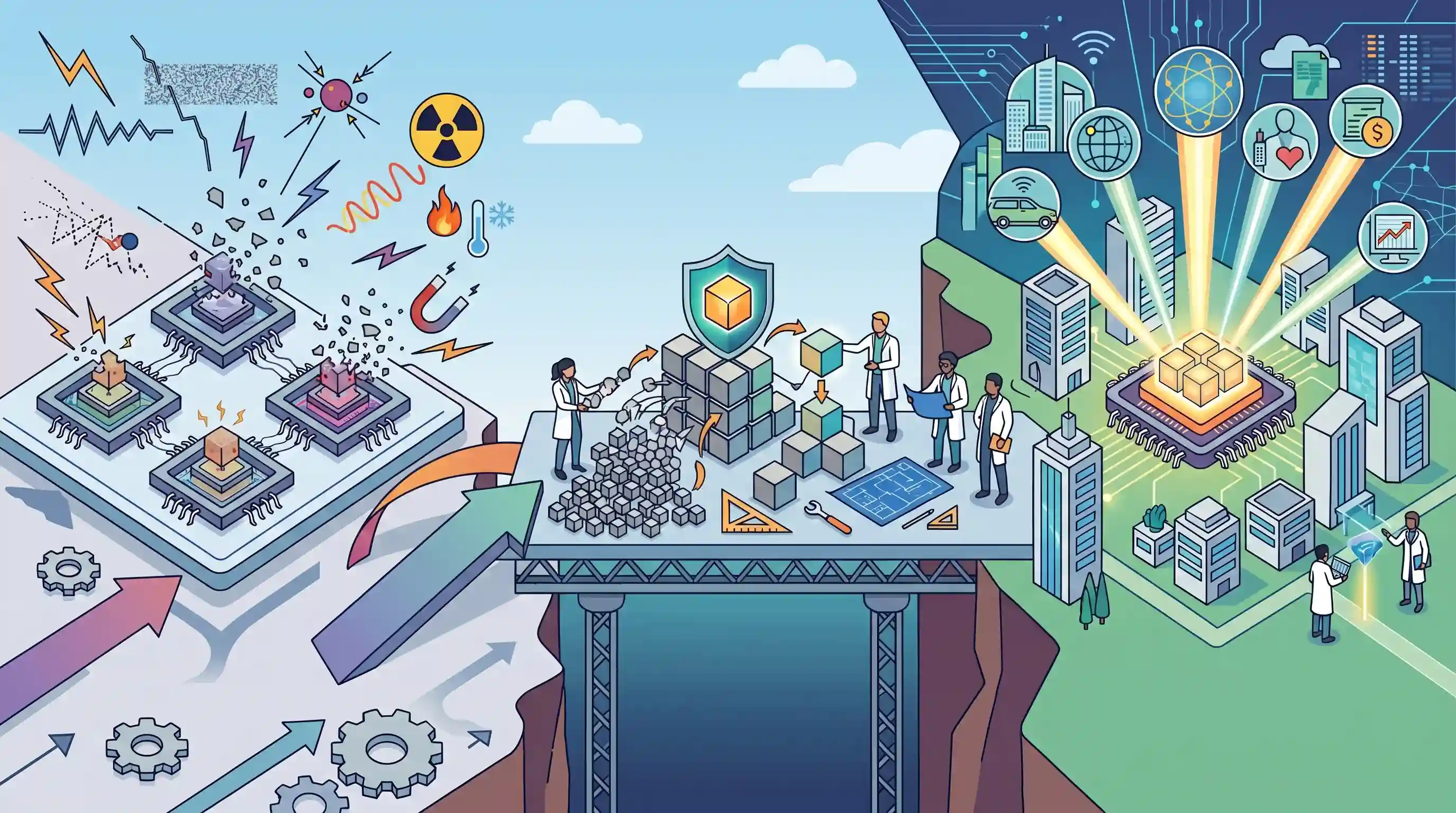
The article details why the era of practical, commercial-scale quantum computing is stalled by the presence of 'quantum noise.' Currently stuck in the Noisy Intermediate-Scale Quantum (NISQ) era, existing quantum computers suffer from decoherence, where environmental disturbances destroy quantum states. To transition to Fault-Tolerant Quantum Computing (FTQC), scientists must implement Quantum Error Correction (QEC) schemes, requiring the bundling of thousands of error-prone physical qubits to construct a single reliable logical qubit. This transition remains the central hurdle for global researchers and India's own National Quantum Mission.
Key Points
- Quantum Noise and Decoherence: The main bottleneck to the realization of functional quantum computing is environmental noise (heat, magnetic fields, material defects) which causes decoherence and destroys delicate superposition and entanglement.
- The NISQ Era Limitation: Current systems operate in the Noisy Intermediate-Scale Quantum (NISQ) era, characterized by devices with dozens of noisy physical qubits which cannot run deep, complex algorithms before accumulated errors render calculations useless.
- Physical vs. Logical Qubits: To overcome noise, researchers must develop Fault-Tolerant Quantum Computing (FTQC). This relies on Quantum Error Correction (QEC), where thousands of physical qubits are combined to create a single, stable 'logical qubit' that is virtually error-free.
- Engineering Hurdles: Building fault-tolerant systems requires resolving monumental engineering challenges, including cooling superconducting qubits to near absolute zero, managing cross-talk between qubits, and developing high-fidelity control systems.
Important Terms
National Quantum Mission (NQM)

A flagship Indian government initiative sanctioned in 2023 to seed, nurture, and scale scientific and industrial R&D in quantum computing, communication, sensing, and materials.
UPSC context
GS Paper 3 (Science and Technology); tests understanding of policy frameworks, scientific missions, and indigenous technological capabilities.
Noisy Intermediate-Scale Quantum (NISQ)
The current generation of quantum computers containing 50 to 1,000 qubits that are highly sensitive to environmental noise and lack full-scale quantum error correction.
UPSC context
GS Paper 3 (Science and Technology); tests awareness of modern computing limitations and milestones in emerging technologies.
Fault-Tolerant Quantum Computing (FTQC)
A regime of quantum processors that successfully implements quantum error correction, enabling them to execute complex, arbitrary algorithms reliably despite physical component errors.
UPSC context
GS Paper 3 (Science and Technology); evaluates knowledge of future computing architectures and engineering breakthroughs in IT.
Quantum Error Correction (QEC)
A set of techniques that protects quantum information from environmental noise by encoding a single logical qubit across multiple entangled physical qubits to detect and fix errors.
UPSC context
GS Paper 3 (Science and Technology); tests understanding of technical challenges and solutions in developing advanced computing systems.
Decoherence
The process where a quantum system loses its fragile quantum properties, such as superposition or entanglement, due to disruptive interactions with its surrounding environment.
UPSC context
GS Paper 3 (Science and Technology); evaluates grasp of core physics principles and roadblocks in next-generation computing hardware.
Qubit
The fundamental unit of quantum information, equivalent to a classical bit, capable of existing in multiple states simultaneously due to superposition and entanglement.
UPSC context
GS Paper 3 (Science and Technology); tests command over fundamental vocabulary in quantum mechanics and modern computational architecture.
Prelims Trap
Quantum error correction copies the state of a physical qubit multiple times to build backup redundancies.
The 'No-Cloning Theorem' of quantum mechanics strictly forbids making duplicate copies of an unknown quantum state, making classical replication methods impossible.
Static Concepts Connected
What physics principles limit how error correction is performed in quantum computers?
- No-Cloning Theorem: Forbids creating identical copies of an arbitrary unknown quantum state, ruling out simple classical-style replication of data.
- Measurement Collapse: Observing a qubit collapses its superposition state into a classical 0 or 1, destroying the active computational process.
- Syndrome Measurement: Bypasses collapse by measuring only error patterns (syndromes) through multi-qubit entanglement without exposing the physical qubits' actual data.
What are the core operational verticals under India's National Quantum Mission?
- Thematic Hubs: Establishes four T-Hubs focusing on Computing, Communication, Sensing & Metrology, and Quantum Materials & Devices.
- Qubit Benchmarks: Aims to develop intermediate-scale systems containing 50 to 1,000 physical qubits by 2031.
- Nodal Department: Executed by the Department of Science and Technology (DST) with an allocated budget of over ₹6,000 crore.
Cross-Topic Patterns
Quantum systems + Post-Quantum Cryptography
FTQC transition will instantly break classical RSA encryption, making development of secure Post-Quantum Cryptography protocols a critical national security imperative.
NQM + Semiconductor Fab Alignment
Fabricating physical superconducting qubits requires extreme nano-precision, necessitating deep alignment between the National Quantum Mission and the India Semiconductor Mission.

Prelims 2026 will likely test the science of the 'no-cloning theorem' and 'decoherence' as core bottlenecks to quantum computing.
Linked PYQs · 2
Linked PYQs · 2
- 2022PrelimsGS1
Which one of the following is the context in which the term "qubit" is mentioned ?
- 2026PrelimsGS1
Which of the following statements with regard to the National Quantum Mission (NQM) is/are correct? 1. It aims at developing intermediate-scale quantum computers with 50-1000 physical qubits. 2. Its implementation includes setting up of four Thematic Hubs (T-Hubs) in academic and national R&D institutes across India. Select the answer using the code given below :
