Addressing Foundational Learning Deficits in Indian Education System
Source:The Hindu ↗
Why It Matters
Analyzing the quality of education and learning outcomes is crucial for GS2. It highlights the persistent gap between policy intent (RTE, enrollment, infrastructure) and actual service delivery (learning), which directly impacts India's human capital formation and its ability to reap the demographic dividend.
Summary
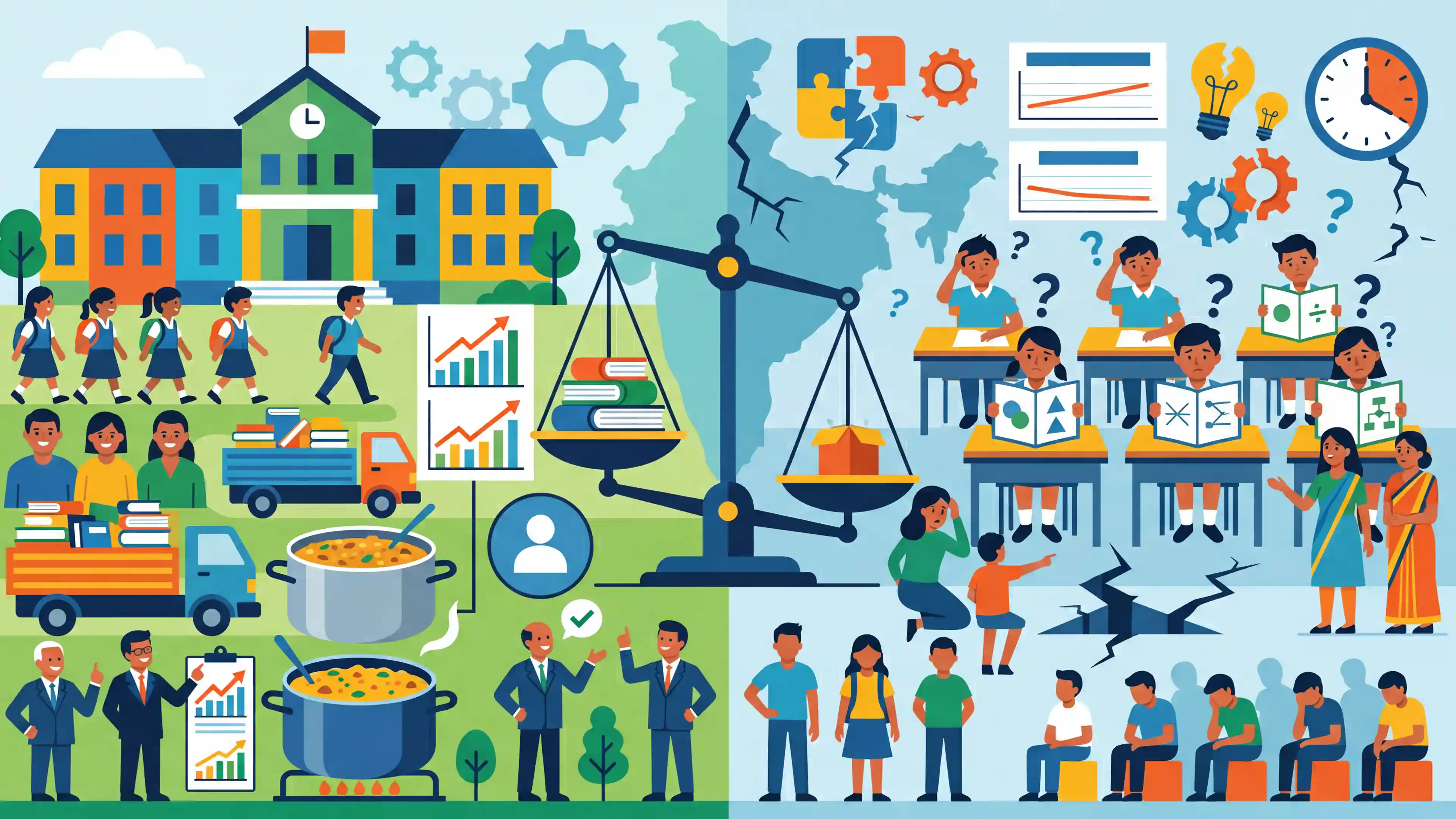
The article discusses the paradox of a 'missing urgency' around foundational learning outcomes in India's education system. Despite consistent data highlighting poor learning levels among children, there is a distinct lack of political and societal mobilization to address this crisis. The focus typically remains on educational inputs—like enrollment, infrastructure, and midday meals—rather than the actual quality of education and measurable learning outcomes, which are critical for harnessing India's demographic dividend and ensuring human capital development.
Key Points
- Highlights the stark contrast between high school enrollment rates and persistently poor learning outcomes among Indian students.
- Points out the lack of political and societal urgency to address the foundational learning crisis, despite regular data from reports like ASER indicating severe deficits in basic reading and math skills.
- Notes that public discourse and policy implementation heavily favor tangible educational inputs (infrastructure, uniforms, meals) over intangible but crucial outcomes (quality of education and actual learning).
- Emphasizes the critical need to shift the educational paradigm towards measurable learning outcomes to truly harness India's demographic dividend and build capable human capital.
Important Terms
Right to Education (RTE) Act, 2009

The 2009 legislation making free, compulsory education a fundamental right for children aged 6–14. While successful in increasing enrollment and infrastructure, it is often criticized for prioritizing schooling 'inputs' over measurable 'learning outcomes.'
UPSC context
GS Paper II: Government policies and social sector issues. Tests understanding of legislative gaps in quality education.
National Education Policy (NEP) 2020
India’s comprehensive 21st-century educational framework replacing the 1986 policy. It identifies 'Foundational Literacy and Numeracy' as an 'urgent national mission,' shifting the systemic focus from rote learning to competency-based education.
UPSC context
GS Paper II: Governance/Education. Key for discussing current reforms and structural shifts in human capital development.
ASER (Annual Status of Education Report)
A nationwide citizen-led household survey by the NGO Pratham. It is the primary source of data on rural children's actual learning levels (reading/arithmetic), highlighting the gap between school enrollment and functional literacy.
UPSC context
GS Paper II: Social sector/Services. Used as a benchmark in Economic Surveys to discuss education quality and learning deficits.
NIPUN Bharat Mission
A national mission launched in 2021 under NEP 2020. It aims to ensure every child in India achieves basic reading, writing, and numeracy skills by the end of Grade 3 (by 2026-27).
UPSC context
GS Paper II: Government schemes. Tests knowledge of targeted interventions to solve the foundational learning crisis.
Foundational Literacy and Numeracy (FLN)
A child’s ability to read with comprehension and perform basic mathematical operations by Grade 3. NEP 2020 describes FLN as the indispensable prerequisite for all future schooling and lifelong learning.
UPSC context
GS Paper II/III: Human resources/Education. Crucial for understanding the 'learning poverty' challenge and demographic dividend.
Pratham Education Foundation
One of India's largest NGOs, established in 1995. Through its ASER reports and 'Teaching at the Right Level' (TaRL) approach, it has been instrumental in advocating for learning-centered educational reforms.
UPSC context
GS Paper II: Role of NGOs/Civil Society in the development process and social sector interventions.
Prelims Trap
"The Annual Status of Education Report (ASER) is published annually by the Ministry of Education."
ASER is an independent, citizen-led household survey facilitated by the NGO Pratham, not a government or Ministry of Education publication.
Static Concepts Connected
What are the core targets of the NIPUN Bharat Mission?
- Primary Objective: To ensure universal Foundational Literacy and Numeracy (FLN) for every child by the end of Grade 3.
- Scheme Integration: It is implemented as a Centrally Sponsored Scheme under the Samagra Shiksha umbrella, aligning with NEP 2020.
- Outcome Focus: Focuses on measurable learning outcomes and play-based pedagogy rather than mere enrollment figures.
How has the RTE Act evolved regarding learning outcomes?
- Initial Input Focus: The original 2009 Act heavily prioritized physical inputs, standardizing norms for infrastructure, pupil-teacher ratios, and midday meals.
- 2017 Amendment: The Central rules were explicitly amended in 2017 to mandate the preparation of class-wise, subject-wise learning outcomes.
Cross-Topic Patterns
Demographic Dividend vs Skilling Crisis
Poor foundational learning at the primary level directly cascades into low vocational trainability, feeding into India's paradox of jobless growth and skilled labor shortages.
Local Governance & School Accountability
RTE-mandated School Management Committees (SMCs) often obsess over funds and infrastructure, missing their crucial statutory role in community-led monitoring of actual learning outcomes.

Expect a 2026 Prelims statement differentiating ASER's household-survey methodology from the MoE's National Achievement Survey.
Linked PYQs · 4
Linked PYQs · 4
- 2022MainsGS2
The Right of Children to Free and Compulsory Education Act, 2009 remains inadequate in promoting incentive-based system for children's education without generating awareness about the importance of schooling. Analyse.
- 2020MainsGS2
National Education Policy 2020 is in conformity with the Sustainable Development Goal-4 (2030). It intends to restructure and reorient education system in India. Critically examine the statement.
- 2016MainsGS2
Demographic Dividend in India will remain only theoretical unless our manpower becomes more educated, aware, skilled and creative." What measures have been taken by the government to enhance the capacity of our population to be more productive and employable?
- 2023MainsGS2
The crucial aspect of development process has been the inadequate attention paid to Human Resource Development in India. Suggest measures that can address this inadequacy.
