Inflation challenges grow due to persistent second-round effects
Source:Indian Express ↗
কেন এটি গুরুত্বপূর্ণ
Crucial for understanding contemporary macroeconomic challenges in India, monetary policy formulation by the RBI, and the handling of persistent inflation.
সারসংক্ষেপ
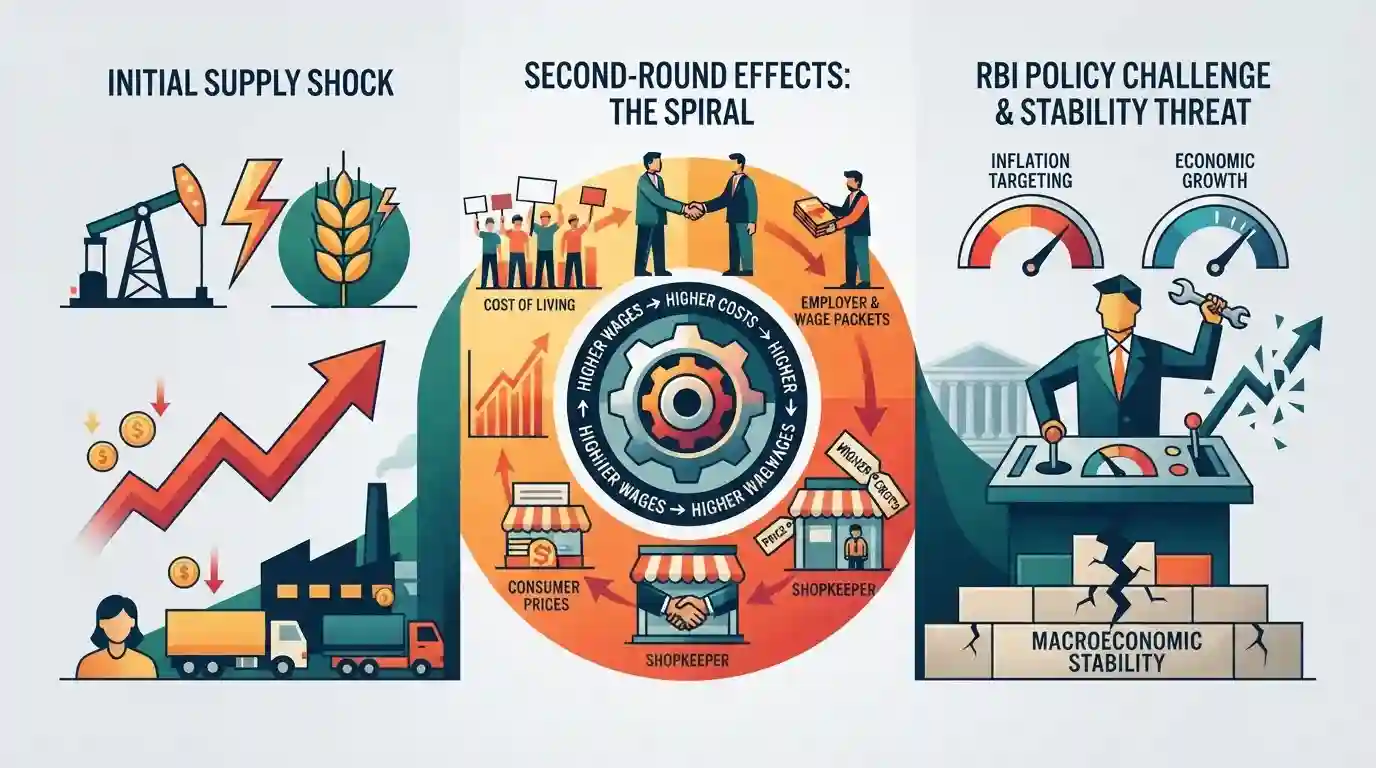
The article discusses the challenge of inflation's second-round effects, where initial price shocks (such as food or fuel spikes) translate into generalized cost-and-price spirals, complicating central bank monetary policy responses and threatening macroeconomic stability.
মূল বিষয়
- Inflation dynamics have shifted from primary supply shocks to second-round effects, where higher input costs and price expectations seep into broader core inflation and wages.
- Central banks face tough trade-offs because traditional monetary tightening (raising interest rates) is less effective against structural supply-side pressures but necessary to anchor inflation expectations.
- Managing second-round effects requires a delicate balance between fiscal measures (supply management) and monetary vigilance to prevent inflation from becoming entrenched.
গুরুত্বপূর্ণ শব্দ
Second-Round Effects

Secondary inflationary pressures that occur when initial supply shocks, such as food or fuel spikes, translate into generalized price and wage increases across the wider economy.
UPSC context
UPSC CSE Paper III (Economy): Crucial for understanding central bank monetary policy responses to sticky inflation and macroeconomic stability.
Reserve Bank of India
India's central banking institution, established under the RBI Act of 1934, responsible for regulating the monetary system, issuing currency, and maintaining price stability.
UPSC context
UPSC CSE Paper III (Economy): Tests understanding of central banking functions, regulatory frameworks, and economic governance in India.
Monetary Policy Committee
A statutory body constituted under the RBI Act, 1934, tasked with determining the policy interest rate required to achieve the inflation target while supporting growth.
UPSC context
UPSC CSE Paper III (Economy): Essential for questions on inflation targeting, interest rate management, and monetary policy governance.
প্রিলিমস ফাঁদ
Monetary tightening immediately neutralizes all forms of inflation, including transient food and fuel supply shocks.
Aspirants often assume central banks can neutralize headline inflation by hiking rates, ignoring that rate hikes do not fix food or supply-side shocks directly and only address second-round demand and expectations.
সংযুক্ত স্থির ধারণা
What is the difference between headline inflation and core inflation in India?
- Headline Inflation:: It includes all commodities in the consumer basket, including volatile food and energy items.
- Core Inflation:: It excludes volatile items (food and fuel) to measure underlying demand-pull pressures and second-round effects.
- Policy Focus:: RBI primarily monitors core inflation trends to anchor medium-term inflation expectations.
আন্তঃবিষয় প্যাটার্ন
Inflation Targeting vs. FRBM Fiscal Deficits
Inflation targeting frameworks are tested alongside fiscal deficit targets under the FRBM Act to show how monetary-fiscal coordination prevents entrenched second-round shocks.
Core Inflation vs. Headline Inflation Dynamics
Core inflation calculations exclude volatile food and fuel items to isolate second-round wage-price spirals from transient primary supply shocks.

RBI monetary policy dilemmas involving second-round effects and core sticky inflation will be tested via analytical statement questions.
সংযুক্ত PYQ · 2
সংযুক্ত PYQ · 2
- 2024MainsGS3
What are the causes of persistent high food inflation in India? Comment on the effectiveness of the monetary policy of the RBI to control this type of inflation.
- 2019MainsGS3
Do you agree with the view that steady GDP growth and low inflation have left the Indian economy in good shape? Give reasons in support of your arguments.
