Diplomacy and Security Challenges After Pahalgam Terror Attack
Source:Indian Express ↗
Why It Matters
The article provides a sophisticated framework for understanding the interplay between military strategy and international diplomacy in dealing with state-sponsored terrorism. It is highly relevant for GS-2 (IR) and GS-3 (Internal Security) answers on India-Pakistan relations, managing global pressures at the UNSC, and handling cross-border conflicts without crossing the nuclear threshold.
Summary
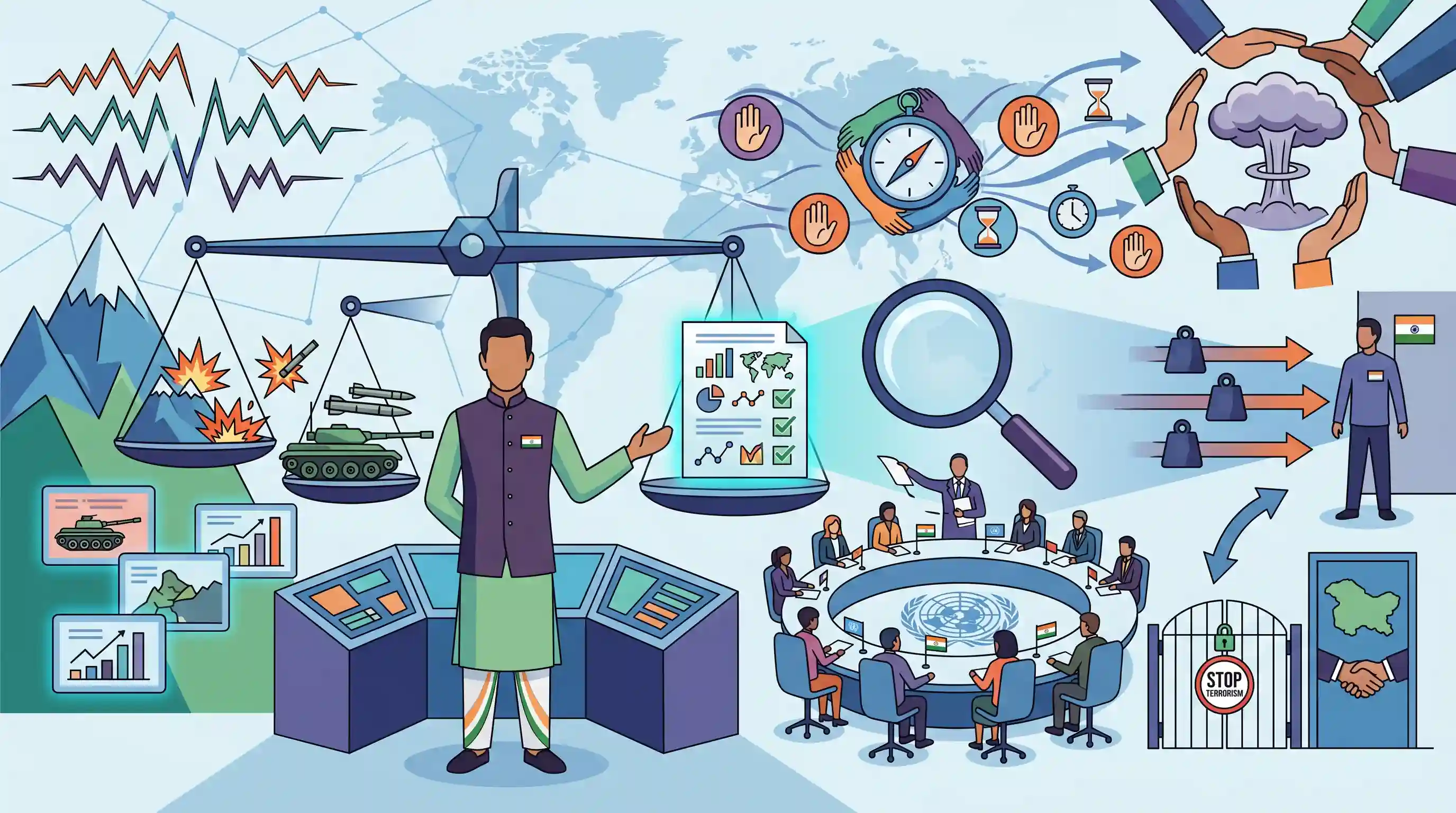
Following the Pahalgam terror attack, India confronts significant diplomatic and political challenges in balancing military retaliation with international diplomacy. The attack requires India to win a narrative war by presenting factual evidence of Pakistan's state-sponsored terrorism at global forums like the UN Security Council. Additionally, Indian diplomacy must strategically manage international calls for restraint and navigate the inevitable diplomatic intervention stemming from fears of nuclear escalation. By learning from past crises like Balakot, India aims to use international pressure to stop cross-border terrorism rather than allowing Pakistan to weaponize the crisis to force negotiations on Kashmir.
Key Points
- Any military response to the Pahalgam terror attack must be guided by political judgment and diplomatic strategy, as the sovereign use of force is inherently a political act.
- India must build a factual case to expose Pakistan's complicity globally, particularly at the UNSC, where Pakistan is currently a non-permanent member and actively backed by China.
- Indian diplomacy faces the challenge of managing international calls for restraint, differentiating between performative diplomatic statements and actual political space available for military action.
- Fears of nuclear escalation often trigger international intervention; India must navigate this by leveraging such intervention to halt cross-border terrorism, countering Pakistan's attempts to use it for forcing negotiations on Kashmir.
Important Terms
United Nations Security Council (UNSC)

The principal UN body for maintaining international peace. India uses this forum to present evidence of state-sponsored terrorism, aiming to isolate Pakistan and counter its narratives on Kashmir.
UPSC context
GS Paper II: Important International institutions. Tests knowledge of global governance and India's strategy for internationalizing counter-terrorism efforts.
Pakistan Army
The dominant institutional actor in Pakistan's "hybrid" regime. It controls the country's foreign policy and is frequently implicated in the "military-ISI-terrorist nexus" used for proxy warfare against India.
UPSC context
GS Paper II/III: Neighborhood relations and security. Essential for understanding regional instability and the structure of cross-border threats.
Nuclear Escalation
The risk of a conventional conflict spiraling into a nuclear exchange. This dynamic is central to South Asian security due to Pakistan's "First Use" policy and tactical nuclear weapons.
UPSC context
GS Paper III: Security challenges. Tests understanding of deterrence, nuclear doctrines (NFU), and crisis management in a nuclearized environment.
Balakot Airstrike
The 2019 preemptive aerial strike by India on a JeM camp in Pakistan. It marked a doctrinal shift from "strategic restraint" to "offensive deterrence" against state-sponsored terror infrastructure.
UPSC context
GS Paper III: Security. Significant for tracing the evolution of India’s military response to sub-conventional warfare and cross-border terrorism.
Indus Waters Treaty (IWT)
A 1960 water-sharing agreement between India and Pakistan. Recently used by India as a diplomatic lever, where "suspension" or "repudiation" serves as a non-military retaliatory measure against terrorism.
UPSC context
GS Paper II: Bilateral relations. Crucial for understanding hydro-diplomacy and legal/economic countermeasures in conflict resolution.
Cross-border Terrorism
The infiltration of militants across the border to commit violence. India frames this as a "low-cost" war by Pakistan, demanding global accountability for terror funding and safe havens.
UPSC context
GS Paper III: Security challenges in border areas. A core topic involving internal security, infiltration, and the role of external state actors.
Prelims Trap
Under the UNSC 1267 sanctions regime, only P5 members possess the authority to place a 'technical hold' on a listing.
False. Any of the 15 members of the UNSC 1267 committee can place a technical hold. China (P5) merely utilizes it the most.
Static Concepts Connected
How does the UNSC 1267 Sanctions Committee function?
- Origin: Established in 1999 initially to oversee targeted sanctions on the Taliban and Al-Qaida.
- Composition: It comprises all 15 members of the UN Security Council. Decisions are made by consensus, granting every member an effective veto over listings.
- Technical Hold: A procedural measure allowing any member to pause a terrorist listing for up to 6 months to gather more information, often abused to shield proxies.
What defines the contrasting nuclear doctrines of India and Pakistan?
- India's Posture: Strictly maintains a 'No First Use' (NFU) policy alongside credible minimum deterrence, promising massive retaliation to any WMD attack.
- Pakistan's Doctrine: Explicitly rejects NFU, maintaining an ambiguous 'first-use' policy designed to deter India's overwhelming conventional military superiority.
- Strategic Shield: Pakistan leverages this deliberately low nuclear threshold to trigger global escalation fears, inviting third-party diplomatic intervention during bilateral crises.
Cross-Topic Patterns
Economic coercion vs. Diplomatic isolation
India increasingly combines kinetic military action with multilateral tools like FATF greylisting and UNSC sanctions to financially choke cross-border terror networks.
Sub-conventional war and nuclear thresholds
India's post-Balakot doctrine seeks to exploit the space for conventional military strikes below the nuclear threshold, directly challenging Pakistan's strategy of nuclear blackmail.

The intersection of Pakistan's 'first-use' nuclear doctrine and China's use of UNSC procedural holds is prime for a 2026 IR Mains question.
Linked PYQs · 3
Linked PYQs · 3
- 2024MainsGS2
‘Terrorism has become a significant threat to global peace and security.’ Evaluate the effectiveness of the United Nations Security Council's Counter Terrorism Committee (CTC) and its associated bodies in addressing and mitigating this threat at the international level.
- 2016MainsGS2
Increasing cross-border terrorist attacks in India and growing interference in the internal affairs of several member-states by Pakistan are not conducive for the future of SAARC (South Asian Association for Regional Cooperation)." Explain with suitable examples.
- 2015MainsGS2
Terrorist activities and mutual distrust have clouded India-Pakistan relations. To what extent the use of soft power like sports and cultural exchanges could help generate goodwill between the two countries? Discuss with suitable examples.
