Balancing climate mitigation with development needs of Global South
Source:The Hindu ↗
Why It Matters
Provides a critical counter-narrative to extreme climate rhetoric, emphasizing the need to balance environmental goals with the socio-economic realities and developmental priorities of emerging economies. This is highly relevant for GS-3 Environment and GS-2 International Relations regarding climate negotiations.
Summary
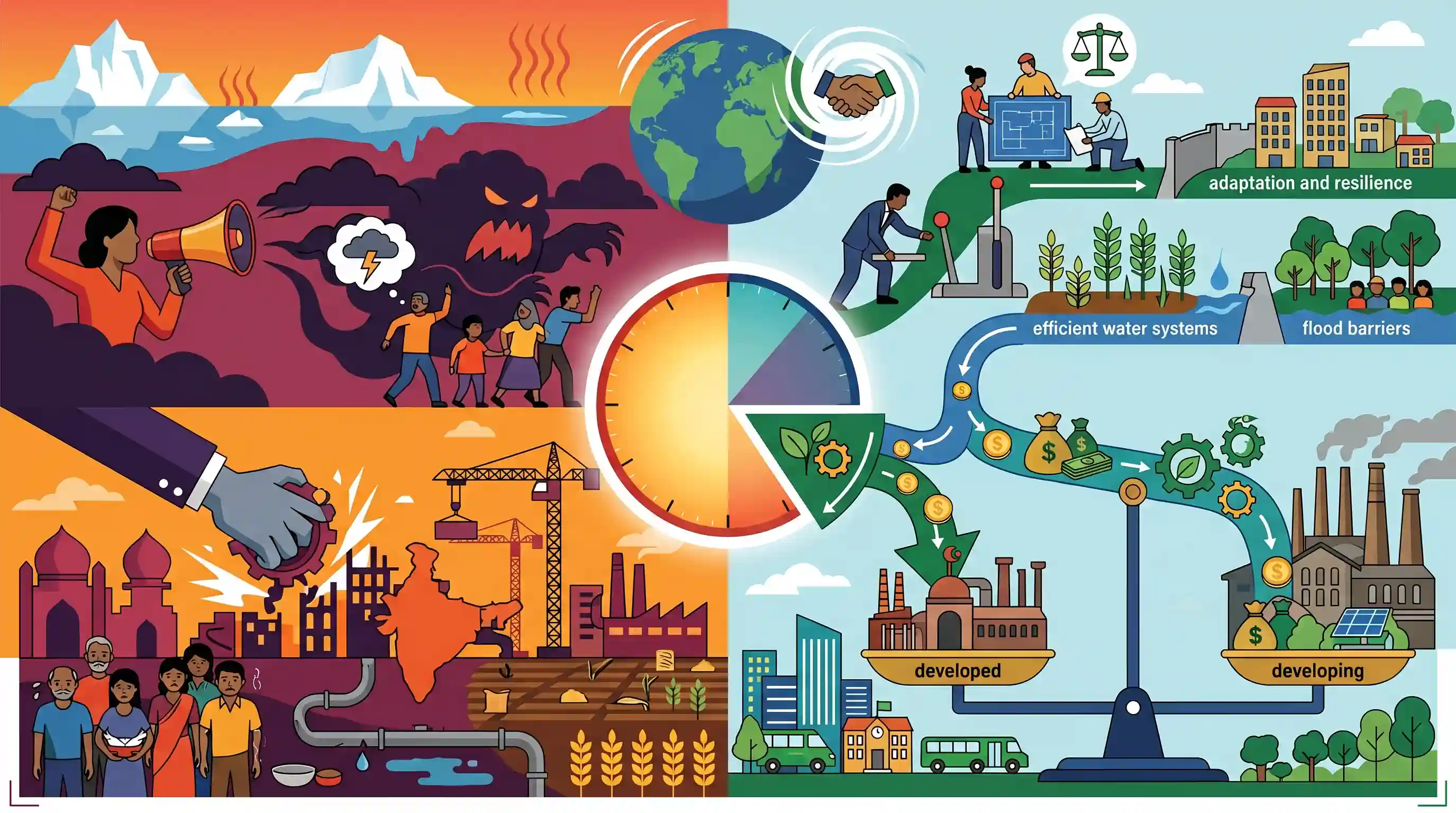
The article critically examines the negative implications of "climate alarmism," arguing that extreme narratives of impending doom often hinder pragmatic climate action. While climate change is an undeniable crisis, alarmist rhetoric tends to focus disproportionately on aggressive mitigation, which can undermine the pressing economic and developmental needs of the Global South. For countries like India, an abrupt transition away from fossil fuels could jeopardize poverty alleviation and inclusive growth. Instead, the focus should shift towards a balanced approach that equally prioritizes adaptation, resilience-building, and climate justice. Developed countries must honor their commitments to climate finance and technology transfer while respecting the principle of Common But Differentiated Responsibilities (CBDR), ensuring that developing nations retain their rightful carbon space for sustainable development.
Key Points
- Exaggerated climate narratives ("alarmism") can cause public panic and eco-anxiety without offering pragmatic, actionable solutions.
- Alarmist approaches often prioritize aggressive, short-term mitigation over the developmental needs of the Global South, threatening poverty alleviation and inclusive growth.
- Developing nations require a balanced strategy emphasizing climate adaptation, resilience building, and technology transfer, rather than an abrupt abandonment of fossil fuels.
- Upholding the principle of Common But Differentiated Responsibilities (CBDR) is crucial to ensure climate justice and preserve the carbon space for emerging economies.
- Constructive climate action must harmonize environmental sustainability with economic realities, backed by adequate climate finance from developed countries.
Important Terms
Common But Differentiated Responsibilities (CBDR)

A principle of international environmental law acknowledging that while all states share responsibility for climate change, developed nations bear a greater burden due to historical emissions and higher capacity.
UPSC context
GS Paper III (Environment); tests understanding of climate justice, equity, and North-South dynamics in global negotiations.
UNFCCC
A near-universal 1992 treaty aimed at stabilizing greenhouse gas concentrations to prevent dangerous human interference with the climate system, serving as the foundational framework for global climate action.
UPSC context
GS Paper III (Environment); fundamental for understanding global climate governance, COPs, and international environmental cooperation.
Paris Agreement
A legally binding 2015 treaty aiming to limit global warming to well below 2°C through self-determined climate action plans known as Nationally Determined Contributions (NDCs).
UPSC context
GS Paper III (Environment); tests knowledge of current global goals, India's NDCs, and international climate policy shifts.
Climate Finance
Financial resources mobilized by developed nations to assist developing countries in funding climate mitigation and adaptation efforts, often tied to a USD 100 billion annual commitment.
UPSC context
GS Paper III (Environment/Economy); central to discussions on sustainable development and the financial obligations of the developed world.
IPCC
The UN body established in 1988 by WMO and UNEP to provide scientific, technical, and socioeconomic assessments that inform international climate policy and negotiations.
UPSC context
GS Paper III (Environment/S&T); relevant for understanding the scientific evidence (e.g., AR6) that underpins global climate targets and debates.
Climate Adaptation
Actions taken to adjust systems and societies to the actual or expected effects of climate change, such as building resilient infrastructure or developing drought-resistant agriculture.
UPSC context
GS Paper III (Environment/Disaster Management); tests the priority shift toward resilience for vulnerable nations compared to emission reduction (mitigation).
Global South
Geopolitical term for developing and emerging economies that often advocate for developmental space, climate justice, and equitable technology transfer in international forums.
UPSC context
GS Paper II (International Relations); critical for analyzing India's leadership role and perspectives on fair global governance.
Prelims Trap
"India committed to a complete 'phase-out' of unabated coal power to achieve its net-zero target."
India and other developing nations successfully negotiated for a 'phase-down' (not phase-out) of coal at COP26 to protect their developmental carbon space.
Static Concepts Connected
What is Common But Differentiated Responsibilities (CBDR-RC)?
- Origin: Formalized at the 1992 Earth Summit, it acknowledges asymmetrical historical contributions to global greenhouse gas emissions.
- Core principle: Developed nations must take the lead in mitigation and provide finance/technology, given their historical responsibility.
- Paris shift: While Kyoto exempted developing nations from binding targets, the Paris Agreement requires Nationally Determined Contributions (NDCs) from all.
How do Mitigation and Adaptation differ in Climate Action?
- Mitigation: Efforts to reduce or prevent GHG emissions, such as transitioning to renewable energy or enhancing carbon sinks.
- Adaptation: Adjusting systems to withstand expected climate impacts, such as building coastal seawalls or developing drought-resistant crops.
- Global South stance: Developing nations argue for equal emphasis and funding for adaptation to balance immediate economic realities with climate goals.
Cross-Topic Patterns
Energy Security vs Decarbonization
Premature coal phase-outs threaten India's baseload power. This links climate policy directly to domestic energy security, grid stability, and poverty alleviation.
Climate Finance as Debt
Much of the promised global climate finance comes as loans rather than grants, exacerbating sovereign debt crises in the Global South instead of providing equitable compensation.

Expect a 2026 multi-statement Prelims question contrasting CBDR obligations under the Kyoto Protocol versus the Paris Agreement NDCs.
Linked PYQs · 4
Linked PYQs · 4
- 2022MainsGS3
Discuss global warming and mention its effects on the global climate. Explain the control measures to bring down the level of greenhouse gases which cause global warming, in the light of the Kyoto Protocol, 1997.
- 2021MainsGS3
Describe the major outcomes of the 26th session of the Conference of the Parties (COP) to the United Nations Framework Convention on Climate Change (UNFCCC). What are the commitments made by India in this conference?
- 2020MainsGS3
Explain intra-generational and inter-generational issues of equity from the perspective of inclusive growth and sustainable development.
- 2019MainsGS3
It is argued that the strategy of inclusive growth is intended to meet the objectives of inclusiveness and sustainability together. Comment on this statement.
