Durand Line and Pashtun unrest fueling Af-Pak border conflict
Source:Indian Express ↗
Why It Matters
Understanding the historical context of the Durand Line and ethnic fault lines like the Pashtun question is crucial for analyzing the changing dynamics of the Af-Pak region. It highlights the consequences of state-sponsored terrorism and provides essential context for India's security calculations in its neighborhood.
Summary
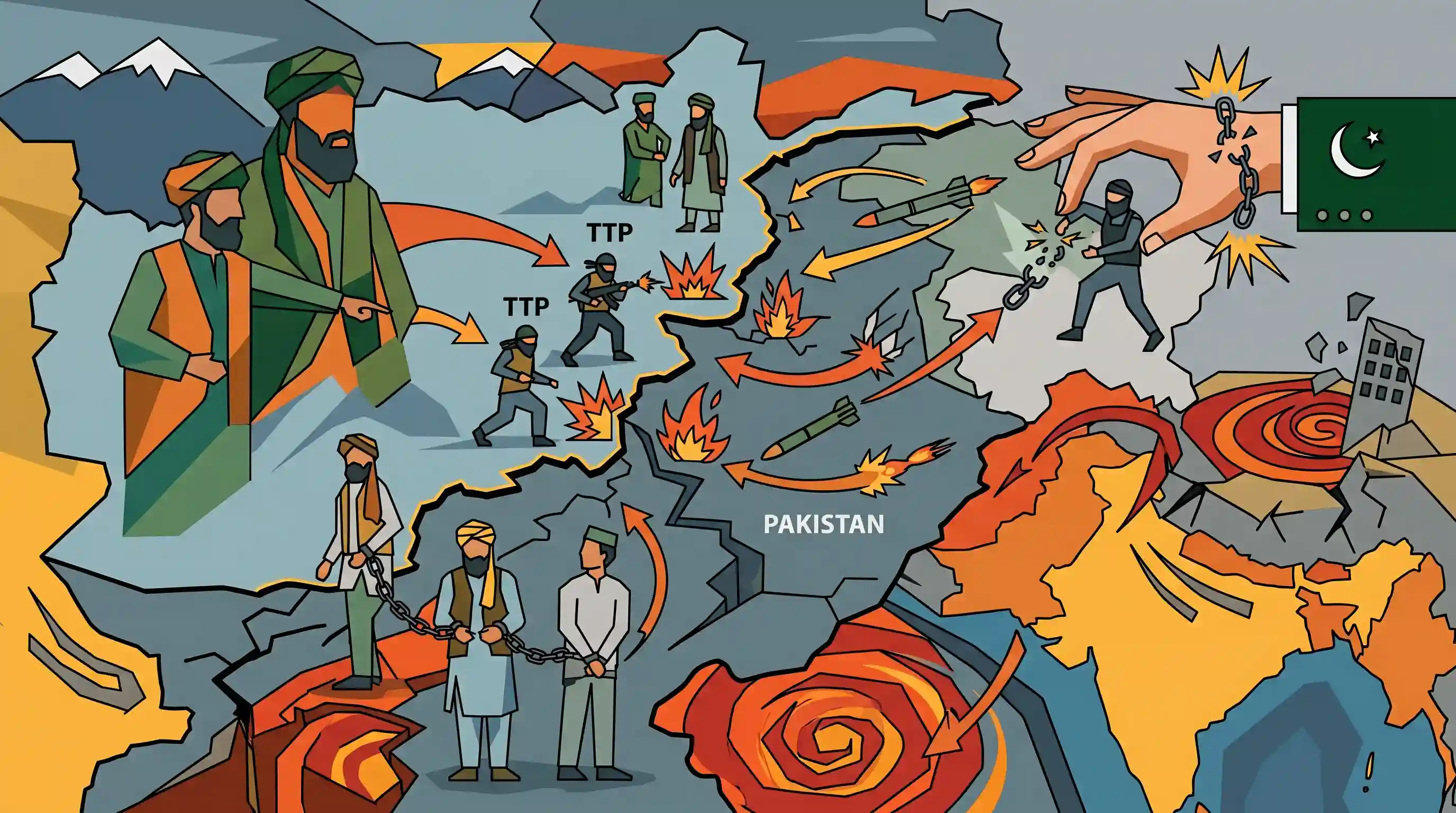
The article explores the historical 'Pashtun question' rooted in the contentious Durand Line, which divided the Pashtun population between Afghanistan and Pakistan. This enduring ethnic grievance, combined with the resurgence of the Tehrik-i-Taliban Pakistan (TTP) following the Afghan Taliban's rise to power, has led to severe cross-border hostilities. Pakistan's retaliatory strikes and the ensuing 'open war' highlight the failure of its proxy terrorism strategy, bringing immense instability to the Af-Pak region with significant implications for South Asian security.
Key Points
- The colonial-era Durand Line remains a core dispute, as Afghanistan refuses to recognize the border that partitioned the Pashtun ethnic homeland.
- The Afghan Taliban's return to power has emboldened the Tehrik-i-Taliban Pakistan (TTP), providing them with a safe haven to launch attacks against the Pakistani state.
- Escalating cross-border terrorism by the TTP and retaliatory military strikes by Pakistan have resulted in a state of near 'open war' between Kabul and Islamabad.
- The crisis underscores the backfiring of Pakistan's long-standing policy of cultivating militant proxies for strategic depth in Afghanistan.
- The volatility and ethnic conflicts in the Af-Pak region present ongoing security challenges and strategic implications for India's neighborhood.
Important Terms
Durand Line Agreement

An 1893 boundary agreement between British India and Afghanistan's Emir, demarcating the 2,640-km frontier. Inherited by Pakistan in 1947, it remains unrecognized by Afghanistan, which views it as an arbitrary colonial division of Pashtun lands.
UPSC context
GS Paper 2 (International Relations); tests knowledge of colonial-era treaties and their modern impact on South Asian border disputes.
Tehrik-i-Taliban Pakistan (TTP)
A militant umbrella group formed in 2007 seeking to overthrow the Pakistani state. It exploits the porous Af-Pak border and shares ideological ties with the Afghan Taliban, complicating regional counter-terrorism efforts.
UPSC context
GS Paper 3 (Internal Security/Terrorism); critical for analyzing cross-border security threats and non-state actors in India's neighborhood.
Afghan Taliban
A Sunni Islamist nationalist movement that regained control of Afghanistan in 2021. Their governance has strained ties with Pakistan due to disagreements over the Durand Line and safe havens for anti-Pakistan militants.
UPSC context
GS Paper 2 (International Relations); essential for understanding geopolitical shifts and the security architecture of the Af-Pak region.
Pashtunistan Question
A nationalist movement advocating for an independent state for Pashtuns, encompassing areas of Afghanistan and Pakistan. This movement rejects the Durand Line and remains a core ethnic grievance in bilateral relations.
UPSC context
GS Paper 2 (International Relations); tests understanding of ethnic nationalism and its role in regional instability.
Strategic Depth
A Pakistani military doctrine aimed at ensuring a pro-Islamabad government in Kabul to avoid a two-front war with India and provide a fallback territory. Recent hostilities suggest this proxy-based policy has backfired.
UPSC context
GS Paper 2 (International Relations); key to evaluating Pakistan’s foreign policy and its consequences for Indian security interests.
Prelims Trap
Because of Pakistan's support, the Afghan Taliban formally recognizes the Durand Line as the international border.
No Afghan government, including the Taliban, has ever accepted the 1893 Durand Line. They reject it because it artificially divides the Pashtun ethnic homeland.
Static Concepts Connected
What is the historical basis of the Durand Line dispute?
- Origin (1893): Drawn in 1893 between British India and Afghanistan, it arbitrarily bisected the Pashtun and Baloch tribal territories.
- Pakistan's Claim: Pakistan claims the border is internationally recognized and legitimate through the legal principle of state succession post-1947.
- Afghan Rejection: Kabul views it as an expired, imposed colonial treaty that unnaturally partitioned the Pashtun homeland, refusing to recognize it.
What is Pakistan's 'Strategic Depth' doctrine regarding Afghanistan?
- Core Objective: A military doctrine seeking political and military influence in Afghanistan to provide a strategic rear base in the event of an Indian invasion.
- Proxy Mechanism: This strategy relied on cultivating and sponsoring proxy groups like the Afghan Taliban to ensure a pliant, anti-India regime in Kabul.
- Strategic Blowback: The doctrine failed as the empowered Afghan Taliban now provides sanctuary to the anti-Pakistan TTP, resulting in 'open war' instead of security.
Cross-Topic Patterns
Colonial cartography and ethnic fractures
Like the Durand Line, the McMahon Line (India-China) and Radcliffe Line highlight how colonial borders ignored ethnic realities, causing perpetual modern geopolitical disputes.
State sponsorship and proxy blowback
Pakistan's crisis illustrates the 'Frankenstein effect' in IR, where cultivating terrorist proxies (like the Afghan Taliban) for strategic leverage ultimately backfires and threatens the sponsor state.
Af-Pak volatility and India's LoC posture
Tensions on the Durand Line force Pakistan to secure its western flank, altering its military posture on the LoC and impacting India's two-front war calculations.

GS-2 Mains 2026 will likely test Pakistan's failing 'strategic depth' doctrine, the Durand Line dispute, and its fallout on Indian security.
Linked PYQs · 2
Linked PYQs · 2
- 2020MainsGS3
Analyze internal security threats and transborder crimes along Myanmar, Bangladesh and Pakistan borders including Line of Control (LoC). Also discuss the role played by various security forces in this regard.
- 2016MainsGS2
Increasing cross-border terrorist attacks in India and growing interference in the internal affairs of several member-states by Pakistan are not conducive for the future of SAARC (South Asian Association for Regional Cooperation)." Explain with suitable examples.
