US India Bilateral Relations and Diaspora Driven Strategic Resilience
Source:The Hindu ↗
Why It Matters
Understanding the multi-dimensional nature of U.S.-India relations is critical for UPSC aspirants, especially how non-state actors, trade, technology (iCET), and the diaspora shape foreign policy outcomes and provide stability to strategic partnerships.
Summary
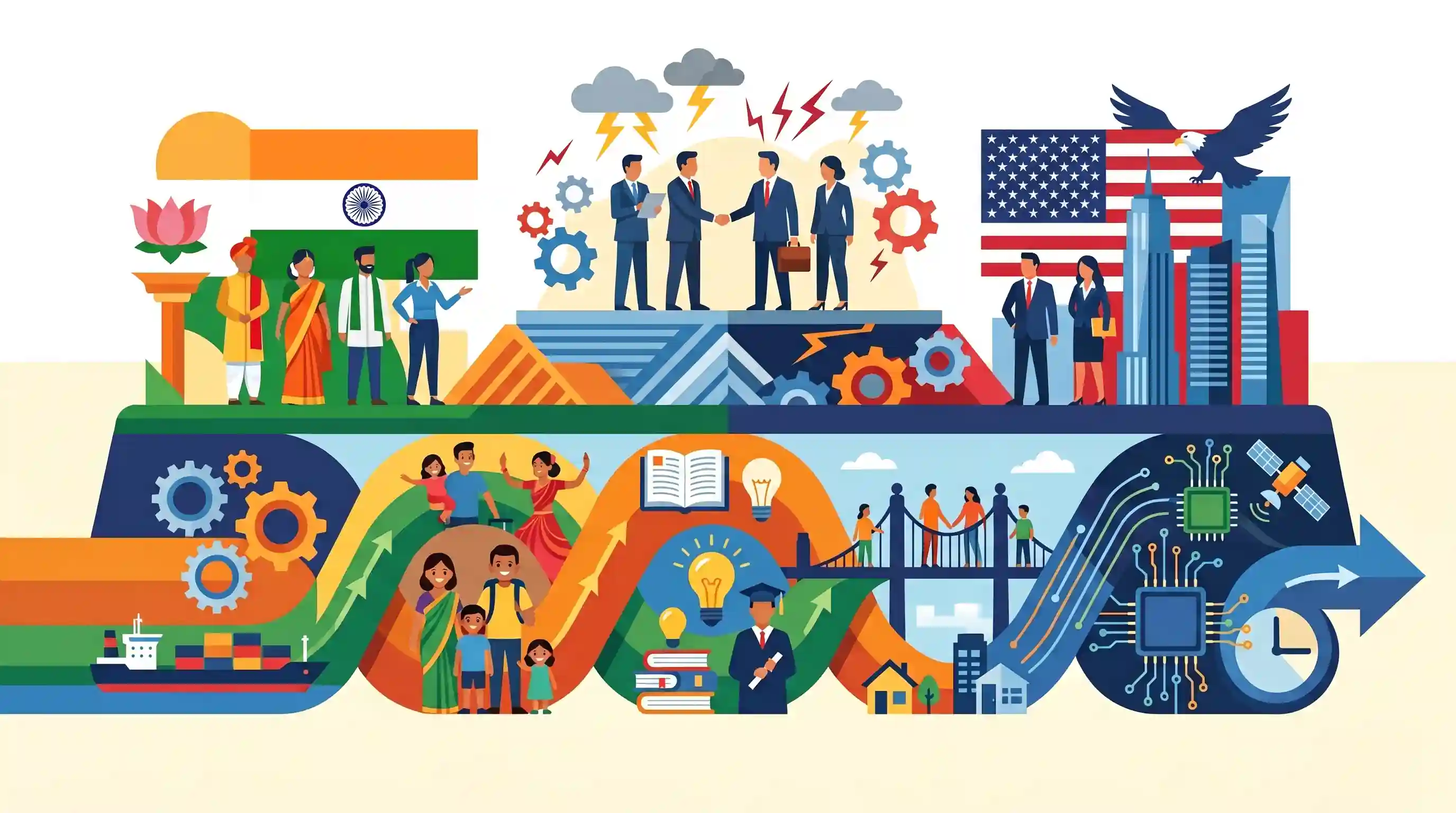
The article explores the resilience of the U.S.-India strategic partnership, attributing its sustained momentum to a 'parallel track' that operates alongside formal diplomacy. This track comprises robust bilateral trade, deep-rooted people-to-people connections, academic exchanges, and the highly influential Indian diaspora. Furthermore, technological collaborations like the Initiative on Critical and Emerging Technology (iCET) play a vital role in deepening economic and defense ties. Together, these elements create a strong foundation that cushions the overarching relationship against episodic diplomatic frictions and geopolitical divergence, ensuring long-term institutional continuity.
Key Points
- The structural resilience of U.S.-India relations depends heavily on a robust 'parallel track' involving non-state actors, economic interdependence, and people-to-people ties.
- Private sector engagement, academic exchanges, and the influential Indian diaspora provide critical momentum that insulates the strategic partnership from periodic diplomatic frictions.
- Collaborations in critical and emerging technologies (such as the iCET framework) are serving as a catalyst for deeper defense interoperability and future economic integration.
- The strength of bilateral trade and investments continues to anchor the relationship despite political turbulence or disagreements over global geopolitical issues.
Important Terms
Initiative on Critical and Emerging Technology (iCET)

A bilateral framework (launched 2023) led by the National Security Councils of India and the U.S. to expand cooperation in AI, quantum computing, semiconductors, and space.
UPSC context
GS Paper II: International Relations. Tests understanding of technology's role as a strategic tool in bilateral diplomacy.
Track 1.5 Diplomacy
A diplomatic channel where official government representatives and non-governmental experts (academics, think tanks) engage in informal dialogue to resolve conflicts or explore new policy ideas.
UPSC context
GS Paper II: International Relations. Relevant for understanding non-formal mechanisms that sustain bilateral ties during official diplomatic friction.
Indian Diaspora
The global community of persons of Indian origin; in the U.S., it comprises ~4.8 million influential individuals contributing via remittances, political lobbying, and technology leadership.
UPSC context
GS Paper II: Indian Diaspora. Tests knowledge of the diaspora's role in influencing the policies of developed nations toward India.
INDUS-X (India-U.S. Defence Acceleration Ecosystem)
An initiative under iCET launched in 2023 to bridge defense startups, industries, and academic institutions of India and the U.S. to accelerate defense innovation.
UPSC context
GS Paper II: International Relations/Defence. Focuses on co-development and co-production in the defense sector.
Comprehensive Global Strategic Partnership
The highest level of diplomatic cooperation between India and the U.S., covering defense, trade, energy, and education, grounded in shared democratic values and Indo-Pacific security.
UPSC context
GS Paper II: Bilateral Groupings. Tests the breadth and depth of India’s most consequential foreign relationship.
Prelims Trap
"iCET is a multilateral framework launched under the Quad to counter China's technology dominance."
iCET is strictly a bilateral initiative between India and the US, led by their respective National Security Councils. It is not a multilateral or Quad-led framework.
Static Concepts Connected
What are the three main tracks of diplomacy in International Relations?
- Track I: Official, formal government-to-government diplomatic engagement conducted by state actors and diplomats.
- Track 1.5: Diplomatic initiatives involving both official state actors and non-official entities like think tanks or subject matter experts.
- Track II: Unofficial, informal engagements between private citizens, academics, NGOs, and businesses that build foundational bilateral trust.
How does India legally classify its overseas diaspora for governance and rights?
- Non-Resident Indians (NRIs): Indian citizens residing abroad for employment or education. They hold Indian passports and retain their voting rights.
- Overseas Citizens (OCIs): Foreign citizens of Indian origin. They enjoy lifetime visa-free travel to India but lack voting rights and cannot buy agricultural land.
Cross-Topic Patterns
Diaspora economics shaping foreign policy
The Indian diaspora bridges IR and Economy. Record-breaking remittances shield India's Current Account Deficit, while political lobbying (like the US-India Caucus) directly shapes favorable bilateral foreign policy outcomes.
Tech-diplomacy as the new defense pact
Initiatives like iCET align with India's domestic Semiconductor Mission and PLI schemes, marking a structural shift from traditional buyer-seller defense procurement to joint technology co-production.

Mains 2026 will likely test 'tech-diplomacy'—linking iCET and semiconductor supply chains as the new anchor of US-India defense ties.
Linked PYQs · 4
Linked PYQs · 4
- 2020MainsGS2
Indian diaspora has a decisive role to play in the politics and economy of America and European Countries'. Comment with examples.
- 2023MainsGS2
Indian diaspora has scaled new heights in the West. Describe its economic and political benefits for India.
- 2020MainsGS2
What is the significance of Indo-US defence deals over Indo-Russian defence deals? Discuss with reference to stability in the Indo-Pacific region.
- 2023MainsGS2
‘The expansion and strengthening of NATO and a stronger US-Europe strategic partnership works well for India.’ What is your opinion about this statement ? Give reasons and examples to support your answer.
