India-China Trade Dynamics and Import Dependence Paradox
Source:The Hindu ↗
Why It Matters
It highlights the structural vulnerabilities in India's external trade and manufacturing sectors, illustrating the friction between the policy goal of self-reliance (Atmanirbhar Bharat) and the reality of deep supply-chain integration with China.
Summary
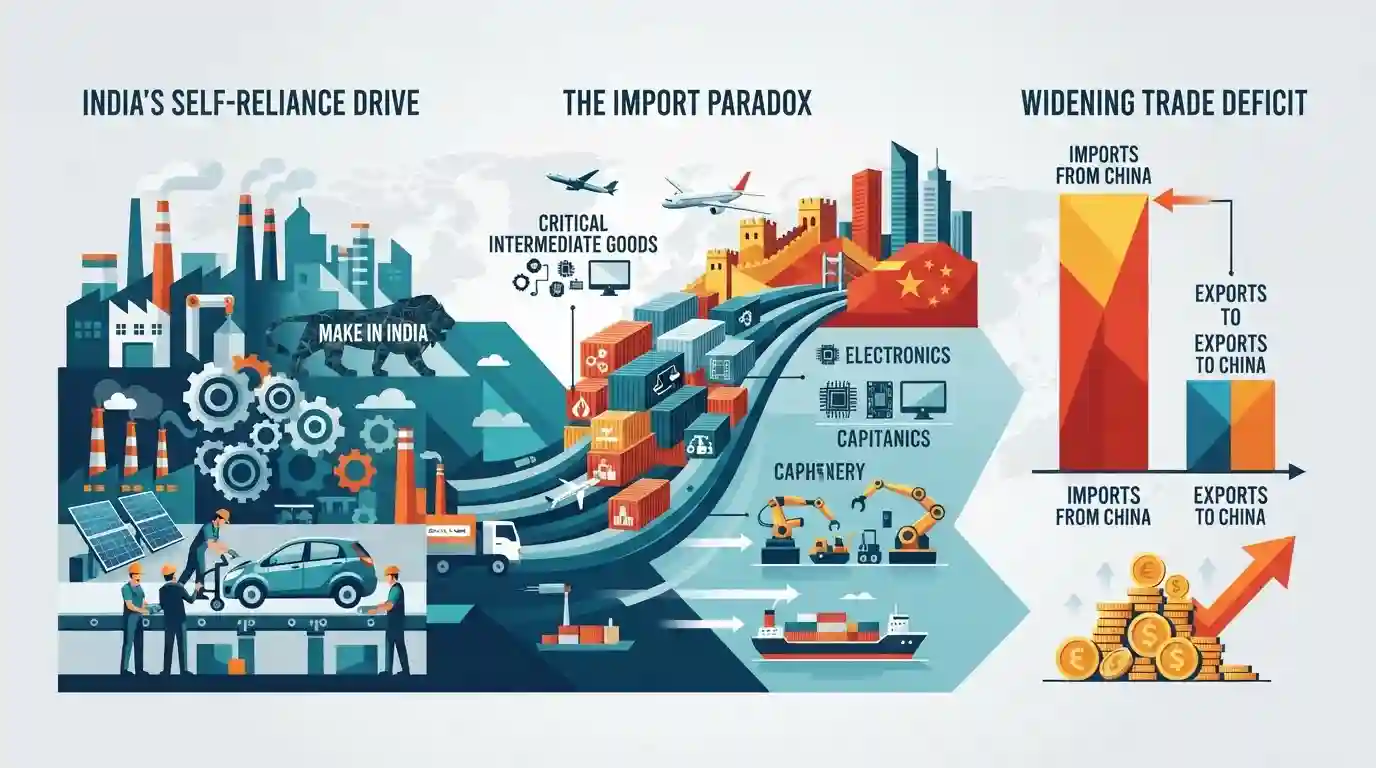
The article analyzes the paradox of India-China trade dynamics, highlighting how India's push for self-reliance and domestic manufacturing has paradoxically deepened its import dependence on China for critical intermediate goods, electronics, and capital machinery, resulting in a widening trade deficit.
Key Points
- India's trade deficit with China has widened significantly despite policy measures and rhetoric aimed at reducing economic dependence.
- India remains heavily reliant on Chinese imports for critical sectors, including electronics, active pharmaceutical ingredients (APIs), and machinery, which form the bedrock of domestic manufacturing.
- The push for self-reliance (Atmanirbhar Bharat) and domestic manufacturing initiatives like PLI schemes paradoxically require intermediate goods and capital machinery sourced from China.
- Bilateral trade dynamics reflect a complex structural asymmetry where decoupling is difficult due to deeply embedded global supply chains.
Important Terms
Production-Linked Incentive (PLI) scheme

A flagship government scheme providing financial incentives to companies on incremental sales from domestic manufacturing, aimed at boosting key sectors, attracting investment, and reducing import dependency.
UPSC context
GS Paper III (Economy - Growth & Manufacturing). Tests understanding of industrial policy, import substitution, and export promotion.
Atmanirbhar Bharat
India’s strategic vision and policy framework launched to achieve economic self-reliance by strengthening domestic manufacturing, promoting local supply chains, and reducing foreign dependencies.
UPSC context
GS Paper III (Economy - Industrial Policy). Important for evaluating India's strategic push towards self-sufficiency versus global trade integration.
Prelims Trap
policies aimed at self-reliance and domestic manufacturing automatically lead to a reduction in bilateral trade deficits and import dependence on adversary nations
Aspirants often assume that successful domestic manufacturing schemes (like PLI) automatically reduce import dependence, missing the structural reality that intermediate goods and machinery must often be imported first.
Static Concepts Connected
What are the components of India's Current Account Deficit and how does merchandise trade deficit impact it?
- Merchandise Balance: Net Exports, measures the difference between total exports and imports of goods and services; merchandise trade deficit is typically its largest drag.
- Invisibles Balance: Net Invisible Earnings, comprise services (IT, business services), private transfers (remittances), and investment income, which partially offset the goods deficit.
- Macroeconomic Impact: Structural Deficit, persistent high import dependence on capital goods and electronics expands the trade gap, pressuring forex reserves and the Rupee exchange rate.
Cross-Topic Patterns
Manufacturing PLI Schemes and Current Account Deficit
Import dependence on intermediate goods for domestic manufacturing undermines export-led growth models, linking bilateral trade deficits directly to foreign exchange reserves and current account deficit management.
Critical Mineral Dependencies and National Security Strategy
Over-reliance on a single geopolitical rival for critical APIs and electronics components creates systemic supply vulnerabilities that intersect with national security and defense preparedness.

India-China trade asymmetry & PLI paradox will likely feature as a statement-based question in Prelims or Mains GS-3.
Linked PYQs · 2
Linked PYQs · 2
- 2024MainsGS2
‘The West is fostering India as an alternative to reduce dependence on China's supply chain and as a strategic ally to counter China's political and economic dominance.’ Explain this statement with examples.
- 2025MainsGS3
Discuss the rationale of the Production Linked Incentive (PLI) scheme. What are its achievements? In what way can the functioning and outcomes of the scheme be improved?
