The Other G2 Dynamics and Strategic Lessons for India
Source:Indian Express ↗
ఇది ఎందుకు ముఖ్యం
It evaluates India's strategic positioning, multialignment policy, and diplomatic maneuvers in response to major power dynamics between the US and China.
సారాంశం
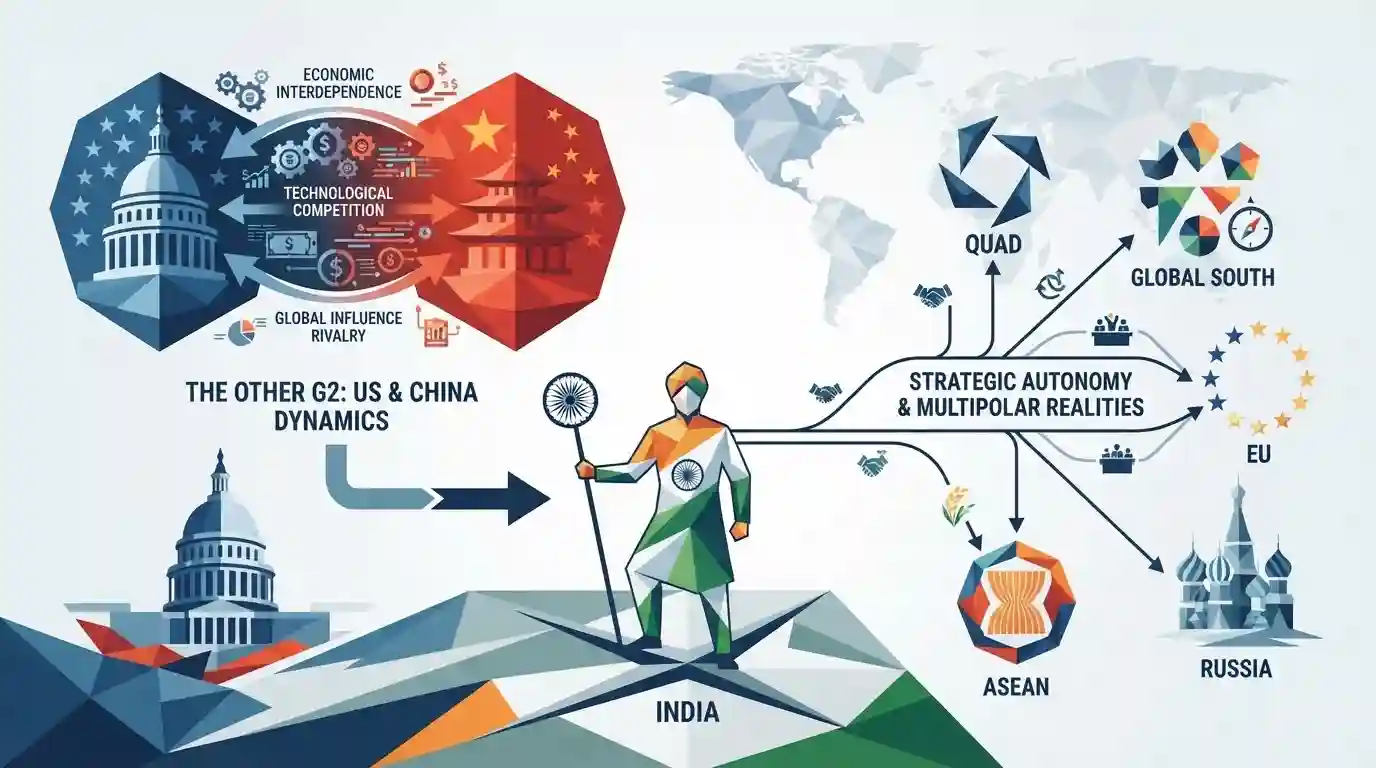
The article analyses the dynamics of 'The Other G2' involving the US and China, drawing strategic lessons for India's foreign policy amidst global polarization and multipolar realities.
ముఖ్య అంశాలు
- The article discusses the concept of 'The Other G2' (US and China) and examines its implications and three key lessons for India's foreign policy and strategic calculus.
- India must navigate great power competition while maintaining strategic autonomy and economic resilience.
- Multialignment remains a critical pillar for India to balance interests across global divides.
ముఖ్యమైన పదాలు
G2

An informal, hypothetical or emergent concept referring to the dominant bilateral relationship and potential condominium between the United States and China in shaping global economic and security governance.
UPSC context
GS Paper 2 - International Relations: Important International Institutions, groupings and agreements, and India's bilateral relations with superpowers.
ప్రిలిమ్స్ ఉచ్చు
India continues to follow its traditional policy of non-alignment, maintaining absolute equidistance from the US and China.
Aspirants often confuse India's contemporary 'multi-alignment' with the Cold War era 'non-alignment', assuming India maintains equidistance from all powers. Multi-alignment is issue-based engagement, not passive neutrality.
అనుసంధానమైన స్థిర భావనలు
What are the core distinctions between India's traditional Non-Alignment and contemporary Multi-Alignment?
- Historical NAM:: Cold War NAM prioritized passive neutrality and moral distancing from military blocs led by superpowers.
- Modern Strategy:: Multi-alignment involves active, simultaneous engagement with multiple competing power centers to maximize national interest.
- Operational Shift:: Issue-based coalitions replace rigid ideological alliances, allowing cooperation with rivals on shared economic or climate platforms.
అంతర-అంశ నమూనాలు
Quad + SCO: Bridging Divergent Geopolitical Groupings
India's active membership in both the Quad and the SCO illustrates how multi-alignment bridges divergent security architectures, preventing diplomatic isolation in a bipolar US-China framing.
Strategic Autonomy + Domestic Manufacturing Resilience
Economic de-risking and supply chain diversification connect foreign policy autonomy directly to domestic manufacturing initiatives like PLI schemes.

Expect a statement-based question contrasting traditional Non-Alignment (NAM) with contemporary Multi-alignment in India's grand strategy.
అనుసంధాన PYQలు · 2
అనుసంధాన PYQలు · 2
- 2024MainsGS2
‘The West is fostering India as an alternative to reduce dependence on China's supply chain and as a strategic ally to counter China's political and economic dominance.’ Explain this statement with examples.
- 2025MainsGS2
"Energy security constitutes the dominant kingpin of India's foreign policy, and is linked with India's overarching influence in Middle Eastern countries.” How would you integrate energy security with India's foreign policy trajectories in the coming years?
