OPEC plus production policy and geopolitical oil price dynamics
Source:The Hindu ↗
Why It Matters
Global oil price dynamics are critical to India's macroeconomic stability, heavily influencing the current account deficit, inflation, and the livelihood of the Indian diaspora in the Gulf. Understanding the geopolitical maneuvers of Middle Eastern powers provides essential context for India's energy diplomacy and foreign policy.
Summary
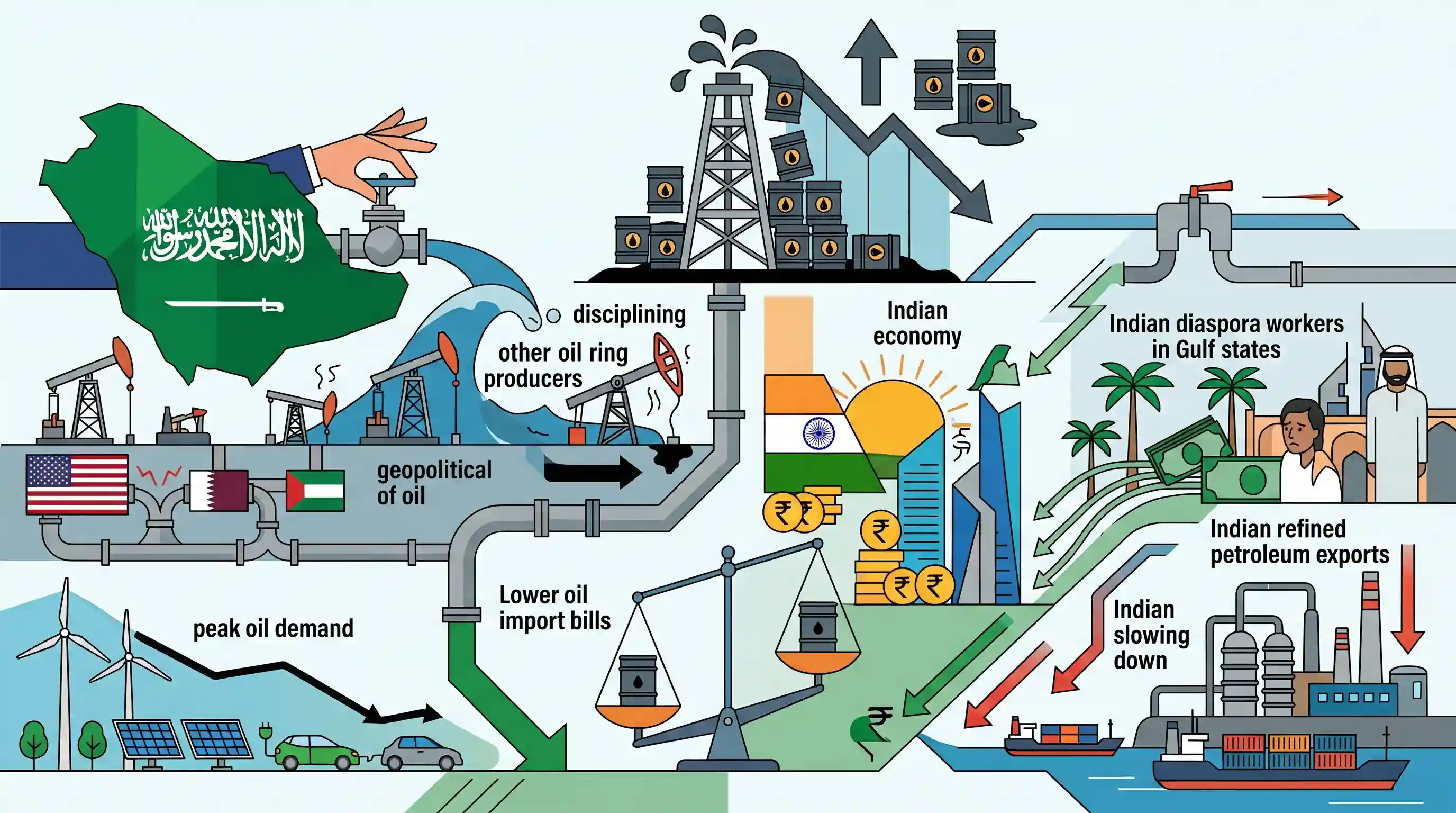
The article examines the recent decline in global oil prices triggered by OPEC+'s decision to increase production. It explores Saudi Arabia's strategic pivot toward an 'oil price war' aimed at disciplining overproducing cartel members, combatting the rise of non-OPEC producers, and extracting geopolitical concessions from the US. The piece highlights the 'peak oil demand' phenomenon driven by renewable energy transitions. For India, the analysis presents a dual narrative: while falling oil prices significantly reduce the import bill, they also threaten vital economic lifelines like diaspora remittances from the Gulf and refined petroleum exports.
Key Points
- OPEC+ announced an increase in collective output by 4,11,000 barrels per day from June, reversing previous production cuts and triggering a sharp decline in Brent crude prices.
- Saudi Arabia is employing a strategic 'oil price war' to discipline non-compliant OPEC+ members, regain market share lost to non-OPEC producers like US shale and Brazil, and preempt a plateauing global oil demand driven by EV adoption.
- Geopolitically, Riyadh aims to frontload oil revenues and use lower prices as a bargaining chip with the incoming Trump administration to secure US defense guarantees, a nuclear agreement, and weapons deals.
- For India, a $1/barrel decline in crude prices yields an annual foreign exchange saving of $1.5 billion, easing its massive import bill.
- Conversely, sustained low oil prices pose risks to India by reducing petroleum product export values, lowering pro rata tax revenues, and threatening the over $50 billion in remittances from the 9 million Indian diaspora working in the Gulf.
Important Terms
OPEC+

An alliance of 12 OPEC members and 10 non-OPEC oil-producing nations (e.g., Russia) formed in 2016. It coordinates production quotas to manage global oil prices and stabilize the market.
UPSC context
GS-II International Relations; GS-III Economy. Tests understanding of global cartels and their impact on India’s energy import costs.
International Energy Agency (IEA)
A Paris-based autonomous organization (est. 1974) advising on energy security and clean energy transitions. It mandates member nations maintain 90-day oil reserves; India is currently an Associate Member.
UPSC context
GS-II International Institutions; GS-III Energy. Tests knowledge of global energy governance and India’s strategic role as a major consumer.
S&P Global
A financial intelligence firm providing credit ratings and commodity benchmarks. Its 'Platts' assessment serves as a primary global standard for pricing crude oil and refined petroleum products.
UPSC context
GS-III Economy. Relevant for understanding how market data and private benchmarks influence global trade and India’s fuel pricing.
Strategic Petroleum Reserves (SPR)
Massive emergency crude oil stockpiles stored in underground rock caverns to protect against supply shocks. India’s Phase-I reserves (Visakhapatnam, Mangaluru, Padur) provide roughly 9.5 days of fuel cover.
UPSC context
GS-III Infrastructure/Energy Security. Tests preparedness against geopolitical supply disruptions and the institutional framework of ISPRL.
Peak Oil Demand
The projected point when global petroleum demand begins a terminal decline due to the rise of renewables and electric vehicles, signaling a structural shift in global energy markets.
UPSC context
GS-III Environment/Economy. Tests understanding of the global energy transition and its long-term impact on India’s refining sector.
Current Account Deficit (CAD)
Occurs when the value of a nation's imports exceeds its exports. For India, high crude oil prices are a primary driver of a widening CAD, impacting macroeconomic stability.
UPSC context
GS-III Economy. Tests macroeconomic concepts related to the Balance of Payments and India’s vulnerability to commodity price volatility.
Remittances
Funds sent by Indian workers abroad to their families. These inflows are a vital source of foreign exchange, significantly influenced by the economic health of oil-exporting Gulf nations.
UPSC context
GS-III Indian Economy. Tests understanding of external sector vulnerabilities and the socio-economic links between the Indian diaspora and Gulf stability.
Prelims Trap
Lower global crude oil prices unambiguously decrease India's Current Account Deficit and boost export earnings.
While a lower import bill saves forex, India's largest merchandise export is refined petroleum (which loses value). Additionally, Gulf remittances may drop, offsetting some CAD gains.
Static Concepts Connected
How do crude oil and remittances shape India's Balance of Payments?
- Merchandise Trade: Crude oil is India's largest import, while refined petroleum products are among its largest exports. Crude prices dictate the merchandise trade deficit.
- Invisibles Surplus: Private transfers (remittances), especially from the 9 million Indians in the GCC, provide a massive surplus in the 'invisibles' account, cushioning the trade deficit.
- Pro-cyclical Risks: A drop in crude prices benefits the import bill but concurrently risks reducing refined export realization and Gulf remittance flows.
What distinguishes the OPEC and OPEC+ groupings?
- Core OPEC: Founded in 1960, OPEC currently has 12 member countries led heavily by Saudi Arabia. It sets production quotas to influence global prices.
- The 'Plus' Allies: Formed in 2016, OPEC+ includes the core members plus 10 allied non-OPEC oil-producing nations, most notably Russia, Kazakhstan, and Mexico.
- Strategic Goal: OPEC+ was created to regain market control lost to the rapid rise of non-OPEC producers like US shale and Brazil.
Cross-Topic Patterns
Peak Oil Demand & Stranded Assets
The transition to EVs threatens the long-term viability of Gulf economies. Middle Eastern states are accelerating production to 'frontload' revenues before peak oil demand turns reserves into stranded assets.
Diaspora Remittances as a Macroeconomic Buffer
Remittances from the Gulf act as a crucial invisible surplus balancing India's merchandise trade deficit. Shocks to GCC economies from oil price crashes directly transmit to India's BOP vulnerability.

Expect a 2026 prelims question linking crude price volatility directly to India's refined petroleum export values and GCC remittance flows.
Linked PYQs · 4
Linked PYQs · 4
- 2025MainsGS2
"Energy security constitutes the dominant kingpin of India's foreign policy, and is linked with India's overarching influence in Middle Eastern countries.” How would you integrate energy security with India's foreign policy trajectories in the coming years?
- 2017MainsGS2
The question of India's Energy Security constitutes the most important part of India's economic progress. Analyze India's energy policy cooperation with West Asian countries.
- 2020PrelimsGS1
The term 'West Texas Intermediate', sometimes found in news, refers to a grade of
- 2022MainsGS3
Do you think India will meet 50 percent of its energy needs from renewable energy by 2030 ? Justify your answer. How will the shift of subsidies from fossil fuels to renewables help achieve the above objective ? Explain.
