China Pakistan Strategic Collusion Poses Two Front Security Challenge
Source:The Hindu ↗
Why It Matters
The prospect of a coordinated military and strategic threat from China and Pakistan is the foundational premise for modern Indian defense planning. Analyzing the dimensions of this collusion is critical for Mains answers on border security, defense procurement, and geopolitical strategies.
Summary
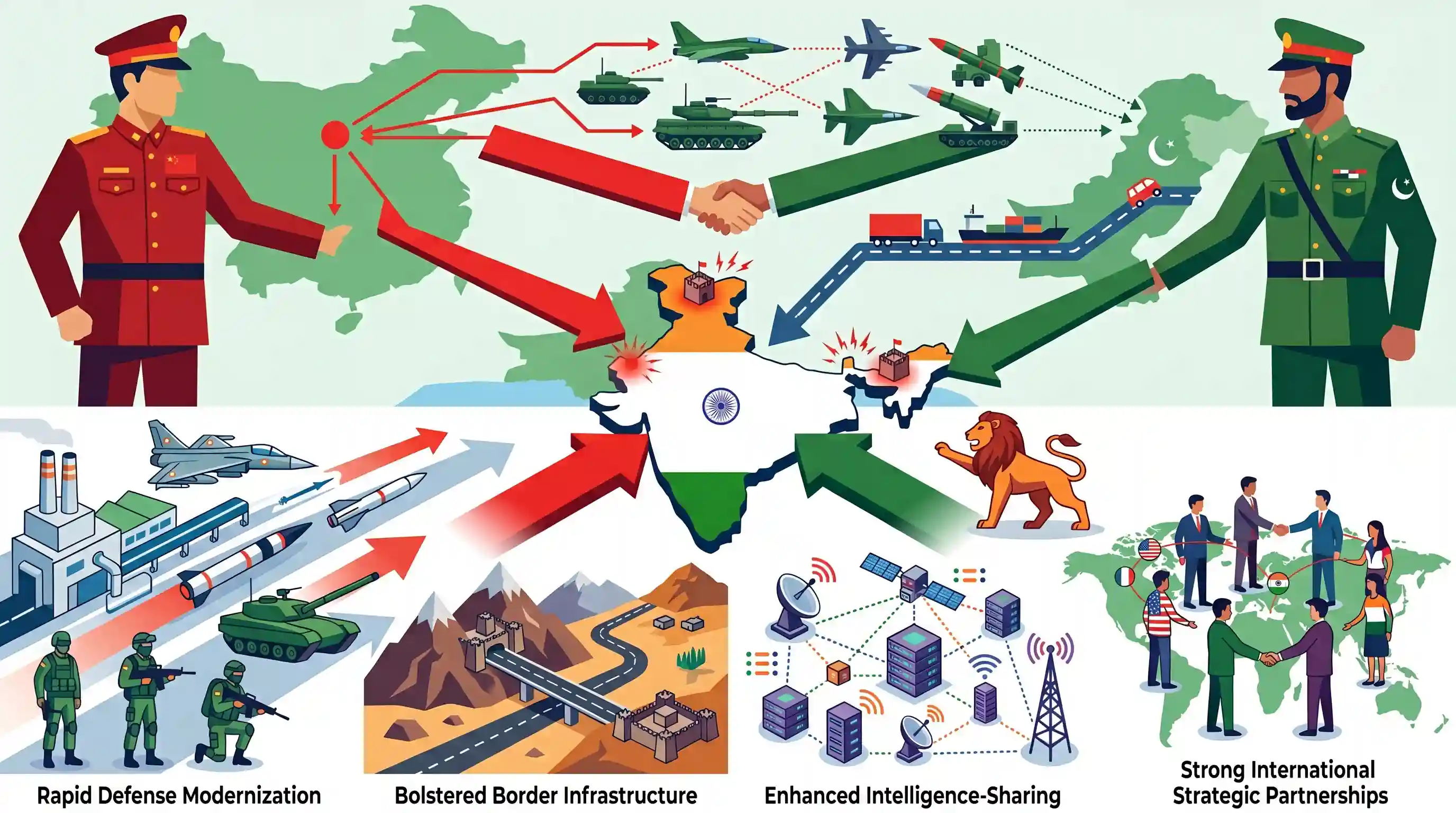
The article analyzes the intensifying strategic and military collusion between China and Pakistan, presenting a formidable 'two-front' security challenge for India. It highlights how growing interoperability, equipment standardization, and joint military exercises have elevated their alliance beyond mere diplomatic support to active, tactical military cooperation. Driven further by strategic projects like the China-Pakistan Economic Corridor (CPEC), this axis significantly amplifies pressure on India's northern and western borders (LAC and LoC). To effectively counter this dual threat, India must prioritize rapid defense modernization, bolster border infrastructure, enhance intelligence-sharing capabilities, and build strong international strategic partnerships to ensure robust deterrence.
Key Points
- The strategic partnership between China and Pakistan has evolved into deep military collusion, heightening the risk of a coordinated two-front conflict for India.
- The alliance is now characterized by high levels of military interoperability, joint exercises, and extensive defense equipment standardization.
- Strategic infrastructure initiatives like the China-Pakistan Economic Corridor (CPEC) serve dual civilian-military purposes, improving troop mobility and logistics near Indian borders.
- To counter this threat, India's strategy must encompass accelerated indigenous defense production, comprehensive border infrastructure development, and proactive strategic alignments.
Important Terms
China-Pakistan Economic Corridor (CPEC)

A 3,000-km flagship project of China's Belt and Road Initiative (BRI) connecting Xinjiang to Pakistan's Gwadar Port through transport and energy infrastructure, notably passing through Indian-claimed Gilgit-Baltistan.
UPSC context
GS Paper II (International Relations); tests knowledge of India's neighborhood, sovereignty concerns, and regional strategic shifts.
Two-Front War
A strategic challenge where India must simultaneously defend its northern (China) and western (Pakistan) borders. Evolving dynamics now suggest a 'one-front reinforced war' where China provides active technical support to Pakistan.
UPSC context
GS Paper III (Internal Security); tests analysis of national security doctrines and defense preparedness challenges.
Border Infrastructure and Management (BIM) Scheme
A Central Sector Umbrella Scheme (2021–2026) under the Ministry of Home Affairs that funds physical and technological border security, including fencing, floodlights, roads, and smart surveillance systems.
UPSC context
GS Paper III (Border Management); tests understanding of physical and technological strategies for border security.
Border Area Development Programme (BADP)
A Centrally Sponsored Scheme aimed at improving social and physical infrastructure in remote border villages to enhance security. It is currently being superseded by the Vibrant Villages Programme.
UPSC context
GS Paper III (Internal Security); relevant for socio-economic development as a tool for border stability.
Military Interoperability
The ability of diverse military forces to conduct joint operations through shared equipment, unified communication systems, and standardized tactics, as seen in intensifying China-Pakistan tactical cooperation.
UPSC context
GS Paper III (Defense); tests understanding of modern warfare, military alliances, and technology-driven combat integration.
Prelims Trap
CPEC respects India's sovereignty and territorial integrity by bypassing disputed regions.
CPEC passes directly through Gilgit-Baltistan in Pakistan-Occupied Kashmir (PoK). India asserts this is its sovereign territory, forming the core basis for India's boycott of China's Belt and Road Initiative (BRI).
Static Concepts Connected
What are India's primary border infrastructure and management initiatives?
- Vibrant Villages Programme: Develops border villages in northern states to prevent out-migration, boost local economies, and structurally counter China's 'Xiaokang' (prosperous) model border villages.
- BADP: The Border Area Development Programme under the MHA funds socio-economic infrastructure to meet the special developmental needs of remote communities near international borders.
- Strategic BRO Tunnels: Constructs all-weather access nodes (e.g., Sela, Atal, and Shinku La tunnels) to ensure swift logistical support and troop mobility across the LAC.
What characterizes the 'Two-Front War' challenge for India?
- Collusive Military Action: Simultaneous hostilities from Pakistan and China, shifting from passive diplomatic backing to active, tactical joint military operations and real-time intelligence sharing.
- Equipment Standardization: Pakistan's deep reliance on Chinese defense platforms (drones, naval vessels, jets) creates seamless interoperability, acting as a force multiplier against India's flanks.
- Theatre Commands: Accelerates the necessity for India's military theaterisation to optimize resource allocation, as attempting to hold dual fronts severely strains supply chains and budgets.
Cross-Topic Patterns
CPEC's dual-use maritime extension
Gwadar port's integration into CPEC gives China a naval foothold in the Arabian Sea, physically linking the land border threat in PoK to maritime chokepoints in the Indian Ocean.
Atmanirbharta vs. Imported Interoperability
While the Sino-Pak axis achieves rapid military interoperability via heavy reliance on Chinese imports, India's strategy balances immediate border deterrence with long-term strategic autonomy through indigenous defense production.

A 2026 GS-3 Mains question linking CPEC's dual-use infrastructure, two-front war doctrine, and India's Vibrant Villages is highly likely.
Linked PYQs · 3
Linked PYQs · 3
- 2024MainsGS3
India has a long and troubled border with China and Pakistan fraught with contentious issues. Examine the conflicting issues and security challenges along the border. Also give out the development being undertaken in these areas under the Border Area Development Programme (BADP) and Border Infrastructure and Management (BIM) Scheme.
- 2016MainsGS3
Border management is a complex task due to difficult terrain and hostile relations with some countries. Elucidate the challenges and strategies for effective border management.
- 2024MainsGS2
‘The West is fostering India as an alternative to reduce dependence on China's supply chain and as a strategic ally to counter China's political and economic dominance.’ Explain this statement with examples.
