Climate resilient urban planning and cardiovascular health adaptation
Source:The Hindu ↗
Why It Matters
Urbanization and climate change are consistently tested across GS1 (Geography/Society), GS2 (Public Health/Governance), and GS3 (Disaster Management/Environment). Understanding the intersection of urban design, climate resilience, and health outcomes is essential for holistic answers.
Summary
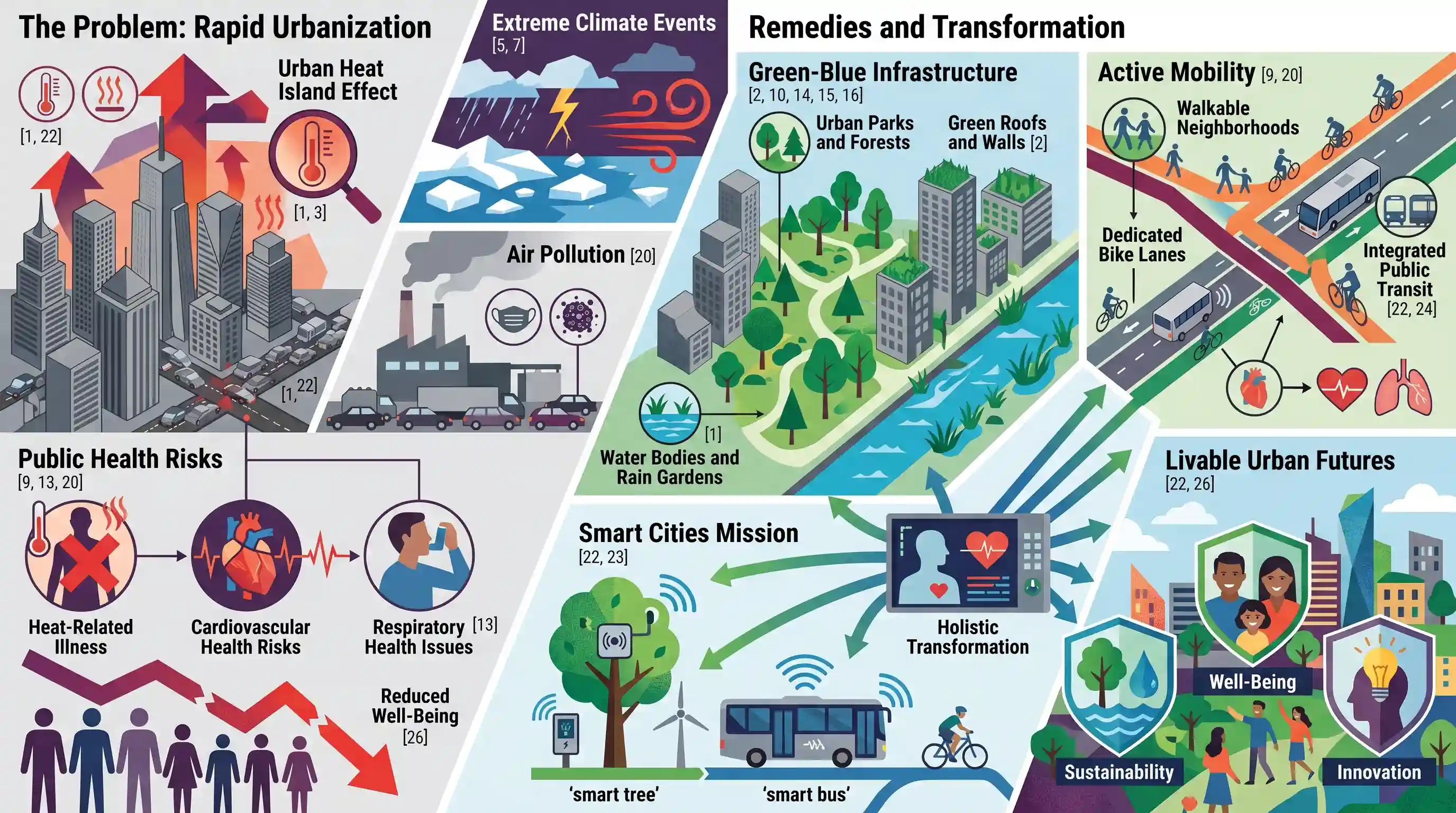
The article emphasizes the critical need for 'heart-resilient' and climate-resilient urban planning in the face of rapid urbanization. It argues that modern cities must evolve to address environmental stressors like the Urban Heat Island (UHI) effect, extreme climate events, and rising air pollution, which collectively pose severe risks to public and cardiovascular health. By advocating for the integration of green-blue infrastructure, the promotion of active mobility, and the prioritization of human well-being over purely economic expansion, the author calls for a holistic transformation of initiatives like the Smart Cities Mission to ensure sustainable, healthy, and livable urban futures.
Key Points
- The compounding crises of urban heat islands, rising pollution, and sedentary lifestyles necessitate a paradigm shift in urban planning towards public health and climate resilience.
- Integrating green and blue infrastructure (parks, wetlands, and water bodies) is crucial to mitigate extreme heat, control urban flooding, and provide spaces for active mobility.
- Urban design must prioritize 'active mobility' (walking and cycling) over car-centric models, directly reducing air pollution and mitigating cardiovascular/NCD risks.
- Existing frameworks like the Smart Cities Mission must evolve to focus on human well-being, spatial equity, and disaster risk reduction, rather than solely on economic or technological advancement.
Important Terms
Smart Cities Mission (SCM)

A centrally sponsored scheme launched in 2015 to develop 100 cities as models of sustainable urban development using technology and 'smart' solutions to improve core infrastructure and quality of life.
UPSC context
GS Paper 2 (Government Policies) and GS Paper 3 (Urbanization, Infrastructure). Tests understanding of urban governance and technological integration.
AMRUT (Atal Mission for Rejuvenation and Urban Transformation)
A flagship urban renewal mission focused on providing basic civic amenities—water supply, sewerage, and green spaces—to 500 cities. AMRUT 2.0 (2021) aims for universal water coverage and circular economy principles.
UPSC context
GS Paper 2 (Government Schemes) and GS Paper 3 (Infrastructure). Crucial for questions on sustainable urban habitats and water security.
Urban Heat Island (UHI) Effect
A localized warming phenomenon where urban areas experience significantly higher temperatures than surrounding rural areas due to heat-trapping surfaces like concrete, lack of vegetation, and anthropogenic heat emissions.
UPSC context
GS Paper 3 (Environment/Geography). Tests knowledge of micro-climates, urbanization's environmental impact, and climate-resilient urban design strategies.
Sendai Framework for Disaster Risk Reduction
A 15-year voluntary international agreement (2015-2030) that sets seven global targets to reduce disaster risk and losses to lives, livelihoods, health, and physical assets.
UPSC context
GS Paper 3 (Disaster Management). Core framework for evaluating India's disaster preparedness and international commitments to resilience.
National Disaster Management Authority (NDMA)
The apex statutory body for disaster management in India, chaired by the Prime Minister, responsible for laying down policies, plans, and guidelines for timely and effective disaster response.
UPSC context
GS Paper 3 (Disaster Management). Key for understanding the institutional framework and legal mechanisms (DM Act 2005) for crisis response.
National Action Plan on Climate Change (NAPCC)
A 2008 national strategy comprising eight missions (e.g., Solar, Sustainable Habitat, Water) designed to address climate change through mitigation and adaptation while promoting sustainable economic growth.
UPSC context
GS Paper 3 (Environment/Climate Change). Essential for questions on India's climate policy architecture and domestic mission-mode interventions.
Ministry of Housing and Urban Affairs (MoHUA)
The nodal ministry of the Government of India for formulating policies and implementing programs related to urban housing, infrastructure, transport, and sustainable urban development.
UPSC context
GS Paper 2 (Governance). Relevant for understanding the executive oversight of urban transformation and housing-for-all initiatives.
World Health Organization (WHO)
The United Nations' specialized agency for public health, which provides global leadership and standards for health-resilient urban planning, air quality, and emergency preparedness.
UPSC context
GS Paper 2 (International Institutions). Tests knowledge of global health governance and the intersection of environmental determinants with public health.
Prelims Trap
"Blue-green infrastructure" refers to the integration of marine fisheries (blue) with coastal agriculture (green) for food security.
Blue-green infrastructure actually refers to urban planning networks combining water bodies (blue) and green spaces (parks) to manage flooding and urban heat.
Static Concepts Connected
What are the primary drivers of the Urban Heat Island (UHI) effect?
- Albedo reduction: Concrete and asphalt absorb and retain significantly more solar radiation compared to natural vegetative cover.
- Evapotranspiration loss: The removal of trees and water bodies eliminates the natural cooling effect provided by plant moisture release and evaporation.
- Anthropogenic heat: Waste heat from vehicles, HVAC systems, and industrial activities gets trapped within densely packed urban canyons.
What distinguishes the Smart Cities Mission from AMRUT in urban planning?
- Target scope: Smart Cities focuses on intensive, tech-driven area-based development in 100 selected cities, while AMRUT operates on a broader scale across 500 cities.
- Core objectives: AMRUT prioritizes universal coverage of basic amenities like water supply and sewerage, whereas Smart Cities integrates IT, smart mobility, and localized sustainability models.
Cross-Topic Patterns
Urban Planning as Public Health
Linking UHI to cardiovascular NCDs shifts urbanization from a purely spatial infrastructure issue to a planetary health concern, bridging GS-1 urbanization and GS-2 health governance.
Sendai Framework & Urban Flooding
Integrating natural wetlands (blue infrastructure) into city planning reflects the Sendai Framework's push for ex-ante disaster risk reduction to manage recurrent urban pluvial flooding.

Expect a 2026 Mains question linking GS-1 Urbanization with GS-3 Climate Change, explicitly testing 'blue-green infrastructure' for UHI.
Linked PYQs · 5
Linked PYQs · 5
- 2013MainsGS1
Bring out the causes for the formation of heat islands in the urban habitat of the world.
- 2025MainsGS1
How does smart city in India, address the issues of urban poverty and distributive justice?
- 2024MainsGS3
Flooding in urban areas is an emerging climate-induced disaster. Discuss the causes of this disaster. Mention the features of two such major floods in the last two decades in India. Describe the policies and frameworks in India that aim at tackling such floods.
- 2016MainsGS1
With a brief background of quality of urban life in India, introduce the objectives and strategy of the 'Smart City Programme'.
- 2022MainsGS3
The increase in life expectancy in the country has led to newer health challenges in the community. What are those challenges and what steps need to be taken to meet them?
