Judicial Diversity Vital for Representative Justice and Jurisprudence
Source:The Hindu ↗
Why It Matters
The demographic composition of the higher judiciary directly impacts the nature of justice delivery and institutional legitimacy. It is a vital area for UPSC aspirants as it intersects issues of constitutional appointments, the functioning of the Collegium system, and social justice.
Summary
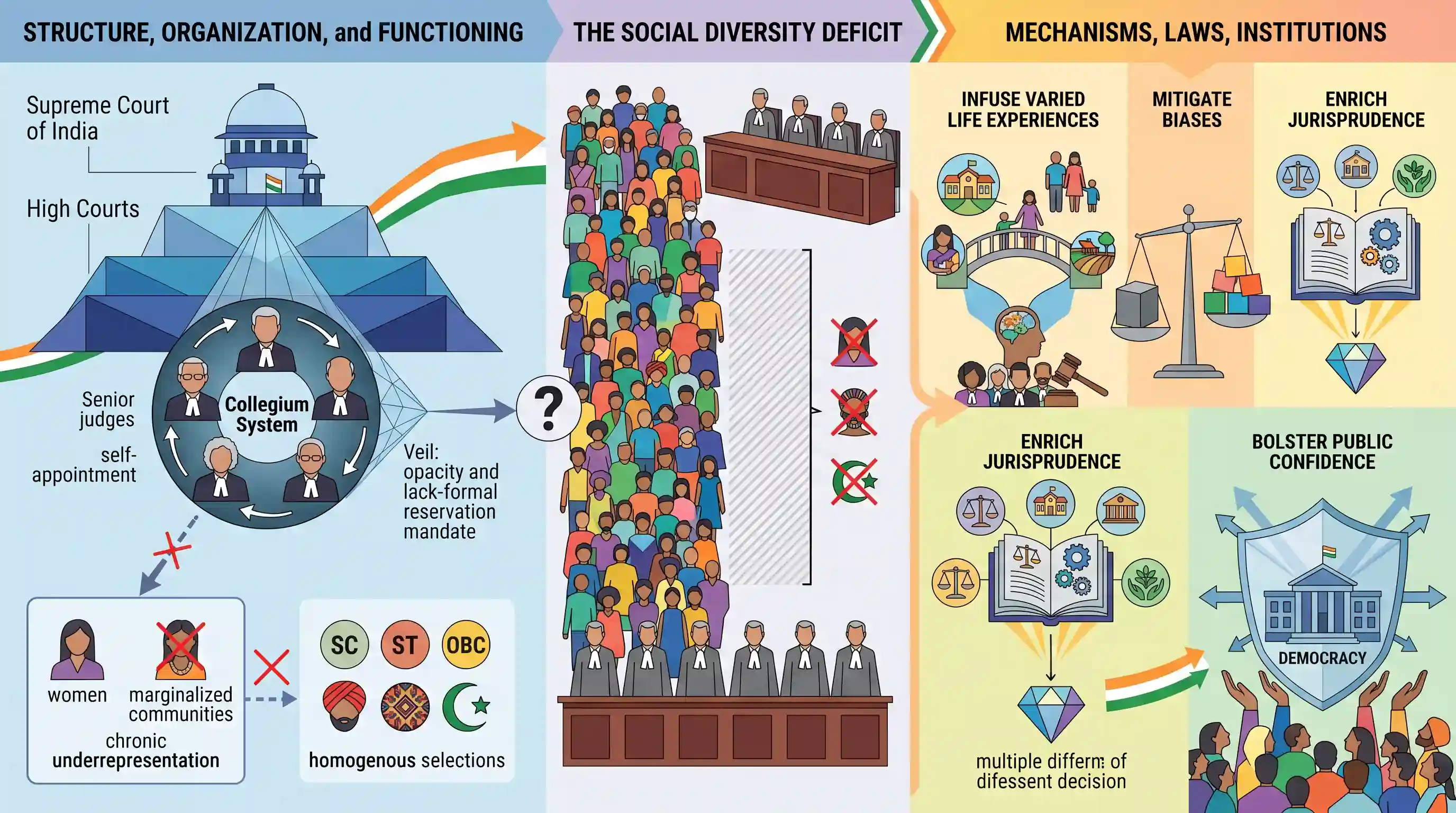
The article underscores the critical need for social diversity in India's higher judiciary, highlighting the chronic underrepresentation of women and marginalized communities such as SCs, STs, OBCs, and religious minorities. With no formal reservation mandate for appointments to the High Courts and the Supreme Court, the responsibility largely rests on the Collegium system, which is often criticized for its opacity and homogenous selections. Promoting diversity is deemed essential not merely for equitable representation, but to infuse the justice system with varied life experiences, mitigate biases, enrich jurisprudence, and bolster public confidence in democratic institutions.
Key Points
- India's higher judiciary suffers from a stark lack of diversity, with significant underrepresentation of women, Scheduled Castes (SCs), Scheduled Tribes (STs), Other Backward Classes (OBCs), and religious minorities.
- Unlike subordinate courts where state-level reservations may apply, there is no formal constitutional or statutory reservation for marginalized groups in the appointment of judges to the Supreme Court and High Courts.
- The Collegium system, responsible for judicial appointments, has been repeatedly criticized for its opacity and for perpetuating a homogenous demographic composition on the bench.
- Advocates for diversity argue that a heterogeneous bench brings a variety of life experiences, which helps mitigate implicit biases, enriches judicial reasoning, and promotes more equitable jurisprudence.
- Greater inclusivity is essential to ensure the judiciary reflects the demographic reality of the country, thereby strengthening public trust and institutional legitimacy.
Important Terms
Supreme Court of India

The apex judicial body in India, established under Article 124. It acts as the final court of appeal, the guardian of the Constitution, and the protector of Fundamental Rights.
UPSC context
GS Paper 2: Indian Judiciary structure, functions, and role in upholding constitutional morality and protecting vulnerable sections.
High Courts
The highest judicial authorities at the state level (Articles 214-231). They possess original, appellate, and writ jurisdiction (Article 226) and oversee the subordinate judiciary within their respective states.
UPSC context
GS Paper 2: State Judiciary, appointment of judges, and judicial supervision over lower courts.
Collegium System
A system evolved through Supreme Court judgments (Three Judges Cases) where a forum of the Chief Justice of India and senior-most judges recommends appointments and transfers in the higher judiciary.
UPSC context
GS Paper 2: Issues with the appointment process, judicial independence vs. executive interference, and lack of transparency.
Judicial Diversity
The representation of various social, gender, and regional groups (SCs, STs, OBCs, minorities, women) within the judiciary to ensure inclusive jurisprudence and maintain public trust in democratic institutions.
UPSC context
GS Paper 2: Social justice, protection of vulnerable sections, and the need for a representative higher judiciary.
Articles 124 and 217
Constitutional provisions governing the appointment of judges to the Supreme Court (124) and High Courts (217) by the President, historically interpreted to mandate consultation/concurrence with the judiciary.
UPSC context
GS Paper 2: Constitutional provisions related to the Union and State Judiciary and the appointment process.
Memorandum of Procedure (MoP)
The administrative document agreed upon by the Government and Judiciary that outlines the detailed procedure for the appointment of judges to the Supreme Court and High Courts.
UPSC context
GS Paper 2: Executive-Judiciary relations and administrative reforms in judicial appointments post-NJAC verdict.
Prelims Trap
The Constitution mandates reservation for SCs, STs, and OBCs in the appointment of judges to the High Courts.
Articles 124 and 217 do not provide any reservation for marginalized sections or women in higher judicial appointments. Reservation applies only to the subordinate judiciary via State rules.
Static Concepts Connected
How does the Constitution govern appointments to the higher judiciary?
- Constitutional mandate: Articles 124(2) and 217 empower the President to appoint judges to the Supreme Court and High Courts respectively.
- Collegium evolution: Established through the Three Judges Cases, prioritizing the Chief Justice of India and a panel of senior-most judges over executive discretion.
- Diversity mandate: The Memorandum of Procedure (MoP) guides appointments, but currently relies entirely on the Collegium's internal discretion to ensure demographic diversity.
How is reservation implemented in India's subordinate judiciary?
- State domain: Appointments to district and subordinate courts are governed by Articles 233 and 234, falling under the jurisdiction of State governments and High Courts.
- Quota implementation: Unlike the higher judiciary, many state governments explicitly mandate reservations for SCs, STs, OBCs, and women in lower judicial service examinations.
Cross-Topic Patterns
Glass ceiling in Constitutional bodies
The steep drop in female judges from lower courts (35%) to higher courts (<15%) highlights structural barriers, a theme overlapping with women's reservation debates in legislative bodies.
Collegium opacity vs NJAC debate
Homogeneous demographics in the higher judiciary strengthen arguments for institutional reform, frequently linking back to the Supreme Court striking down the NJAC to protect judicial independence.

Expect a Prelims statement contrasting statutory state-level reservations in subordinate courts with the lack of quotas in the Supreme Court.
Linked PYQs · 3
Linked PYQs · 3
- 2021MainsGS2
Discuss the desirability of greater representation to women in the higher judiciary to ensure diversity, equity and inclusiveness.
- 2025MainsGS2
Discuss the evolution of collegium system in India. Critically examine the advantages and disadvantages of the system of appointment of the Judges of the Supreme Court of India and that of the USA.
- 2017MainsGS2
Critically examine the Supreme Court's judgement on 'National Judicial Appointments Commission Act, 2014' with reference to appointment of judges of higher judiciary in India.
