Malaria Impact on Human History and Vector Borne Disease Control
Source:The Hindu ↗
Why It Matters
Vector-borne diseases are a recurring theme in UPSC Prelims (S&T) and Mains (GS2 Health, GS3 S&T). Questions frequently target modern vector control strategies (e.g., Wolbachia) and genetic conditions linked to diseases (e.g., sickle cell trait and malaria). The historical and evolutionary context provides strong foundational knowledge for essays and GS1.
Summary
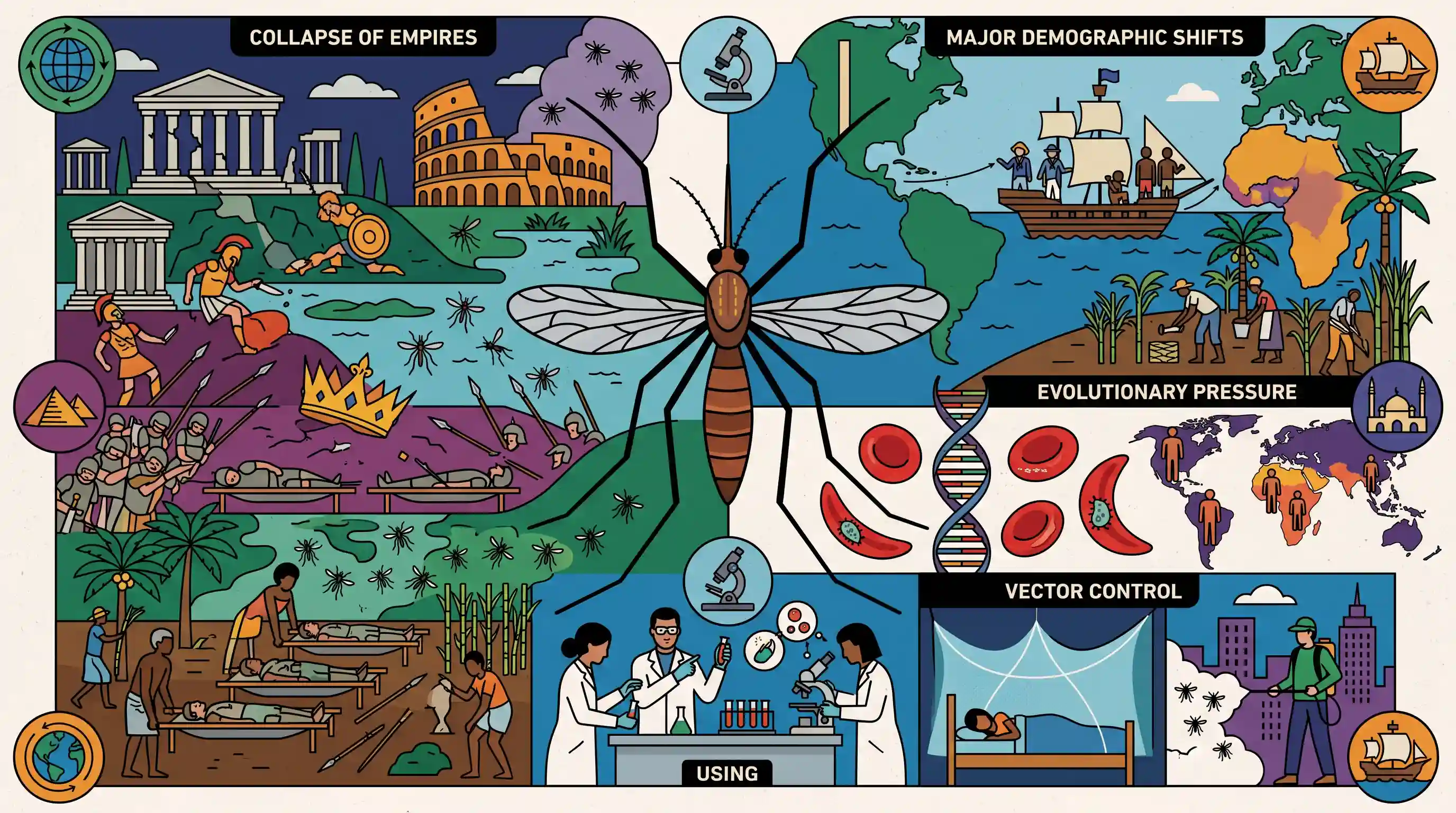
The article explores the profound impact of mosquitoes and malaria on the course of human history, positioning the insect as an apex predator that has shaped civilizations. Beyond being a modern public health crisis, malaria has historically influenced the collapse of empires, altered the outcomes of military campaigns, and driven major demographic shifts such as the transatlantic slave trade. The disease's evolutionary pressure has even left a lasting mark on the human genome, notably through the prevalence of the sickle cell trait in endemic regions which offers partial resistance to malaria. This historical perspective highlights the critical intersection of biology, environment, and history, while reinforcing the contemporary need for advanced vector control methods to combat mosquito-borne illnesses.
Key Points
- Mosquitoes, particularly as vectors for malaria, have acted as significant historical agents, influencing the outcomes of wars and contributing to the rise and fall of empires, such as Rome.
- The disease played a major role in shaping demographic and economic patterns during the colonial era, including driving the transatlantic slave trade due to the relative malarial resistance of African populations.
- The persistent evolutionary pressure of malaria has fundamentally altered human genetics in endemic regions, most notably by selecting for the sickle cell trait which provides partial immunity.
- Understanding the historical devastation of malaria underscores the importance of modern, innovative vector control strategies (like the Wolbachia method) and robust public health infrastructure.
Important Terms
Malaria

A life-threatening parasitic disease transmitted by infected female Anopheles mosquitoes. It causes high morbidity in tropical regions and has historically influenced human demographics and evolutionary genetics through environmental pressure.
UPSC context
GS Paper II/III: Health/S&T. Tests knowledge of communicable diseases and India’s elimination targets (zero indigenous cases by 2027; elimination by 2030).
Sickle Cell Trait
A genetic condition where a person carries one mutated hemoglobin gene. It causes red blood cells to sickle under low oxygen, providing a documented evolutionary survival advantage against severe malaria infections.
UPSC context
GS Paper III: Science & Technology (Genetics). Tests understanding of biological adaptations, evolution, and genetic inheritance patterns.
National Sickle Cell Anemia Elimination Mission
Launched in 2023, this mission aims to eliminate sickle cell disease as a public health issue by 2047. It focuses on universal screening and counseling for 7 crore people in tribal-dominated areas.
UPSC context
GS Paper II: Social Justice/Health. Tests knowledge of targeted government interventions for vulnerable tribal populations and public health missions.
Anaemia Mukt Bharat (AMB)
A flagship Indian government strategy (6x6x6) launched in 2018 to reduce anemia. It targets six age groups through six interventions, including addressing non-nutritional causes like malaria and hemoglobinopathies.
UPSC context
GS Paper II: Governance/Health. Tests awareness of comprehensive public health schemes and the multi-sectoral approach to nutrition and health.
Vector-borne Diseases (VBDs)
Illnesses caused by pathogens (parasites, viruses, or bacteria) transmitted to humans by living organisms (vectors) like mosquitoes, ticks, or fleas. They account for over 17% of all infectious diseases globally.
UPSC context
GS Paper II: Health. Tests knowledge of epidemiological challenges and the National Vector Borne Disease Control Programme (NVBDCP).
World Health Organization (WHO)
The UN’s specialized agency for global health. It sets international standards for malaria control and provides the framework for certifying countries as malaria-free after three consecutive years of zero indigenous cases.
UPSC context
GS Paper II: International Relations. Tests understanding of global health governance and India’s role in international health strategies.
Prelims Trap
The Wolbachia method is primarily deployed to control the spread of Malaria.
Wolbachia bacteria is introduced into Aedes mosquitoes to control viral diseases like Dengue and Zika. Malaria is a parasitic disease spread by Anopheles mosquitoes.
Static Concepts Connected
How does the Sickle Cell trait provide evolutionary resistance against Malaria?
- Autosomal recessive: Individuals inheriting one mutated gene (heterozygous) have the trait, offering disease resistance without developing severe sickle cell anemia.
- RBC alteration: The malaria parasite (Plasmodium) struggles to survive and reproduce in the altered, sickle-shaped red blood cells.
- Heterozygote advantage: The trait persists heavily in endemic regions because it offers a distinct survival and reproductive advantage against deadly malaria outbreaks.
What are the targets of the National Sickle Cell Anaemia Elimination Mission?
- 2047 Target: The mission aims to completely eliminate sickle cell disease as a public health problem in India by 2047.
- Demographic focus: It focuses on universal screening for 7 crore people in the 0-40 years age group across 278 districts with high tribal populations.
- Genetic counseling: The strategy relies heavily on screening, genetic counseling, and distributing color-coded cards to prevent the mating of two carrier individuals.
Cross-Topic Patterns
Genetics meets Tribal Health Policy
Malaria's evolutionary pressure made the sickle trait prevalent in India's tribal belts. Consequently, the 2047 Elimination Mission merges applied genetics with targeted tribal welfare policies.
Quinine and Colonial Imperialism
European conquest of inland Africa was historically stalled by high malaria mortality. The widespread use of quinine directly enabled the late 19th-century 'Scramble for Africa', linking pharmacology to imperialism.

Expect a multi-statement Prelims question intertwining genetic diseases (Sickle Cell), vector biology, and GoI's 2047 elimination goals.
Linked PYQs · 2
Linked PYQs · 2
- 2023PrelimsGS1
'Wolbachia method' is sometimes talked about with reference to which one of the following?
- 2023PrelimsGS1
Consider the following statements in the context of interventions being undertaken under Anaemia Mukt Bharat Strategy: 1. It provides prophylactic calcium supplementation for pre-school children, adolescents and pregnant women. 2. It runs a campaign for delayed cord clamping at the time of child-birth. 3. It provides for periodic deworming to children and adolescents. 4. It addresses non-nutritional causes of anaemia in endemic pockets with special focus on malaria, hemoglobinopathies and fluorosis. How many of the statements given above are correct?
