Electric Vehicle Battery Reuse Integration in Circular Economy
Source:The Hindu ↗
हे का महत्त्वाचे आहे
Crucial for evaluating India's green mobility roadmap, clean technology lifecycle management, and sustainable management of e-waste and battery waste under circular economy paradigms.
सारांश
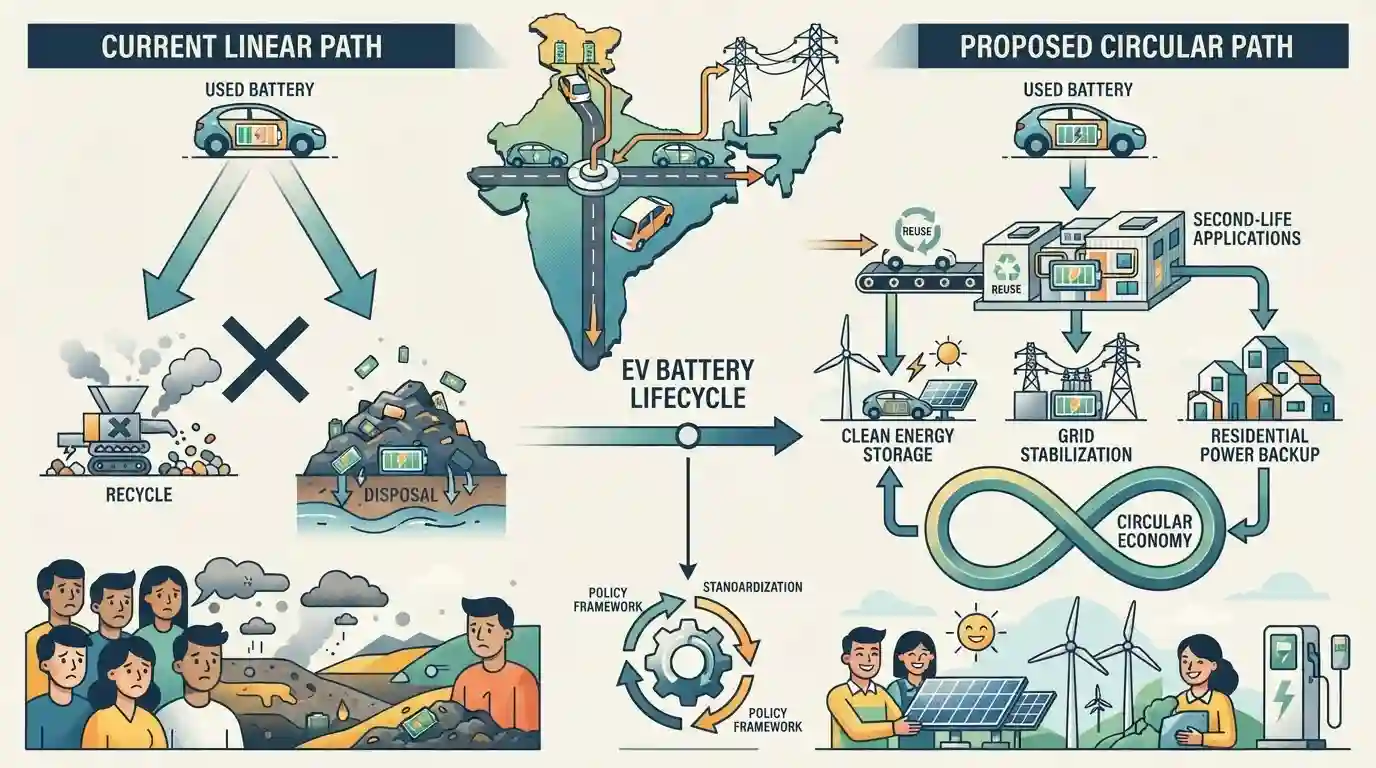
The article examines India's electric vehicle (EV) journey, highlighting a critical gap: the neglect of the 'reuse' principle for EV batteries in favor of immediate recycling or disposal. It discusses how second-life applications of EV batteries can bolster clean energy storage, reduce environmental footprints, and create a circular economy, provided policy frameworks and standardization improve.
मुख्य मुद्दे
- India's EV transition currently focuses heavily on adoption and battery recycling, often overlooking the critical 'reuse' principle (second-life applications).
- Second-life applications for EV batteries (such as stationary energy storage for renewable grids or telecom towers) can extract maximum value before recycling.
- Regulatory frameworks like the Battery Waste Management Rules need stronger integration and incentives for secondary use markets.
- Lack of standardization across EV battery packs, diagnostic data opacity, and ownership models hinder second-life deployment.
संबंधित स्थिर संकल्पना
What are the core principles of Extended Producer Responsibility (EPR) under Indian environmental law?
- Polluter Pays: Mandates producers to finance and manage post-consumer product collection, recycling, and disposal.
- Statutory Backing: Enforced via statutory rules like Plastic Waste, E-Waste, and Battery Waste Management Rules.
- Burden Shift: Shifts waste management burden from civic authorities to the industrial producers.
आंतर-विषय नमुने
Critical Minerals + EV Circular Economy
India's push for critical minerals in the EV transition directly overlaps with supply chain dependencies and bilateral resource partnerships like the MSPG.
Renewable Grids + Stationary Battery Storage
Second-life battery storage links national grid decarbonization targets with decentralized renewable energy integration under NAPCC missions.

Second-life EV batteries + EPR norms under Battery Waste Management Rules will likely be tested via a multi-statement application question.
संबंधित PYQ · 2
संबंधित PYQ · 2
- 2023MainsGS3
The adoption of electric vehicles is rapidly growing worldwide. How do electric vehicles contribute to reducing carbon emissions and what are the key benefits they offer compared to traditional combustion engine vehicles?
- 2025MainsGS3
How can India achieve energy independence through clean technology by 2047? How can biotechnology can play a crucial role in this endeavour?
