Strategic Hedging and Mecca Pact in West Asian Geopolitics
Source:The Hindu ↗
આ શા માટે મહત્વનું છે
The concept of 'strategic hedging' is crucial for UPSC aspirants as it explains the contemporary foreign policy behavior of key middle powers, especially in West Asia. Understanding this shift helps in analyzing India's bilateral and multilateral engagements, energy security imperatives, and the broader transition toward a multipolar global order.
સારાંશ
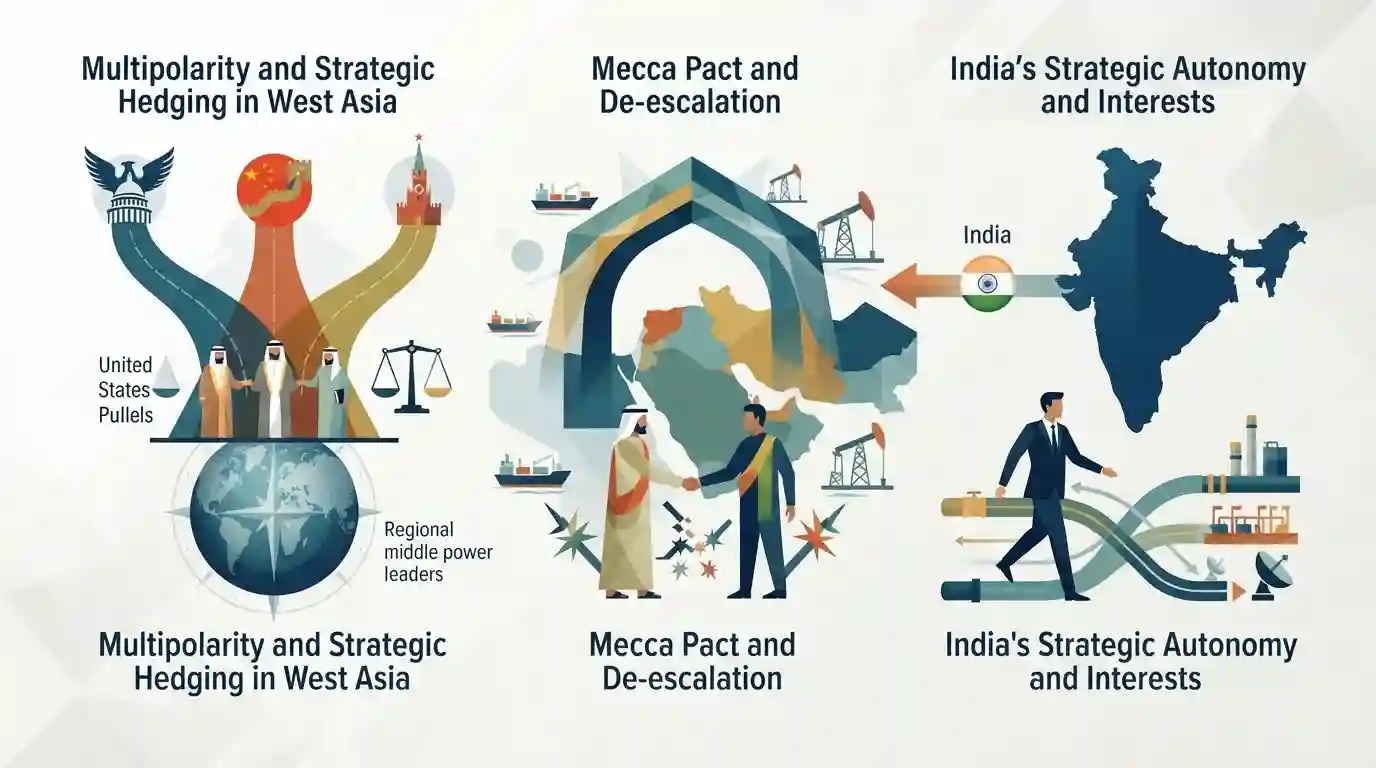
The article analyzes the growing trend of 'strategic hedging' in international relations, particularly in the context of the Middle East and the newly articulated 'Mecca Pact'. As the global order shifts towards multipolarity, regional powers are increasingly balancing their relationships among major powers—such as the US, China, and Russia—to secure their national interests. This approach reduces their dependence on a single superpower, allows for the de-escalation of regional rivalries, and maximizes economic and security dividends. The pact exemplifies how middle powers are taking charge of their geopolitical destinies, moving away from traditional alliances to flexible, interest-driven partnerships. For India, this regional transformation underscores the need for agile diplomacy that aligns with its own strategic autonomy and growing interests in West Asia.
મુખ્ય મુદ્દા
- Strategic hedging has become a dominant foreign policy approach for middle powers in West Asia, allowing them to balance relationships among global powers like the US, China, and Russia.
- The 'Mecca Pact' serves as a critical example of regional diplomacy, underscoring a broader shift toward de-escalation and intra-regional conflict resolution without over-reliance on external security guarantors.
- By employing strategic hedging, these nations aim to maximize their economic and security interests while avoiding entanglements in zero-sum great power competition.
- The evolving geopolitical landscape in West Asia creates both opportunities and complexities for India's foreign policy, particularly concerning its energy security, strategic autonomy, and deepening engagements in the region.
મહત્વપૂર્ણ શબ્દો
Mecca Pact

A trilateral mutual defense agreement signed in August 2026 by Saudi Arabia, Turkey, and Pakistan. It establishes collective defense provisions, signaling a move by regional powers to reduce reliance on US security guarantees.
UPSC context
Relevant for GS Paper 2 (International Relations); illustrates shifting West Asian geopolitics and the impact on India's strategic calculations.
Strategic Hedging
A foreign policy strategy where a state avoids full alignment with a single superpower. Instead, it cultivates diverse ties with multiple competing powers to minimize risk, maximize benefits, and maintain flexibility.
UPSC context
Core concept for GS Paper 2 (IR); vital for understanding India's multi-alignment and Middle Eastern states' responses to multipolarity.
Gulf Cooperation Council (GCC)
A regional political and economic union comprising six Arab states bordering the Persian Gulf (Bahrain, Kuwait, Oman, Qatar, Saudi Arabia, and the UAE) aimed at fostering regional integration and security.
UPSC context
Crucial for GS Paper 2 (IR) concerning India's foreign policy towards West Asia, energy security, trade, and diaspora welfare.
Middle Powers
Sovereign states that lack superpower status but possess substantial economic, diplomatic, or military influence. They increasingly shape regional geopolitics and international institutions, operating independently of major-power blocs.
UPSC context
Essential for GS Paper 2 (IR) to analyze the rising diplomatic agency and influence of countries like India, Turkey, and Saudi Arabia.
પ્રિલિમ્સ ટ્રેપ
The 2026 Mecca Pact replicates NATO's Article 5 by establishing an integrated military command and joint standing forces.
While it contains a collective defence clause, it lacks an integrated command structure or joint standing forces, relying instead on operational ambiguity.
સંલગ્ન સ્થિર ખ્યાલો
What is 'Strategic Hedging' in international relations?
- Core definition: A strategy where states avoid choosing sides, combining cooperation and deterrence to mitigate geopolitical risks.
- Contrast: Unlike balancing or bandwagoning, hedging preserves long-term strategic autonomy and prevents entrapment in great-power rivalry.
How does UN Charter Article 51 govern self-defence?
- Inherent right: It guarantees states the right to individual or collective self-defence if an armed attack occurs.
- UNSC oversight: Actions must be reported to the Security Council and do not diminish its primary security responsibility.
- Legal foundation: It provides the international legal basis for mutual defense agreements and regional security pacts.
આંતર-વિષય પેટર્ન
West Asia De-hyphenation vs. Trilateral Realities
India's policy of engaging Arab states independently faces strategic friction when Gulf partners enter formal military pacts with Pakistan, complicating India's 'Link West' objectives.
Middle-power coalitions and strategic autonomy
The shift from superpower security umbrellas to localized, mini-lateral defense pacts shows how regional middle powers are rewriting post-Cold War security architectures.

UPSC may contrast the Mecca Pact's collective defense model with India's preference for issue-based coalitions like I2U2 in West Asia.
સંલગ્ન PYQ · 3
સંલગ્ન PYQ · 3
- 2025MainsGS2
"Energy security constitutes the dominant kingpin of India's foreign policy, and is linked with India's overarching influence in Middle Eastern countries.” How would you integrate energy security with India's foreign policy trajectories in the coming years?
- 2024MainsGS2
‘The West is fostering India as an alternative to reduce dependence on China's supply chain and as a strategic ally to counter China's political and economic dominance.’ Explain this statement with examples.
- 2017MainsGS2
The question of India's Energy Security constitutes the most important part of India's economic progress. Analyze India's energy policy cooperation with West Asian countries.
