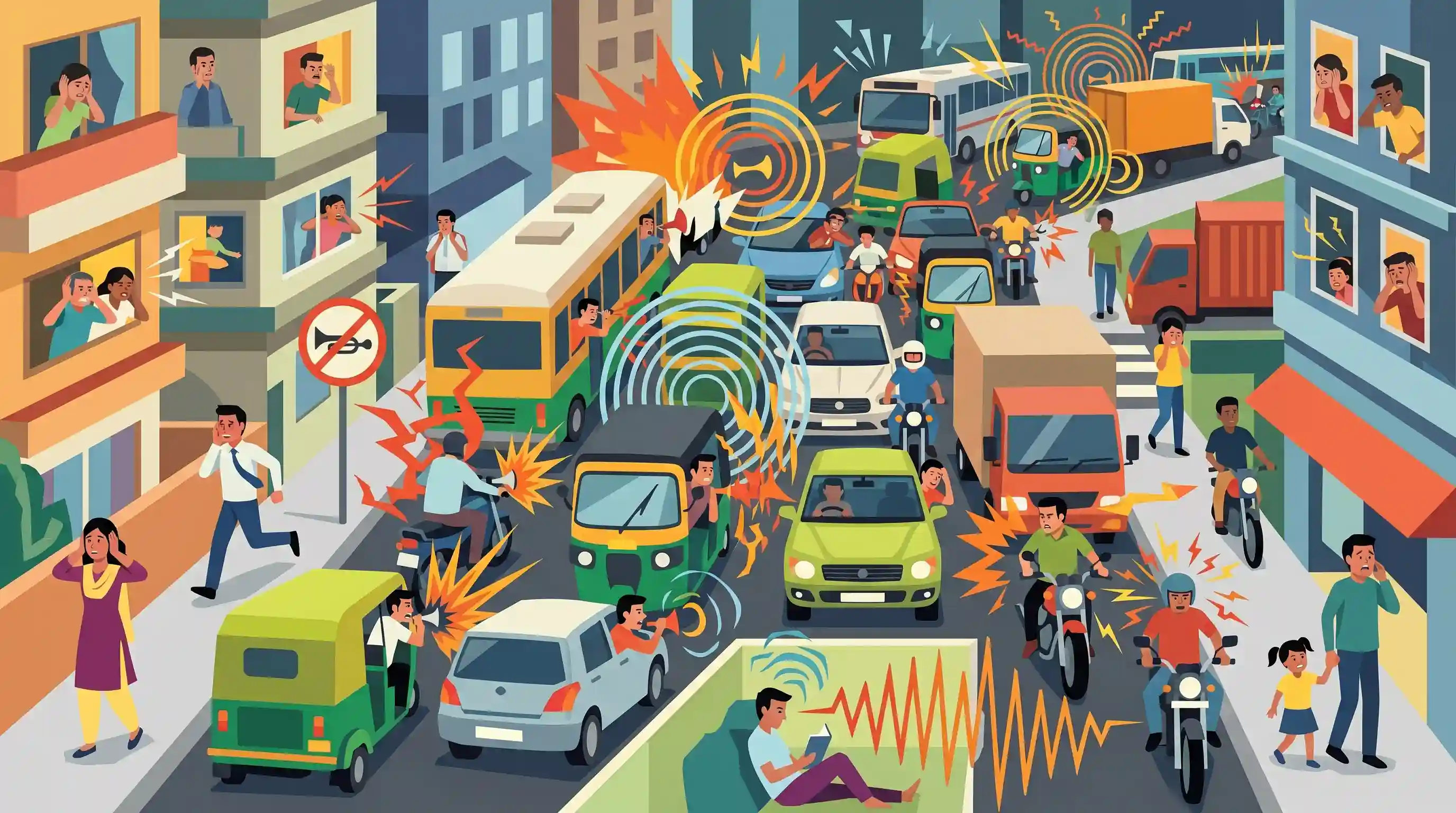
Vehicle honking culture and civic sense deficit in India
Source:The Hindu ↗
Why It Matters
Provides a practical, everyday example of civic deficit and lack of public ethics (GS4). It serves as an excellent anecdote for essays or ethics case studies on public behavior, compliance with laws versus conscience, and social responsibility.
Summary
An observational piece on the varied uses of vehicle horns in India, shedding light on the underlying lack of civic sense and widespread noise pollution on Indian roads. The article frames honking not just as a traffic nuisance but as a reflection of societal attitudes, impatience, and a disregard for public etiquette, calling for behavioral change and better self-regulation in public spaces.
Key Points
- The pervasive culture of honking on Indian roads serves as a unique but disruptive form of non-verbal communication among drivers.
- Frequent and unnecessary honking highlights a significant deficit in civic sense, patience, and public ethics.
- The varied uses of the horn—from asserting right-of-way and expressing frustration to casual warnings—contribute heavily to urban noise pollution.
- Addressing this societal habit requires a shift in public attitudes, behavioral change, and cultivating empathy and responsibility toward fellow citizens on the road.
Prelims Trap
The Noise Pollution (Regulation and Control) Rules, 2000 were promulgated under the Air (Prevention and Control of Pollution) Act, 1981.
While noise is classified as an air pollutant under the 1987 amendment to the Air Act, the specific Noise Pollution Rules 2000 were enacted under the Environment (Protection) Act, 1986.
Static Concepts Connected
What are the statutory frameworks governing noise pollution in India?
- Air Act 1981: Amended in 1987 to explicitly include 'noise' in the definition of an air pollutant, empowering state pollution control boards.
- EPA 1986: The Noise Pollution (Regulation and Control) Rules, 2000, which set ambient decibel standards for different zones, were enacted under this umbrella legislation.
- MV Act 2019: Section 194F makes unnecessary or continuous honking, or honking in silent zones, a punishable traffic offense.
Why is civic conscience necessary when statutory laws against public nuisances already exist?
- External vs Internal: Laws enforce behavior through external punitive threats, while conscience and ethics drive voluntary, self-regulated compliance.
- Enforcement Limitations: Pervasive everyday violations (like honking) outpace police capacity; sustainable compliance requires ingrained public empathy and a sense of duty toward fellow citizens.
Cross-Topic Patterns
Urbanization, Noise, and NCDs
Chronic traffic noise is increasingly recognized as an environmental stressor linked to cardiovascular diseases, bridging GS3 pollution with GS2 public health outcomes.
Nudge Theory in public policy
Behavioral interventions—like Mumbai police's "Punishing Signal" that resets red lights if decibels cross 85dB—serve as practical applications of GS4 attitude change and persuasion.

Expect a GS4 question on urban civic apathy or an essay on how mundane habits like honking reflect a nation's collective conscience.
Linked PYQs · 2
Linked PYQs · 2
- 2023MainsGS4
Is conscience a more reliable guide when compared to laws, rules and regulations in the context of ethical decision-making ? Discuss.
- 2016MainsGS4
Law and ethics are considered to be the two tools for controlling human conduct so as to make it conducive to civilized social existence. Discuss how they achieve this objective.
