Air Power Limitations and Military Theaterisation Reforms
Source:The Hindu ↗
কেন এটি গুরুত্বপূর্ণ
The creation of Theatre Commands is one of the most significant military reforms in post-independence India. Understanding the doctrinal debates between the services—specifically the IAF's perspective on the utility and indivisibility of air power—is crucial for GS-3 answers on defense modernization, internal security challenges, and the role of the Chief of Defence Staff (CDS).
সারসংক্ষেপ
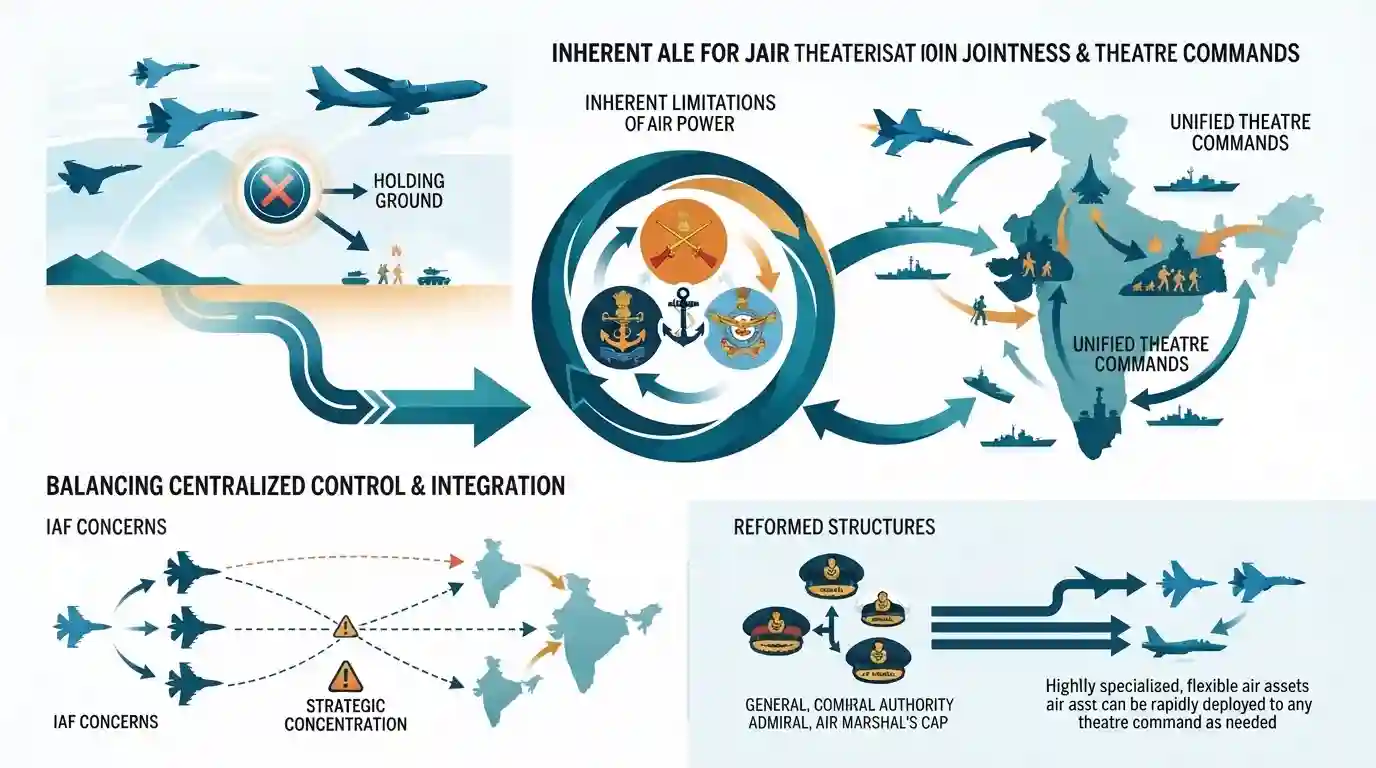
The article examines the inherent limitations of air power and how these constraints necessitate a joint approach to military operations, providing a strong rationale for the ongoing theaterisation of the Indian Armed Forces. While air power offers unmatched speed, flexibility, and strategic reach, its inability to hold ground means it cannot independently secure decisive political victories. This reality underscores the need for multi-domain synergy—combining land, sea, and air forces. In the Indian context, the shift towards unified Theatre Commands aims to achieve this 'jointness.' However, the Indian Air Force has historically expressed concerns that parcelling out its already depleted fleet of combat aircraft to regional theatre commanders could dilute the strategic concentration of air power. Ultimately, the successful implementation of theaterisation requires structural and doctrinal reforms that balance centralized control of specialized air assets with the integrated, localized needs of theatre commanders.
মূল বিষয়
- Air power possesses inherent strategic advantages such as reach, speed, and flexibility, but it is constrained by its inability to hold territory, meaning it rarely achieves final victory without ground or naval forces.
- The limitations of standalone air operations highlight the necessity of jointness and multi-domain military strategies (land, sea, air, space, and cyber) in modern warfare.
- India's ongoing higher defence reform, theaterisation, seeks to integrate the Army, Navy, and Air Force under unified Theatre Commands to optimize resources and ensure swift, synchronized combat responses.
- The Indian Air Force's (IAF) apprehension toward theaterisation largely stems from its current shortfall in combat squadrons and the concern that splitting scarce air assets among regional commanders would degrade their strategic impact.
- A successful theaterisation model in India must reconcile the IAF's doctrine of centralized air operations with the tactical necessity of providing theatre commanders dedicated air support.
গুরুত্বপূর্ণ শব্দ
Theatre Commands

A unified combat structure integrating Army, Navy, and Air Force assets under a single operational commander for a specific geographical region to maximize synergy, jointness, and resource optimization.
UPSC context
GS Paper III (Internal Security/Defence Reforms); tests knowledge of military restructuring, operational synergy, and joint warfighting capabilities.
Chief of Defence Staff (CDS)
A four-star military officer acting as the permanent chairman of the Chiefs of Staff Committee, head of the Department of Military Affairs, and the principal military adviser to the government.
UPSC context
GS Paper III (Higher Defence Management); tests reforms in military hierarchy, inter-service coordination, and joint operational planning.
Indian Armed Forces
The military forces of India, comprising the Indian Army, Indian Navy, and Indian Air Force, with the President of India serving as their Supreme Commander.
UPSC context
GS Paper III (Security Forces and Their Mandate); tests awareness of structural organization, roles, and modernization of India's national defense apparatus.
Indian Air Force (IAF)
The aerial warfare branch of the Indian Armed Forces, tasked with securing Indian airspace and conducting air operations, historically operating through seven independent commands.
UPSC context
GS Paper III (Security Forces/Mandates); tests capabilities of the air arm, challenges in theaterisation, and doctrines of strategic air power projection.
প্রিলিমস ফাঁদ
The Andaman and Nicobar Command (ANC) is currently the only joint tri-service command operating in India.
While ANC is the only geographic joint command, the Strategic Forces Command (SFC), established in 2003, is a functional tri-service command.
সংযুক্ত স্থির ধারণা
How does the proposed Theater Command structure differ from India's current military commands?
- Current fragmentation: India has 17 single-service operational commands (Army 7, Navy 3, Air Force 7) acting independently under respective chiefs.
- Proposed integration: Theaterisation collapses these into fewer, unified, multi-domain geographical commands led by a single tri-service commander.
- Operational shift: Service chiefs will focus on training and acquisition, transferring active operational control to joint theater commanders.
Which major committees paved the way for higher defence reforms and the CDS post?
- Kargil Review Committee: Proposed creating a Chief of Defence Staff (CDS) to enhance jointness and provide single-point military advice.
- Shekatkar Committee: In 2016, recommended structural reforms to optimize combat capability, leading to the Department of Military Affairs.
আন্তঃবিষয় প্যাটার্ন
Defense Indigenization + Air Power
IAF's squadron deficit (31 vs 42) directly impacts theaterisation; resolving it links to 'Atmanirbhar Bharat' in defense, specifically HAL’s Tejas LCA and AMCA procurement timelines.
Nuclear Doctrine + Higher Command Structure
Command over nuclear delivery platforms requires coordination between regional theater commanders and the Strategic Forces Command (SFC) under the Nuclear Command Authority (NCA).

Multi-statement questions may test the distinction between geographic and functional joint commands alongside Shekatkar/Kargil committees.
সংযুক্ত PYQ · 2
সংযুক্ত PYQ · 2
- 2021MainsGS3
Analyse the multidimensional challenges posed by external state and non-state actors, to the internal security of India. Also discuss measures required to be taken to combat these threats.
- 2023MainsGS3
What are the internal security challenges being faced by India? Give out the role of Central Intelligence and Investigative Agencies tasked to counter such threats.
