Expiration of New START treaty and emerging nuclear proliferation
Source:Indian Express ↗
Why It Matters
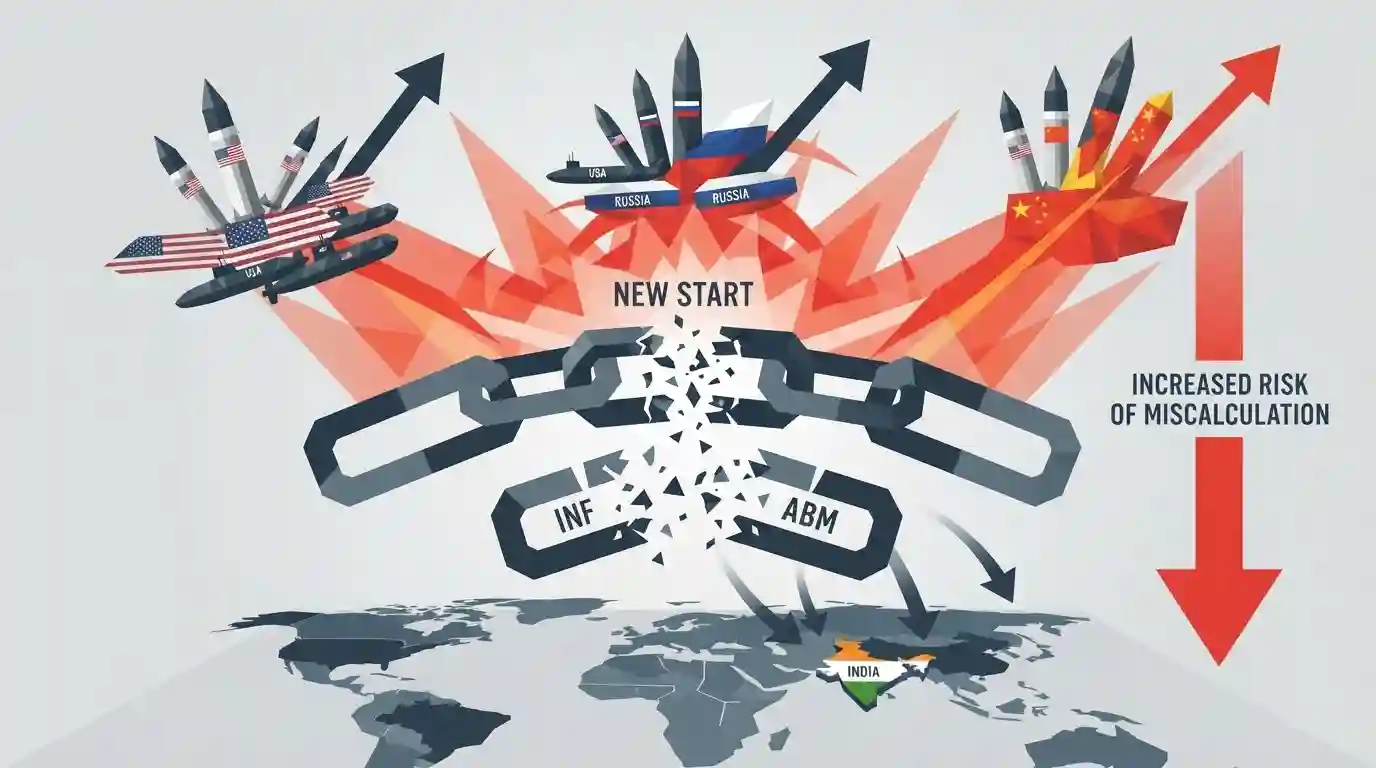
The collapse of global arms control architectures (like New START and INF) profoundly impacts the international security environment. For UPSC aspirants, understanding these treaties is crucial for Prelims (which has previously tested New START directly), while the broader geopolitical consequences—such as a multipolar nuclear arms race involving the US, Russia, and China—are key to answering Mains GS2 questions on global stability and its indirect effects on India's strategic posture.
Summary
The article discusses the expiration of the New START treaty, the last remaining bilateral nuclear arms control agreement between the United States and Russia. Its collapse removes crucial caps on deployed strategic nuclear warheads and delivery vehicles, ending the reciprocal verification regimes that have stabilized US-Russia relations for decades. Compounded by the earlier demise of the INF and ABM treaties, and taking place against the backdrop of China's rapidly expanding nuclear arsenal, the expiration raises profound concerns about an unchecked trilateral nuclear arms race. This structural shift in global geopolitics threatens to replace strategic predictability with ambiguity, increasing the risk of miscalculation.
Key Points
- The New START treaty between the US and Russia officially expires, removing the final bilateral cap on their deployed strategic nuclear arsenals.
- The lapse ends reciprocal data exchanges and on-site inspections, creating a strategic blind spot and ending over 50 years of mutual arms constraints.
- With the prior collapse of the INF and ABM treaties, there is now no legal framework constraining the expansion of nuclear warheads and delivery systems like ICBMs and SLBMs.
- The lack of a bilateral treaty is exacerbated by China's aggressive expansion of its nuclear forces, heightening fears of an unconstrained trilateral arms race.
- The absence of arms control frameworks increases the risks of miscalculation, tests global nuclear deterrence theory, and jeopardizes international security.
Important Terms
New START (Strategic Arms Reduction Treaty)

A 2010 bilateral arms control treaty between the US and Russia that capped deployed strategic nuclear warheads at 1,550. It officially expired in February 2026, ending decades of regulated strategic stability.
UPSC context
GS Paper II (International Relations): Important international treaties affecting global security, bilateral ties of superpowers, and their geopolitical implications for India.
Intermediate-Range Nuclear Forces (INF) Treaty
A landmark 1987 treaty between the US and USSR that eliminated all ground-launched ballistic and cruise missiles with ranges of 500 to 5,500 kilometers. The US withdrew in 2019 citing Russian violations.
UPSC context
GS Paper II (Bilateral agreements affecting India's interests): Tests knowledge of historic disarmament frameworks and post-Cold War security architecture.
Anti-Ballistic Missile (ABM) Treaty
A 1972 Cold War treaty between the US and Soviet Union limiting antiballistic missile systems to ensure Mutual Assured Destruction. The US withdrew in 2002 to develop nationwide missile defenses.
UPSC context
GS Paper II (International Relations) & GS Paper III (Security): Underpins concepts of strategic deterrence, missile defense systems, and global nuclear balance.
Nuclear Non-Proliferation Treaty (NPT)
A landmark 1968 international treaty aimed at preventing the spread of nuclear weapons, promoting peaceful nuclear energy, and pursuing disarmament. India, Pakistan, Israel, and South Sudan are non-signatories.
UPSC context
GS Paper II (International Relations): Crucial for understanding global non-proliferation regimes, India's principled stand on discriminatory treaties, and civil nuclear agreements.
NATO (North Atlantic Treaty Organization)
A transatlantic intergovernmental military alliance established in 1949 by the North Atlantic Treaty, dedicated to collective defense and mutual security cooperation among its North American and European member states.
UPSC context
GS Paper II (Bilateral/regional groupings involving or affecting India): Vital for analyzing European security, transatlantic relations, and emerging geopolitical dynamics in the Indo-Pacific.
Prelims Trap
New START capped the entire absolute stockpile of all nuclear warheads, including tactical and non-deployed weapons, possessed by the US and Russia.
The treaty only restricted deployed strategic warheads (1,550) and deployed delivery vehicles. Tactical nuclear weapons and non-deployed stockpiles were completely excluded from the treaty caps.
Static Concepts Connected
What are the core distinctions between Strategic and Tactical Nuclear Weapons under global frameworks?
- Strategic weapons: High-yield arms designed to destroy targets deep in enemy territory, carried by long-range ICBMs, SLBMs, or heavy bombers.
- Tactical weapons: Lower-yield, short-range battlefield weapons designed for immediate combat use; they have never been limited by bilateral arms control treaties.
- NPT categorization: The NPT does not legally distinguish between strategic and tactical warheads, holding nuclear-armed signatories equally accountable for disarmament of both.
How did cold-war era bilateral treaties stabilize the US-Soviet strategic balance?
- ABM Treaty (1972): Restricted missile defense systems to prevent either side from launching a first strike with impunity; US withdrew in 2002.
- INF Treaty (1987): Banned all ground-launched ballistic and cruise missiles with intermediate ranges (500-5,500 km); collapsed in 2019.
- START I (1991): The first treaty to mandate deep reductions in strategic offensive arms, rather than just capping their growth.
Cross-Topic Patterns
Nuclear expansion vs global development financing
Unconstrained nuclear modernization programs deplete national budgets, directly reducing capital availability for global climate finance and Sustainable Development Goals (SDGs).
Asymmetric trilateral deterrence in Southern Asia
China's unchecked nuclear expansion following New START's collapse disrupts the regional balance, forcing India to reassess its Credible Minimum Deterrence posture.

Collapse of bilateral arms control plus China's expansion will likely frame a 2026 GS-2 question on the systemic failure of NPT Article VI.
Linked PYQs · 2
Linked PYQs · 2
- 2011PrelimsGS1
The "New START" treaty was in the news. What is this treaty?
- 2020PrelimsGS1
In India, why are some nuclear reactors kept under "IAEA Safeguards" while others are not?
