Chakma and Hajong Citizenship Status and Security in Northeast India
Source:Indian Express ↗
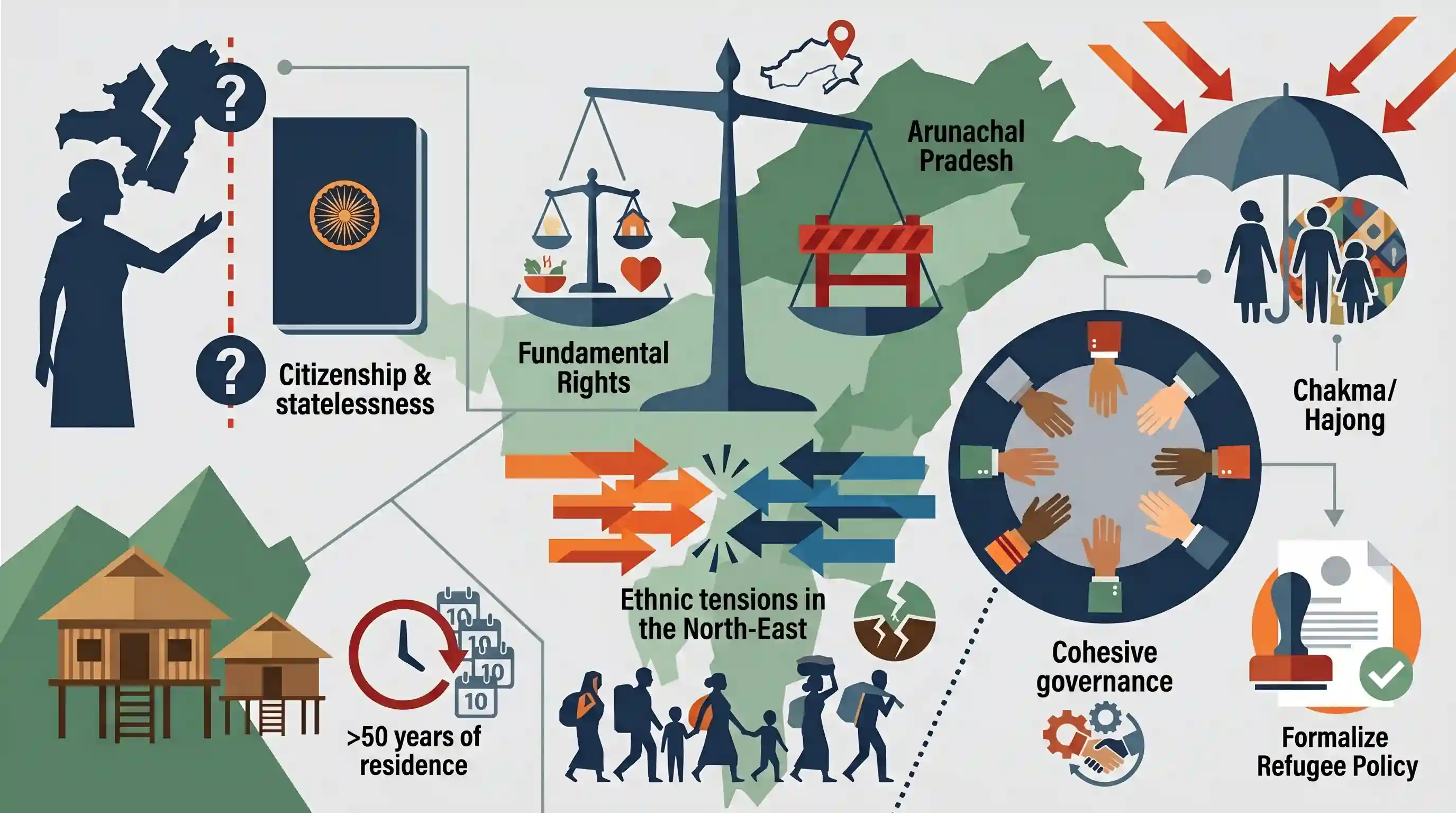
Why It Matters
The Chakma-Hajong issue is a classic case study for UPSC on the intersection of citizenship, refugee rights, and ethnic conflicts. It tests a candidate's understanding of Constitutional guarantees (Article 14, 21 vs Article 19) and the internal security dynamics of Northeast India.
Summary
The article examines the tragic killing of Anjel Chakma, bringing to the forefront the longstanding plight of the Chakma and Hajong communities in Arunachal Pradesh. It discusses the complexities of citizenship, statelessness, and fundamental rights, questioning why these communities continue to be treated as outsiders despite having lived in India for over half a century. The incident underscores the urgent need for a cohesive governance approach to address ethnic tensions, protect minority rights, and resolve the protracted refugee crisis in Northeast India.
Key Points
- The killing of Anjel Chakma highlights the persistent marginalization and security threats faced by the Chakma community in Arunachal Pradesh.
- Despite residing in India for decades, the Chakma and Hajong communities continue to face statelessness and a lack of fundamental citizenship rights.
- The incident raises critical questions about the applicability of human rights (like Article 21) to vulnerable refugee populations in border regions.
- Resolving such issues requires balancing the ethnic sensitivities of indigenous groups with the humanitarian and legal obligations towards refugees under the Indian Constitution.
Important Terms
Chakma and Hajong Communities

Predominantly Buddhist (Chakmas) and Hindu (Hajongs) ethnic groups who fled East Pakistan in the 1960s, resettling primarily in Arunachal Pradesh.
UPSC context
GS II (Vulnerable Sections/Social Justice) and GS III (Internal Security). Tests knowledge of ethnic conflicts and refugee crises in the Northeast.
Citizenship Act, 1955
The primary law governing Indian citizenship; it outlines methods of acquisition (birth, descent, registration, naturalization) and conditions for its termination.
UPSC context
GS II (Polity). Core topic for understanding legal status, naturalization rights, and constitutional provisions (Articles 5-11).
Inner Line Permit (ILP)
An official travel document issued by state governments to regulate the entry and stay of non-resident Indian citizens in protected frontier areas.
UPSC context
GS II (Polity) and GS III (Internal Security). Tests understanding of tribal autonomy, demographic protection, and federalism.
Statelessness
A legal status where an individual is not recognized as a national by any state, often leading to a lack of fundamental rights and protection.
UPSC context
GS II (International Relations/Social Justice). Relevant for discussing human rights, international conventions, and the impact of the NRC process.
Bengal Eastern Frontier Regulation (BEFR), 1873
A colonial regulation that established the 'Inner Line' to protect British interests; it remains the legal basis for the modern ILP system.
UPSC context
GS I (Modern History) and GS II (Polity). Tests the historical origin of administrative exclusion and tribal protection policies.
Prelims Trap
Chakma and Hajong refugees in Arunachal Pradesh are eligible for fast-track citizenship under the CAA 2019.
False. Arunachal Pradesh is protected by the Inner Line Permit (ILP) system (Bengal Eastern Frontier Regulation, 1873), which explicitly exempts the state from the CAA 2019.
Static Concepts Connected
Which areas are exempt from the Citizenship Amendment Act (CAA), 2019?
- Sixth Schedule: Tribal areas of Assam, Meghalaya, Mizoram, and Tripura are excluded to protect indigenous demographics.
- Inner Line Permit: States requiring a permit under the Bengal Eastern Frontier Regulation, 1873 (Arunachal Pradesh, Nagaland, Mizoram, Manipur) are entirely exempt from the Act.
Which Fundamental Rights are available to foreigners and refugees in India?
- Available to all: Articles 14, 20, 21, 21A, 22, 23, 24, 25, 26, 27, and 28 are available to both citizens and non-citizens.
- Citizens only: Articles 15, 16, 19, 29, and 30 are exclusive to Indian citizens. Refugees cannot claim these.
- Article 21 Precedent: The Supreme Court ruled in NHRC vs State of AP (1996) that the State must protect the life and liberty of Chakma refugees against eviction threats.
Cross-Topic Patterns
CAA, ILP & Demographic Anxiety
The Chakma-Hajong issue mirrors the broader Northeast security dilemma: balancing India's humanitarian refugee protection with the demographic anxieties of indigenous tribes protected by the Sixth Schedule and ILP.
Transnational dam displacement
The initial migration of these communities was triggered by the Kaptai Dam on the Karnaphuli River in Bangladesh, linking development-induced displacement and environmental geography directly to transnational refugee crises.

Expect a multi-statement question in 2026 testing CAA exemptions, explicitly tying Arunachal's ILP status to Chakma-Hajong statelessness.
Linked PYQs · 3
Linked PYQs · 3
- 2022MainsGS2
“Right of movement and residence throughout the territory of India are freely available to the Indian citizens, but these rights are not absolute.” Comment.
- 2024MainsGS2
Right to privacy is intrinsic to life and personal liberty and is inherently protected under Article 21 of the constitution. Explain. In this reference discuss the law relating to D.N.A. testing of child in the womb to establish its paternity.
- 2017MainsGS3
The North-East region of India has been infested with insurgency for a very long time. Analyze the major reasons for the survival of armed insurgency in this region.
