Kigali Amendment Milestone and India Sustainable Cooling Strategy
Source:Indian Express ↗
આ શા માટે મહત્વનું છે
Crucial for understanding global climate governance, international treaties like the Montreal Protocol/Kigali Amendment, and India's domestic policy response via the India Cooling Action Plan (ICAP) under GS3 Environment/Climate change.
સારાંશ
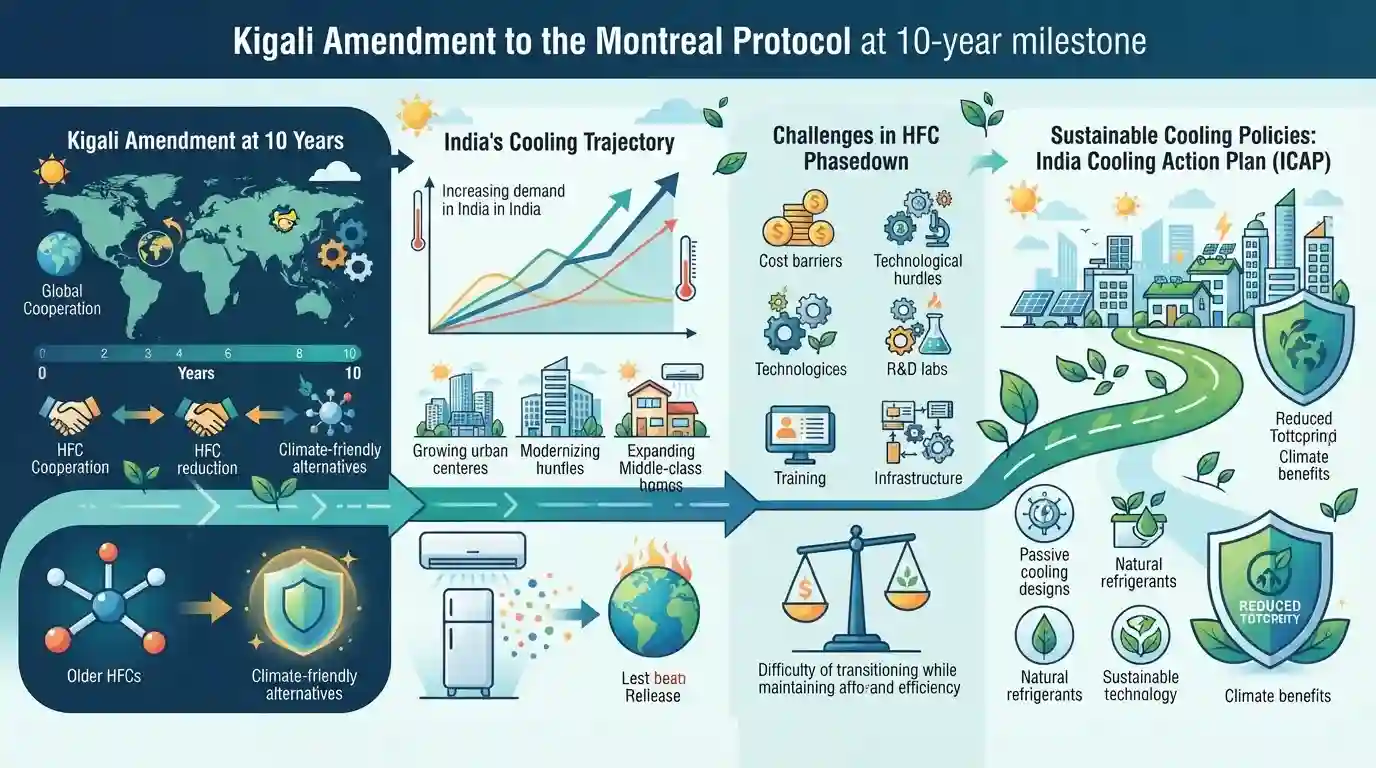
An overview of the Kigali Amendment to the Montreal Protocol at its 10-year milestone, examining India's cooling trajectory, challenges in phasing down hydrofluorocarbons (HFCs), and the significance of sustainable cooling policies like the India Cooling Action Plan.
મુખ્ય મુદ્દા
- The Kigali Amendment to the Montreal Protocol marks its 10th anniversary, highlighting global efforts to phase down Hydrofluorocarbons (HFCs), which are potent greenhouse gases.
- India's cooling choices are crucial given its rapidly rising demand for air conditioning and refrigeration driven by economic growth and warming temperatures.
- India has implemented the India Cooling Action Plan (ICAP) to address sustainable cooling, balancing development needs with climate commitments.
- Transitioning away from HFCs requires technological shifts, energy efficiency improvements, and financial/technical support for developing nations.
મહત્વપૂર્ણ શબ્દો
Kigali Amendment

An international treaty agreed in 2016 under the Montreal Protocol to phase down the production and consumption of hydrofluorocarbons (HFCs), potent greenhouse gases used in cooling and refrigeration.
UPSC context
Important for GS Paper III (Environment and Climate Change). Tests knowledge of international environmental conventions, HFC phase-down targets, and India's climate commitments.
Montreal Protocol
A landmark multilateral environmental agreement signed in 1987 to phase out ozone-depleting substances like chlorofluorocarbons (CFCs), successfully protecting the Earth's ozone layer.
UPSC context
Core topic for GS Paper III (Environment Conservation). Frequently asked in Prelims and Mains regarding successful global environmental governance frameworks.
India Cooling Action Plan (ICAP)
India's comprehensive 20-year strategy launched in 2019 to provide sustainable cooling and thermal comfort for all while reducing cooling demand, energy requirements, and refrigerant emissions.
UPSC context
Essential for GS Paper III (Environment, Energy Policy). Evaluates India's domestic policy response to climate change, energy efficiency, and sustainable development.
સંલગ્ન સ્થિર ખ્યાલો
What are the core features and objectives of the Kigali Amendment?
- Legal Status: Legally Binding: Adopted in 2016 as an amendment to the Montreal Protocol, it is legally binding on ratifying countries with clear reduction schedules.
- HFC Paradox: Not Ozone Depleting: HFCs do not deplete the ozone layer; they were introduced to replace CFCs, but possess extremely high Global Warming Potentials (GWP).
- Differentiation: Differentiated Timelines: Developed and developing nations phase down HFCs at different speeds under Article 5 groupings.
આંતર-વિષય પેટર્ન
Montreal Protocol vs. UNFCCC Architecture
While the Montreal Protocol focuses on ozone and climate via Kigali, the UNFCCC (Paris Agreement) handles broader greenhouse gas mitigation. UPSC often tests institutional overlaps between these climate regimes.
Cooling Demand and Power Grid Vulnerability
Rapidly expanding air conditioning demand tests India's power grid stability, linking cooling policy directly to energy transition and renewable integration challenges.

Expect a statement-based question pairing Kigali Amendment's legally binding nature with India's 2028 baseline freeze year.
સંલગ્ન PYQ · 3
સંલગ્ન PYQ · 3
- 2022MainsGS3
Discuss global warming and mention its effects on the global climate. Explain the control measures to bring down the level of greenhouse gases which cause global warming, in the light of the Kyoto Protocol, 1997.
- 2015PrelimsGS1
Which one of the following is associated with the issue of control and phasing out of the use of ozone-depleting substances?
- 2023PrelimsGS1
Consider the following: 1. Aerosols 2. Foam agents 3. Fire retardants 4. Lubricants In the making of how many of the above are hydrofluorocarbons used?
