Kigali Amendment and India Cooling Policy Challenges
Source:Indian Express ↗
ఇది ఎందుకు ముఖ్యం
It directly connects to India's international climate commitments under the Montreal Protocol's Kigali Amendment, domestic cooling strategies (ICAP), and the balance between energy security, economic growth, and global warming mitigation.
సారాంశం
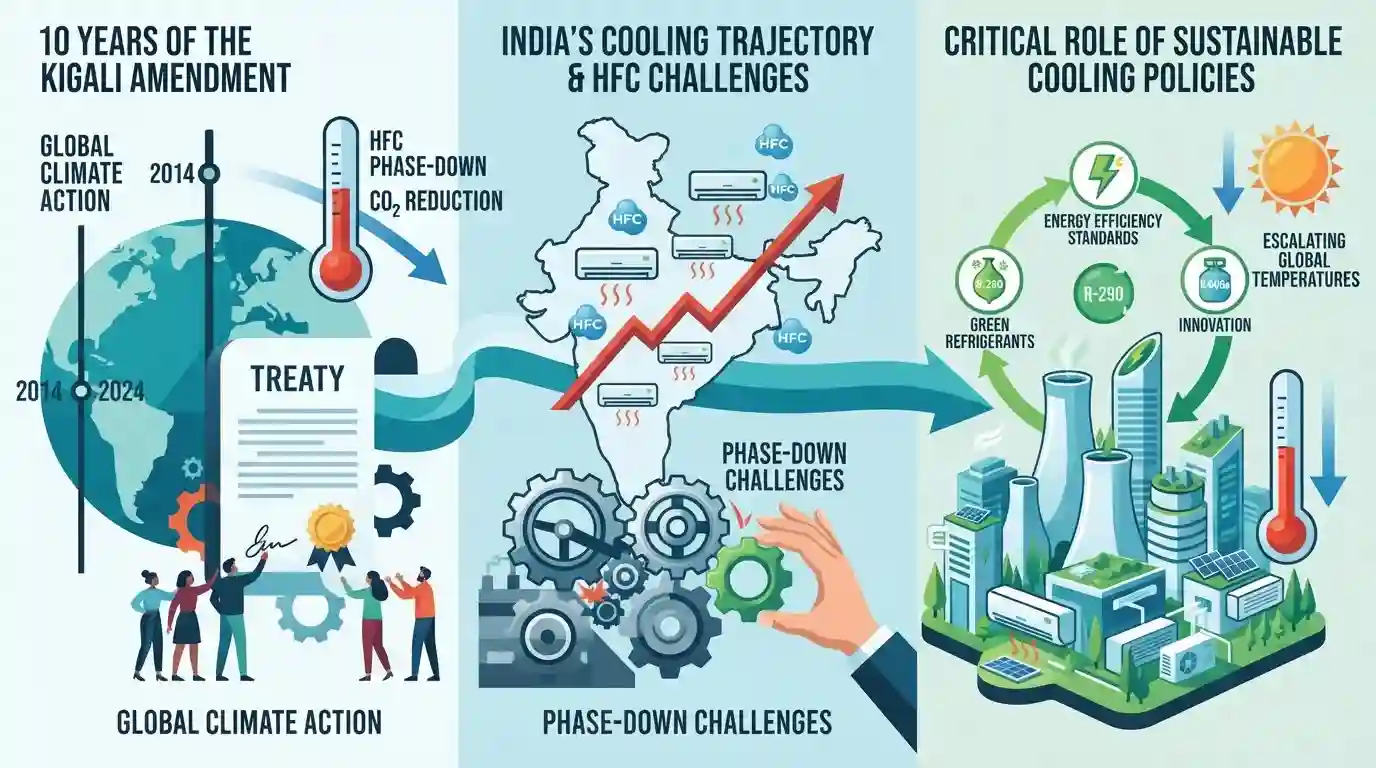
The article reviews the significance of the Kigali Amendment to the Montreal Protocol as it turns 10, examining India's cooling trajectory, challenges in phasing down HFCs, and the critical role of sustainable cooling policies amid escalating global temperatures.
ముఖ్య అంశాలు
- The Kigali Amendment to the Montreal Protocol marks its 10th anniversary, highlighting global efforts to phase down hydrofluorocarbons (HFCs), which are potent greenhouse gases.
- HFCs were originally introduced as substitutes for ozone-depleting substances (ODSs) like CFCs and HCFCs, but they possess extremely high global warming potential (GWP).
- India's cooling choices and domestic policies (such as the India Cooling Action Plan) are crucial as rising temperatures and rapid urbanization drive massive growth in cooling and air conditioning demand.
- India has aligned with the phasedown schedule of the Kigali Amendment, balancing climate commitments with national developmental and energy security priorities.
ముఖ్యమైన పదాలు
Kigali Amendment

An international treaty adopted in 2016 to amend the Montreal Protocol, legally binding countries to phase down the production and consumption of hydrofluorocarbons (HFCs) to mitigate global warming.
UPSC context
UPSC Paper III (Environment & Climate Change): Tests knowledge of international environmental agreements, HFC phase-down timelines, and India's cooling policy commitments.
Montreal Protocol
A landmark 1987 international treaty designed to protect the stratospheric ozone layer by phasing out the production and consumption of ozone-depleting substances like chlorofluorocarbons (CFCs).
UPSC context
UPSC Paper III (Environment): Important for global environmental governance, compliance mechanisms, and successful multilateral frameworks.
United Nations Environment Programme (UNEP)
A specialized agency of the United Nations established in 1972 that coordinates global environmental activities, assists developing nations in policy implementation, and hosts the Montreal Protocol's secretariat.
UPSC context
UPSC Paper II & III: Important for questions on international organizations, global environmental governance, and sustainable development goals.
Intergovernmental Panel on Climate Change (IPCC)
An intergovernmental scientific body established by the WMO and UNEP to provide objective, science-based assessments on climate change, its socio-economic impacts, and future risks.
UPSC context
UPSC Paper III (Climate Change): Essential for understanding scientific assessments, global warming projections, and mitigation pathways.
India Cooling Action Plan (ICAP)
A comprehensive 20-year national policy framework launched by India to address escalating cooling demands sustainably across sectors like buildings, cold chains, and refrigeration.
UPSC context
UPSC Paper III (Energy Efficiency & Environment): Tests national policy responses to rising temperatures, energy demand, and sustainable cooling strategies.
అనుసంధానమైన స్థిర భావనలు
What are the key differences between the Montreal Protocol and the Kyoto Protocol in addressing climate change?
- Scope & Focus: Montreal Protocol focuses specifically on ozone-depleting substances (ODSs) and later HFCs, whereas Kyoto/Paris address broader greenhouse gases across all economic sectors.
- Enforcement: Montreal Protocol features legally binding reduction schedules with strong trade restriction provisions against non-parties, historically yielding near-universal compliance.
- Equity Principle: Montreal operates on a principle of differentiated timelines for developing and developed nations, similar to historical equity frameworks under UNFCCC.
అంతర-అంశ నమూనాలు
HFC Phase-Down + Energy Efficiency PLI Schemes
The phase-down of hydrofluorocarbons intersects directly with energy security and domestic manufacturing schemes like PLI for ACs and LEDs.
Kigali Amendment + CBDR Principle in Climate Talks
Balancing differentiated timelines under the Montreal/Kigali frameworks mirrors India's Common But Differentiated Responsibilities (CBDR) stance in UNFCCC negotiations.

Expect statement-based questions combining ICAP targets (20-year roadmap) with Kigali Amendment legally binding HFC reduction timelines.
అనుసంధాన PYQలు · 3
అనుసంధాన PYQలు · 3
- 2021MainsGS3
Describe the major outcomes of the 26th session of the Conference of the Parties (COP) to the United Nations Framework Convention on Climate Change (UNFCCC). What are the commitments made by India in this conference?
- 2015PrelimsGS1
Which one of the following is associated with the issue of control and phasing out of the use of ozone-depleting substances?
- 2023PrelimsGS1
Consider the following: 1. Aerosols 2. Foam agents 3. Fire retardants 4. Lubricants In the making of how many of the above are hydrofluorocarbons used?
