Judicial Enforcement of Environmental Corporate Social Responsibility
Source:The Hindu ↗
Why It Matters
Understanding the intersection of corporate law (Companies Act), environmental jurisprudence, and judicial activism is crucial for Mains GS2 (Judiciary/Governance), GS3 (Environment), and GS4 (Corporate Ethics). It demonstrates how courts use statutory CSR mandates to enforce environmental accountability.
Summary
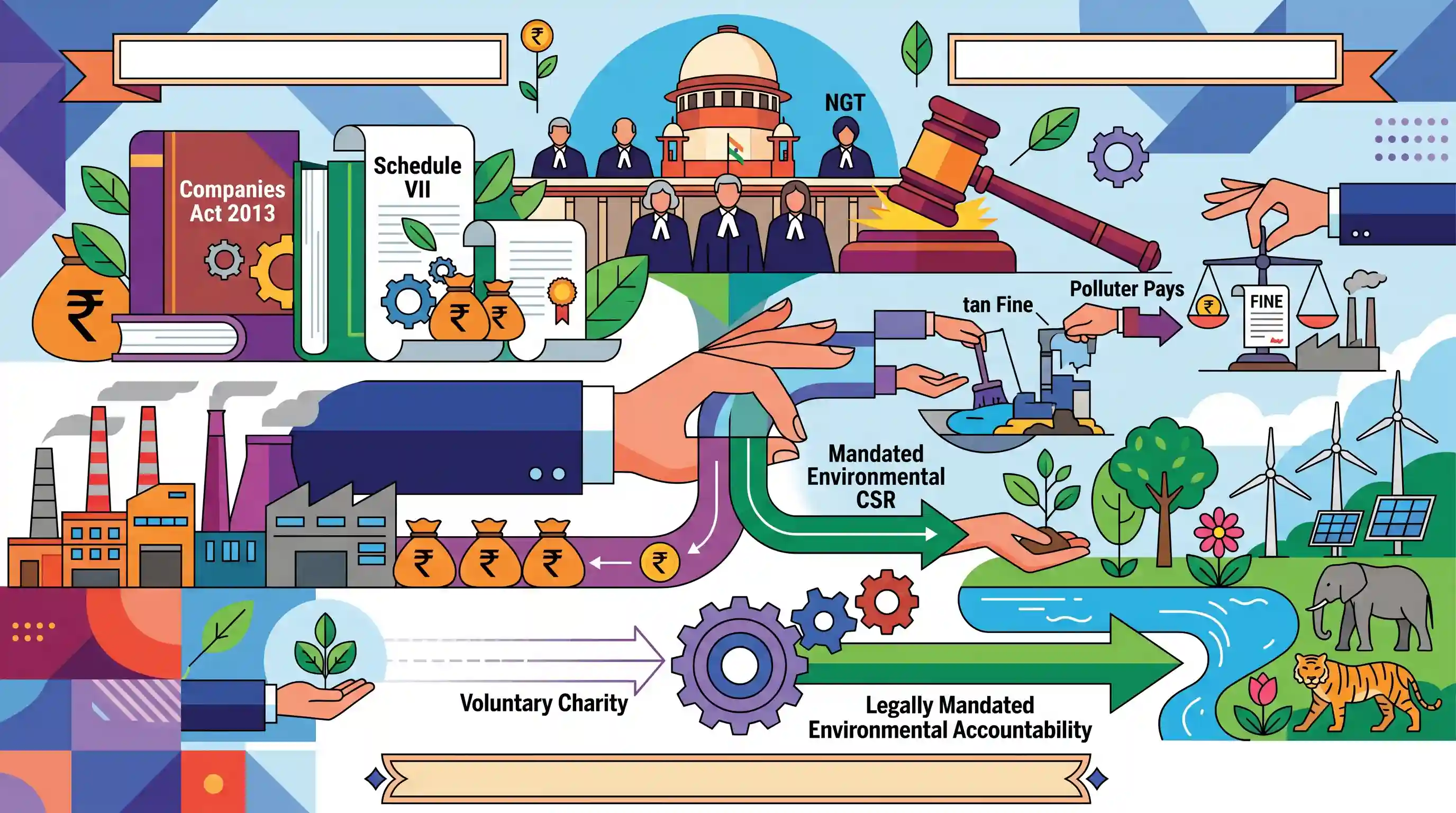
The article explores the active role of the Indian judiciary, notably the Supreme Court and the National Green Tribunal (NGT), in promoting and enforcing Environmental Corporate Social Responsibility (ECSR). Although the Companies Act of 2013 statutorily mandates CSR—with Schedule VII identifying environmental sustainability as a key focus area—courts have increasingly stepped in to direct corporate funds toward specific ecological remediation and conservation efforts. This judicial activism effectively blends the compensatory 'polluter pays' principle with broader CSR mandates, ensuring that corporations take tangible responsibility for their environmental footprint. The trend underscores a critical shift from voluntary corporate charity to legally mandated environmental accountability.
Key Points
- The Indian judiciary (Supreme Court and NGT) is actively intervening to direct Corporate Social Responsibility (CSR) funds toward environmental conservation and ecological restoration.
- Section 135 and Schedule VII of the Companies Act, 2013, provide the statutory framework for CSR, explicitly including environmental sustainability and protection of flora and fauna as valid CSR activities.
- Judicial forums have increasingly intertwined the 'polluter pays' principle with CSR obligations, using CSR as a tool to mandate corporate accountability for environmental degradation.
- This judicial push reflects a transition from voluntary corporate philanthropy to mandatory, compliance-driven environmental stewardship, aiming to address the severe ecological impacts of industrial activities.
Important Terms
Companies Act, 2013

The primary legislation regulating Indian corporations. Section 135 introduced mandatory Corporate Social Responsibility (CSR) for companies meeting specific financial thresholds (e.g., ₹5 crore net profit), requiring 2% of profits for social projects.
UPSC context
GS Paper II (Governance) and IV (Ethics). Tests the statutory framework linking corporate regulation with social development goals.
Schedule VII of Companies Act
A specific list in the Companies Act 2013 enumerating eligible CSR activities. Item (iv) focuses on ensuring environmental sustainability, ecological balance, protection of flora/fauna, and conservation of natural resources.
UPSC context
GS Paper II (Policies) and IV (Corporate Governance). Tests knowledge of the specific focus areas for mandatory corporate social and environmental spending.
National Green Tribunal (NGT)
A statutory body established under the NGT Act 2010 for the expeditious disposal of cases involving environmental protection and forest conservation. It is guided by principles of natural justice rather than strict civil procedure.
UPSC context
GS Paper II (Quasi-judicial bodies) and III (Environment). Essential for understanding specialized environmental adjudication and enforcement mechanisms in India.
Polluter Pays Principle
An environmental law principle where the party responsible for pollution bears the costs of managing it to prevent damage to health or the environment. It internalizes environmental costs into industrial operations.
UPSC context
GS Paper III (Environment). Vital for discussing ecological accountability, compensation for industrial disasters, and the transition toward mandatory environmental remediation.
Judicial Activism
The proactive role of the judiciary in enforcing rights and filling governance gaps. In environmental law, this involves the Supreme Court expanding Article 21 (Right to Life) to include a clean environment.
UPSC context
GS Paper II (Judiciary). Tests the balance of power and the judiciary’s role in shaping public policy and environmental justice.
Supreme Court of India
The apex court of India, which has pioneered environmental jurisprudence through Public Interest Litigation (PIL) and the use of 'continuing mandamus' to oversee the long-term remediation of ecological damage.
UPSC context
GS Paper II (Judiciary). Key for discussing the constitutionalization of environmental rights and the court's oversight of executive/corporate actions.
Prelims Trap
CSR funds can legally be substituted for 'polluter pays' compensation penalties imposed by the NGT.
CSR is a statutory duty (Companies Act), while 'polluter pays' is a distinct liability (NGT Act). Courts blend them functionally, but they are not statutorily interchangeable.
Static Concepts Connected
What is the statutory framework for Corporate Social Responsibility (CSR) in India?
- Legal Mandate: Governed by Section 135 of the Companies Act, 2013, making India the first country to legally mandate CSR.
- Eligibility Thresholds: Applies to companies with a net worth ≥₹500 crore, turnover ≥₹1000 crore, or net profit ≥₹5 crore.
- Spending Rule: Requires spending at least 2% of the average net profits made during the three immediately preceding financial years on Schedule VII activities.
What are the three core statutory doctrines guiding NGT decisions under Section 20?
- Polluter Pays: The polluting entity must bear the financial cost of compensating victims and restoring the degraded environment, moving beyond mere fines.
- Precautionary Principle: Lack of absolute scientific certainty cannot be used as a reason to postpone measures preventing severe environmental degradation.
- Sustainable Development: Mandates striking a necessary balance between economic growth and environmental protection.
Cross-Topic Patterns
Fundamental Duties + Corporate Entities
The Supreme Court invoking Article 51A(g) implies corporations, as legal persons, share the fundamental duty to protect the environment, bridging Polity (Part IVA) with Corporate Governance.
NGT mandate + Statutory CSR overlap
NGT's blending of 'polluter pays' with CSR creates a quasi-judicial expansion of environmental compliance, testing the boundaries between Ministry of Corporate Affairs mandates and environmental tribunals.

Expect a multi-statement Prelims question interlinking Sec 135 (Companies Act), NGT's core principles, and Art 51A(g) for corporate liability.
Linked PYQs · 4
Linked PYQs · 4
- 2022MainsGS2
“The most significant achievement of modern law in India is the constitutionalization of environmental problems by the Supreme Court.” Discuss this statement with the help of relevant case laws.
- 2022MainsGS4
In contemporary world, corporate sector's contribution in generating wealth and employment is increasing. In doing so, they are bringing in unprecedented onslaught on the climate, environmental sustainability and living conditions of human beings. In this background, do you find that Corporate Social Responsibility (CSR) is efficient and sufficient enough to fulfill the social roles and responsibilities needed in the corporate world for which the CSR is mandated? Critically examine.
- 2017MainsGS4
Corporate social responsibility makes companies more profitable and sustainable. Analyse.
- 2025PrelimsGS1
Consider the following statements : I. The Reserve Bank of India mandates all the listed companies in India to submit a Business Responsibility and Sustainability Report (BRSR). II. In India, a company submitting a BRSR makes disclosures in the report that are largely non-financial in nature. Which of the statements given above is/are correct?
