Jat and NonJat Electoral Fault Lines in Haryana Politics
Source:The Hindu ↗
Why It Matters
Understanding caste polarization and electoral realignments in state politics is essential for GS Paper 2 (Governance and Polity) and GS Paper 1 (Indian Society). It highlights how socio-economic grievances and dominant caste statuses translate into political strategies.
Summary
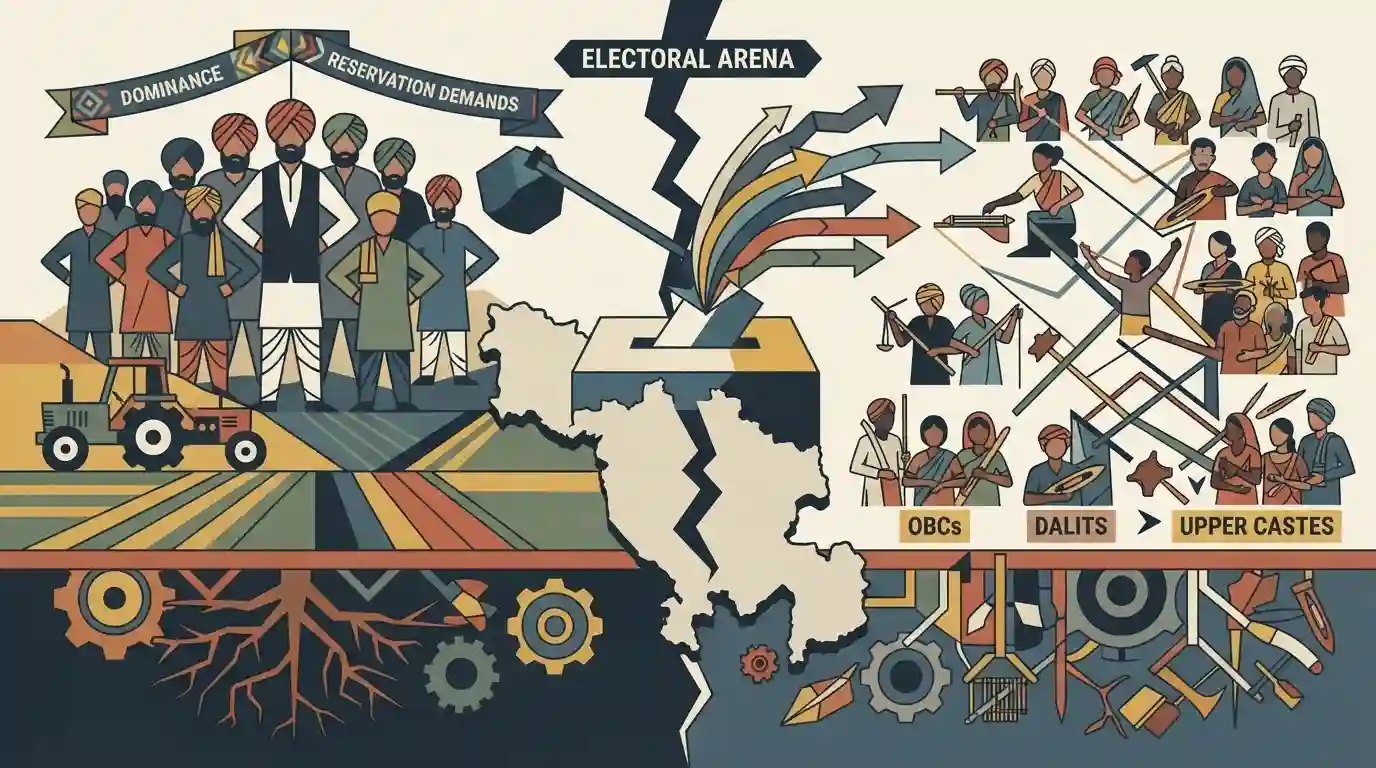
The article explores the pervasive socio-political fault line between the dominant Jat community and non-Jat groups in Haryana. It analyzes how this deep-seated caste polarization dictates the state's electoral strategies, with political parties actively seeking to consolidate non-Jat vote banks (such as OBCs, Dalits, and upper castes) to counterbalance Jat political influence. Rooted in historical agrarian dominance and intensified by reservation demands, this divide highlights the fluidity of caste identity and its continuous reinvention for political mobilization, reflecting broader trends in Indian state politics.
Key Points
- Caste remains the central organizing principle in Haryana's electoral politics, manifesting as a deep-seated Jat versus non-Jat polarization.
- The strategic consolidation of non-Jat voters—comprising OBCs, Dalits, and upper castes—has been effectively utilized to counter the political and demographic dominance of the Jat community.
- Socio-economic developments, including agrarian distress and the violent Jat reservation agitation, have exacerbated mutual distrust and widened social cleavages.
- This fault line exemplifies a broader national phenomenon where traditionally dominant agricultural communities face political challenges from united coalitions of non-dominant castes.
Important Terms
OBC Reservation Policy

Affirmative action providing quotas in government jobs and education for socially and educationally backward classes. In Haryana, dominant agrarian groups like Jats have intensely mobilized to secure this statutory status.
UPSC context
GS Paper 2 (Social Justice). Tests understanding of caste-based affirmative action, dominant caste mobilization, and statutory backwardness criteria.
Bharatiya Janata Party (BJP)
A major Indian national political party. In Haryana, its recent electoral strategy has focused on consolidating non-Jat voters, including Backward Classes and upper castes, often by elevating non-Jat leadership.
UPSC context
GS Paper 2 (Indian Polity). Important for analyzing state-level caste arithmetic, voter polarization, and political mobilization strategies.
Indian National Congress (INC)
One of India's principal national political parties. In Haryana's political landscape, the party has traditionally relied heavily on the dominant Jat community for its leadership base and core electoral support.
UPSC context
GS Paper 2 (Indian Polity). Demonstrates how national parties adapt to regional social fault lines and dominant caste structures.
Indian National Lok Dal (INLD)
A Haryana-based regional political party founded by Devi Lal. It traditionally champions agrarian and rural interests, heavily drawing its core political support from the state's dominant Jat community.
UPSC context
GS Paper 2 (Polity). Illustrates how regional political entities leverage specific caste and agrarian identities for electoral mobilization.
Prelims Trap
M.N. Srinivas\'s \'Dominant Caste\' concept requires a group to occupy the highest position in the traditional ritual Varna hierarchy.
Dominant caste status is determined by land ownership, numerical strength, and political power, not by occupying the highest ritual (Varna) position.
Static Concepts Connected
What are the core features of a "Dominant Caste" according to M.N. Srinivas?
- Numerical Strength: The group must have a significant demographic presence in the local or regional area.
- Economic/Political Power: Ownership of a major share of arable land, giving them leverage over other local groups.
- Ritual Status: They do not need to be at the very top of the traditional Varna hierarchy (like Brahmins).
What does Rajni Kothari\'s theory of the "Politicization of Caste" explain?
- Secularization of Caste: Traditional ritual caste identities morph into modern secular interest groups and voting blocs to demand representation.
- Coalition Building: Castes form horizontal alliances and associational groupings to negotiate with the state.
- Instrumental Power: Political parties use caste identities to mobilize voters, while castes use parties to access state resources.
Cross-Topic Patterns
Agrarian distress + Affirmative action demands
Shrinking landholdings and lack of non-farm jobs drive landowning castes to demand OBC status, linking agricultural distress to affirmative action politics.
Anti-dominant coalitions + Regional party survival
The consolidation of non-dominant castes (lower OBCs, Dalits) by national parties structurally challenges regional dominant-caste-led parties, reshaping state-level federal dynamics.

Agrarian distress shifting dominant castes to demand backward status is a high-yield theme for GS-I Society and GS-II Polity.
Linked PYQs · 3
Linked PYQs · 3
- 2018MainsGS1
Caste system is assuming new identities and associational forms. Hence, caste system cannot be eradicated in India." Comment.
- 2023MainsGS1
Why is caste identity in India both fluid and static?
- 2026PrelimsGS1
Consider the following assertion : The genesis of political alliances based on community lay in the very nature of the Montague-Chelmsford Reforms, 1919. Which of the following statements support/supports the above assertion ? 1. Reforms retained and extended the principle of separate electorates. 2. Separate electorates were supposed to counter Indian nationalism, which was growing stronger. 3. Deprived classes rallied around the favours inherent in separate electorates. Select the answer using the code given below :
