Legal Challenges in Criminalising Consensual Adolescent Relationships
Source:The Hindu ↗
Why It Matters
The POCSO Act is a landmark legislation frequently tested in UPSC GS-2. Understanding the debate surrounding the age of consent, the intersection with child marriage laws, and the Law Commission’s recommendations on judicial discretion is essential for analyzing the efficacy of child protection laws versus the unintended social consequences of blanket criminalisation.
Summary
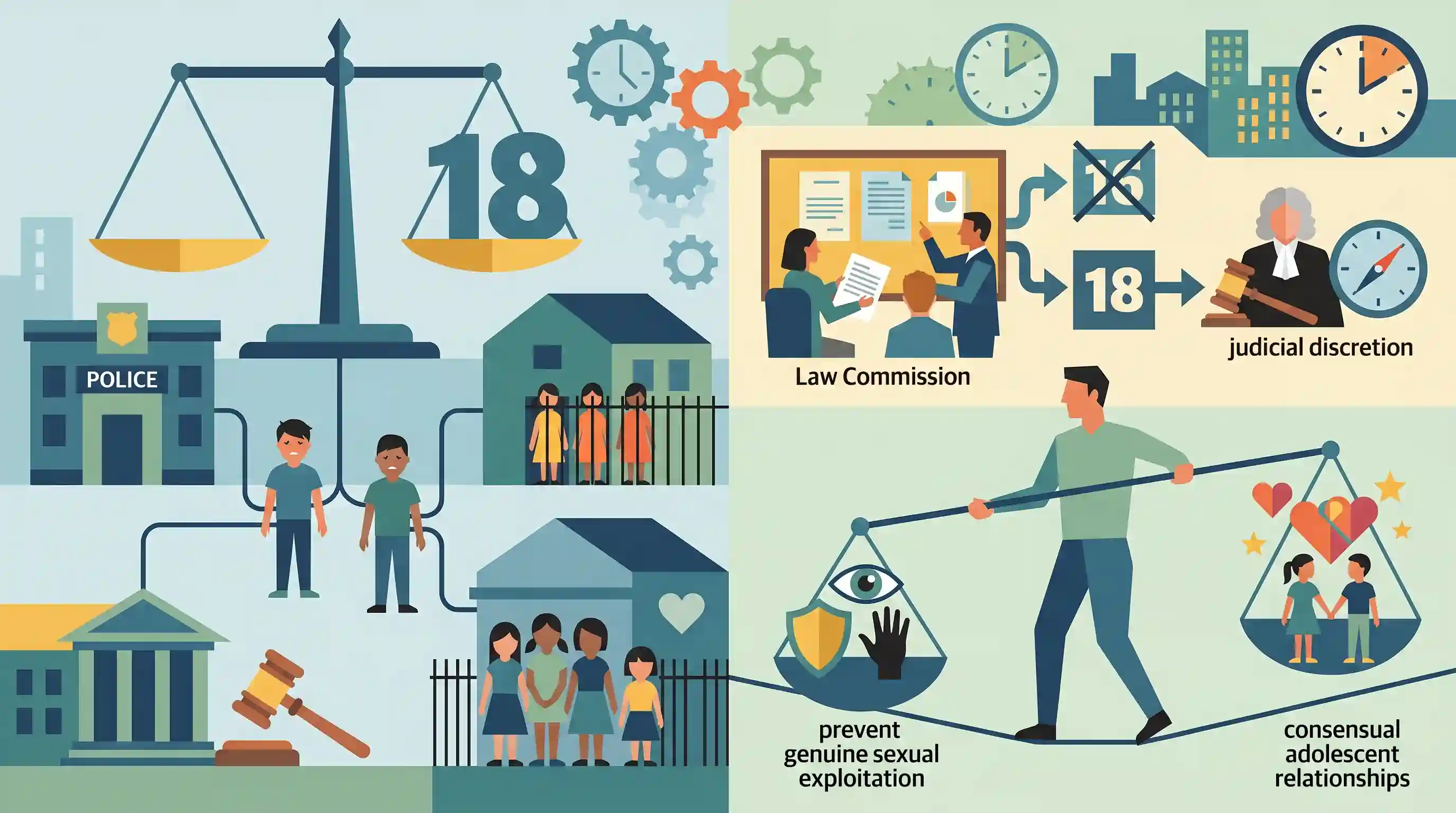
The strict application of the POCSO Act, which mandates 18 as the age of consent, has led to the inadvertent criminalisation of consensual adolescent relationships. This rigid stance routinely forces young boys into the criminal justice system and places young girls in shelter homes, deeply affecting their futures. Although the Law Commission's 274th Report rejected lowering the age of consent to 16, it highlighted the necessity of judicial discretion for cases involving adolescents aged 16 to 18. Policymakers face a delicate balancing act: protecting minors from genuine sexual exploitation while avoiding punitive measures against normal adolescent exploration and consensual relationships.
Key Points
- The POCSO Act sets the age of consent at 18, thereby criminalising all sexual acts involving adolescents below 18, irrespective of consent.
- This rigid legal framework has led to the incarceration of young boys and the institutionalisation of young girls in shelter homes, causing severe social and emotional trauma.
- The 274th Report of the Law Commission of India advised against lowering the age of consent to 16, instead recommending that courts be granted judicial discretion in sentencing cases of consensual adolescent relationships.
- There is an urgent need to align child protection laws with the social realities of adolescent development, preventing the criminal justice system from inadvertently penalising consensual youthful relationships.
Important Terms
Protection of Children from Sexual Offences (POCSO) Act, 2012

Comprehensive law enacted to protect individuals under 18 from sexual assault, harassment, and pornography. It is gender-neutral and defines any sexual act with a minor as a criminal offence, regardless of 'consent'.
UPSC context
GS Paper II: Social Justice; Laws for vulnerable sections. Focuses on legal protection of children and current debates on adolescent consensual relationships.
Age of Consent
The legal age at which a person is deemed capable of agreeing to sexual acts. In India, POCSO strictly sets this at 18, making all adolescent sexual intimacy below this age 'statutory rape'.
UPSC context
GS Paper II: Social Justice; Welfare of children. Tests understanding of the conflict between legal protection and adolescent autonomy.
Law Commission of India
An executive body that advises the government on legal reforms. Its 283rd Report (2023) recommended keeping the age of consent at 18 while introducing 'guided judicial discretion' for adolescent cases.
UPSC context
GS Paper II: Governance; Statutory/Executive bodies. Crucial for understanding legislative reform processes and recent recommendations on criminal law.
National Commission for Protection of Child Rights (NCPCR)
Statutory body established under the CPCR Act, 2005, to monitor and ensure implementation of child rights and laws like POCSO. It functions under the Ministry of Women and Child Development.
UPSC context
GS Paper II: Statutory, regulatory and various quasi-judicial bodies. Tests knowledge of institutional frameworks for child welfare.
Prohibition of Child Marriage Act (PCMA), 2006
Legislation aimed at preventing child marriages by defining the marriageable age as 18 for women and 21 for men. It intersects with POCSO when adolescent relationships involve elopement or marriage.
UPSC context
GS Paper II: Social Justice; Laws for vulnerable sections. Important for understanding contradictions in personal laws and child protection.
Judicial Discretion
A legal concept allowing judges to apply sentencing flexibility. The Law Commission suggests 'guided' discretion in POCSO cases where 16–18 year-olds are in consensual relationships to avoid disproportionate punishment.
UPSC context
GS Paper II: Judiciary/Governance. Tests knowledge of judicial powers in balancing law enforcement with social justice and specific case facts.
Prelims Trap
The Law Commission recommended lowering the POCSO age of consent to 16 for consensual relationships.
The Law Commission explicitly rejected lowering the age of consent. Instead, it recommended retaining it at 18 while introducing "guided judicial discretion" during sentencing.
Static Concepts Connected
What are the distinguishing legal features of the POCSO Act, 2012?
- Gender-neutrality: Defines a child as any person below 18 years, protecting both boys and girls from sexual exploitation.
- Mandatory reporting: Section 19 imposes strict legal obligations and penalties for failing to report known or suspected sexual offences against children.
- Reverse burden of proof: Departs from traditional criminal jurisprudence by presuming the culpable mental state of the accused, placing the burden of proof on them.
How do different Indian statutes create conflicting thresholds for adolescent agency?
- Juvenile Justice Act: Permits adolescents aged 16-18 to be tried as adults for 'heinous' crimes, recognizing their cognitive maturity.
- POCSO Act & BNS: Maintains a strict, inflexible age of consent at 18, completely denying adolescents the legal agency to consent to sexual acts.
- Prohibition of Child Marriage Act: Establishes differential ages for legal marriage (18 for women, 21 for men), further complicating uniform definitions of adulthood.
Cross-Topic Patterns
Right to Privacy vs. POCSO Mandates
Mandatory reporting under POCSO deters teenagers from accessing reproductive healthcare under the MTP Act, clashing with the Article 21 Right to Privacy established in the Puttaswamy judgment.
The Adolescent Legal Agency Paradox
The contradiction between recognizing criminal culpability (JJ Act trying 16-18 year-olds as adults) and the complete denial of sexual agency (POCSO) exposes a deep statutory paradox.

Expect a Mains GS2 question contrasting adolescent legal agency under the Juvenile Justice Act (culpability) versus the POCSO Act (consent).
Linked PYQs · 4
Linked PYQs · 4
- 2025MainsGS2
The National Commission for Protection of Child Rights has to address the challenges faced by children in the digital era. Examine the existing policies and suggest measures the Commission can initiate to tackle the issue.
- 2023MainsGS2
Explain the constitutional perspectives of Gender Justice with the help of relevant Constitutional Provisions and case laws.
- 2024MainsGS1
Despite comprehensive policies for equity and social justice, underprivileged sections are not yet getting the full benefits of affirmative action envisaged by the Constitution. Comment.
- 2018PrelimsGS1
International Labour Organization's Conventions 138 and 182 are related to
