Escalating Iran Conflict Poses Strategic Challenges for India
Source:The Hindu ↗
Why It Matters
West Asia is a critical region for India's energy needs, diaspora, and geostrategic connectivity. Conflict there impacts multiple syllabus areas, making it a high-probability topic for Mains GS2 (IR) and GS3 (Economy/Energy).
Summary
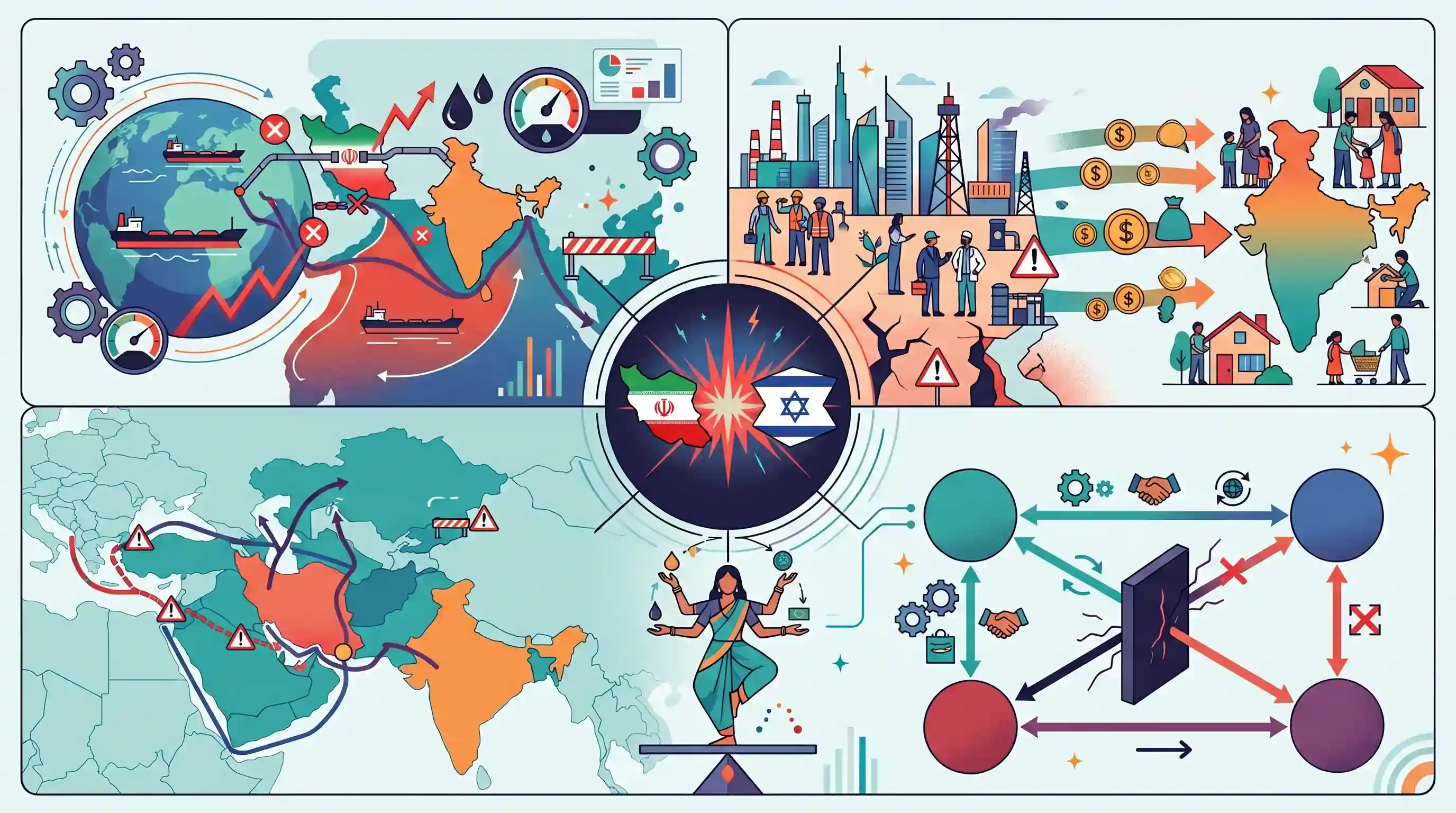
The escalating conflict involving Iran and Israel severely tests India's strategic balancing in West Asia. The crisis poses direct threats to India’s core interests, primarily energy security due to potential disruptions in global oil supplies, and the safety of the massive Indian diaspora in the Gulf, whose remittances are vital to the Indian economy. Additionally, the instability jeopardizes major connectivity initiatives like the Chabahar Port, the International North-South Transport Corridor (INSTC), and the recently proposed India-Middle East-Europe Economic Corridor (IMEC). As regional polarization deepens, New Delhi faces the complex challenge of maintaining its historically strong, multi-aligned relationships with Israel, Iran, and the Arab Gulf states without being drawn into the geopolitical crossfire.
Key Points
- Escalating Iran-Israel hostilities threaten India's delicate diplomatic balancing act in a highly polarized West Asia.
- The conflict risks disrupting oil supplies through key chokepoints like the Strait of Hormuz, heightening India's energy security vulnerabilities and risking imported inflation.
- The safety of millions of Indian expatriates working in the Gulf region remains a primary concern, alongside the potential economic hit from reduced remittances.
- Strategic connectivity projects vital for India's access to Central Asia and Europe, such as the INSTC, Chabahar Port, and IMEC, face severe operational and geopolitical hurdles.
- India must navigate its growing defense and technological ties with Israel while preserving its strategic partnership with Iran and deepening economic linkages with Arab states.
Important Terms
International North-South Transport Corridor (INSTC)

A 7,200-km multi-modal transportation network connecting India to Russia and Europe via Iran. It aims to reduce trade transit time and costs significantly.
UPSC context
GS II: Regional groupings involving India; tests connectivity strategies and trade diversification away from traditional maritime routes.
India-Middle East-Europe Economic Corridor (IMEC)
A multi-modal connectivity initiative launched at G20 2023 to link India, the Middle East, and Europe through ports, railways, and energy pipelines.
UPSC context
GS II: Policies of developed/developing countries; tests India's infrastructure diplomacy and strategic response to China's Belt and Road Initiative.
I2U2
A mini-lateral grouping consisting of India, Israel, the UAE, and the USA, focusing on geoeconomic cooperation in water, energy, and transportation.
UPSC context
GS II: Bilateral and regional groupings; tests India's 'multi-alignment' strategy and deepening economic footprint in West Asia.
Abraham Accords
U.S.-brokered 2020 normalization agreements between Israel and several Arab nations (UAE, Bahrain, Morocco), reshaping West Asian geopolitics.
UPSC context
GS II: Politics of developing countries; tests understanding of the diplomatic shift that allowed India to engage Israel and Arabs simultaneously.
Chabahar Port
Iran's only oceanic port, developed by India to provide a trade gateway to Afghanistan and Central Asia that bypasses Pakistan.
UPSC context
GS II: India’s 'Extended Neighborhood' policy; tests strategic autonomy and India's counter-encirclement tactics (e.g., against Gwadar).
Shanghai Cooperation Organization (SCO)
A Eurasian political, economic, and security alliance including India, Russia, China, and Iran (full member since 2023).
UPSC context
GS II: Important international institutions; tests India’s balancing act between non-Western groupings and Western-led partnerships.
Prelims Trap
Chabahar port is located inside the Persian Gulf, requiring ships to cross the Strait of Hormuz.
Chabahar is located on the Makran coast in the Gulf of Oman, explicitly allowing India to bypass both Pakistan and the Strait of Hormuz.
Static Concepts Connected
What are the key maritime chokepoints in West Asia?
- Strait of Hormuz: Connects the Persian Gulf to the Gulf of Oman and the Arabian Sea. Bordered by Iran, Oman, and the UAE.
- Bab-el-Mandeb: Connects the Red Sea to the Gulf of Aden and the Arabian Sea. Bordered by Yemen, Djibouti, and Eritrea.
- Suez Canal: An artificial sea-level waterway in Egypt, connecting the Mediterranean Sea to the Red Sea.
What is India's 'De-hyphenation' policy in foreign affairs?
- Core Definition: Engaging with two rival regional powers independently, assessing bilateral ties on their own merit without letting the relationship with one dictate terms with the other.
- Israel and Palestine: Historically seen in India treating relations with Israel and Palestine separately, rather than as a zero-sum game.
- Iran vs. Israel/Gulf: Balancing strategic connectivity investments (Chabahar) with Iran against deep defense/tech ties with Israel and energy/diaspora ties with Arab states.
Cross-Topic Patterns
Gulf Crisis & Macroeconomic Stability
Conflict threatens the safety of Indian expats in the Gulf. A sudden drop in inward remittances directly worsens India's Current Account Deficit (CAD) and impacts Rupee stability.
Competing Geoeconomic Corridors in West Asia
The INSTC (India-Iran-Russia) and IMEC (India-Gulf-Europe) represent contrasting geopolitical alignments converging in West Asia. Both corridors are vulnerable to the expanding Iran-Israel war.

Expect a 2026 Prelims mapping question testing the exact routing of IMEC vs. INSTC, paired with locations of West Asian maritime straits.
Linked PYQs · 4
Linked PYQs · 4
- 2025MainsGS2
"Energy security constitutes the dominant kingpin of India's foreign policy, and is linked with India's overarching influence in Middle Eastern countries.” How would you integrate energy security with India's foreign policy trajectories in the coming years?
- 2018MainsGS2
“India’s relations with Israel have, of late, acquired a depth and diversity, which cannot be rolled back.” Discuss.
- 2017MainsGS2
The question of India's Energy Security constitutes the most important part of India's economic progress. Analyze India's energy policy cooperation with West Asian countries.
- 2018MainsGS2
A number of outside powers have entrenched themselves in Central Asia, which is a zone of interest to India. Discuss the implications, in this context, of India's joining the Ashgabat Agreement, 2018.
