Iran Geopolitical Resilience and Shift Toward Multipolar Order
Source:The Hindu ↗
Why It Matters
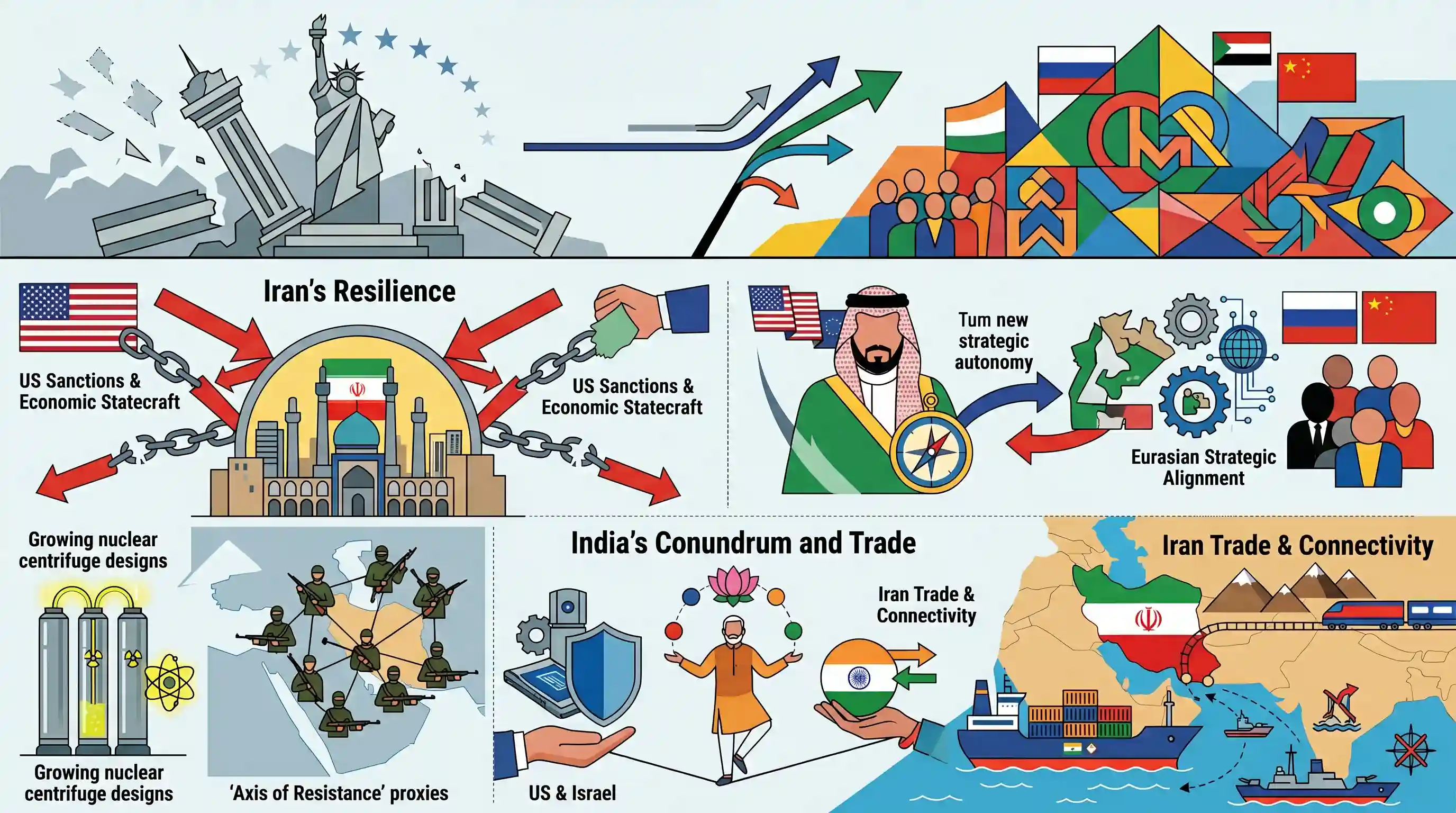
This topic is central to the UPSC GS Paper 2 syllabus on international relations and global geopolitics. It illustrates how the erosion of Western deterrence and the rise of a multipolar order directly affect India's energy security, regional connectivity (via the Chabahar Port and INSTC), and its capacity to exercise strategic autonomy in a highly contested geopolitical landscape.
Summary
The article analyzes the 'Iran conundrum' as a clear indicator of the structural decline of Western hegemony and military-diplomatic deterrence in West Asia and the global arena. Despite continuous Western efforts to isolate and sanction Tehran, Iran has successfully maintained its regional influence, enriched uranium to near-weapons grade, and integrated into the emerging Eurasian economic and security architecture alongside Russia and China. The rising power of its 'Axis of Resistance' proxies and the shift towards strategic autonomy by regional states like Saudi Arabia collectively signal a transition from a Western-dominated unipolar system to a multipolar world order. For India, this changing dynamic complicates its delicate balancing act of maintaining strong ties with the US and Israel while pursuing crucial trade and connectivity corridors, such as Chabahar Port and the INSTC, with Iran.
Key Points
- Failure of Sanctions and Maximum Pressure: Decades of severe economic sanctions by the West have failed to collapse the Iranian regime or compel its submission. Instead, Iran has built a resilient 'resistance economy' and adapted to long-term economic isolation.
- The Eurasian Pivot: To bypass Western isolation, Iran has successfully pivoted eastward, strengthening strategic, military, and energy ties with Russia and China. This integration is cemented by its full membership in key non-Western groupings like the SCO and BRICS.
- Asymmetric Regional Deterrence: Through its 'Axis of Resistance' (including Hezbollah, the Houthis, and Hamas), Iran has established robust regional deterrence. The Houthis' disruption of Red Sea shipping lanes has shown the limits of Western maritime control and military deterrence.
- Emergence of Multipolarity and Strategic Autonomy: Traditional Western allies in West Asia, such as Saudi Arabia and the UAE, are actively hedging their positions. The Chinese-brokered Saudi-Iran normalization highlights the declining diplomatic monopoly of the United States in the region.
- The Strategic Western Dilemma: The West is caught in a policy dead-end. Military action against Iran risks triggering a catastrophic regional conflict and global economic shocks, while diplomacy has stalled after the unilateral US exit from the JCPOA, leaving the West with highly limited leverage.
Important Terms
Joint Comprehensive Plan of Action (JCPOA)

A 2015 landmark nuclear agreement between Iran and the P5+1 powers that restricted Iran's uranium enrichment and nuclear program in exchange for global sanctions relief.
UPSC context
GS Paper II (International Relations). Tests global non-proliferation, West Asian geopolitics, and impacts on India's energy security.
International North-South Transport Corridor (INSTC)
A 7,200 km-long multimodal transportation network of ship, rail, and road routes connecting India, Iran, Azerbaijan, and Russia to bypass traditional maritime bottlenecks and boost Eurasian trade.
UPSC context
GS Paper II (International Relations/Connectivity). Tests knowledge of Eurasian connectivity corridors bypassing Pakistan.
Axis of Resistance
An informal military and political coalition led by Iran, uniting regional state and non-state actors like Hezbollah and the Houthis to counter Western and Israeli influence.
UPSC context
GS Paper II (International Relations). Tests understanding of regional proxy networks and Middle Eastern conflict dynamics.
Abraham Accords
A series of 2020 agreements normalizing diplomatic and economic relations between Israel and several Arab nations, including the UAE, Bahrain, Morocco, and Sudan, brokered by the US.
UPSC context
GS Paper II (International Relations). Tests regional realignments in West Asia and implications for India's balancing act.
Ashgabat Agreement
A multimodal transport agreement signed by Central Asian nations, Iran, Oman, and India to create an international transit corridor facilitating trade between Central Asia and the Persian Gulf.
UPSC context
GS Paper II (International Relations/Connectivity). Tests connectivity policies (Connect Central Asia) and trade diversification.
Prelims Trap
Chabahar Port, located on the Persian Gulf, provides India with a strategic alternative route to Afghanistan and Central Asia.
Chabahar is strategically located on the Makran coast of Iran along the Gulf of Oman, not the Persian Gulf. UPSC frequently swaps these adjacent water bodies to confuse candidates.
Static Concepts Connected
What are the primary maritime chokepoints in West Asia and their strategic significance?
- Strait of Hormuz: Connects the Persian Gulf to the Gulf of Oman; acts as the world's most critical energy transit bottleneck, handling over 20% of global petroleum.
- Bab-el-Mandeb: Connects the Red Sea to the Gulf of Aden; serves as the southern gate to the Suez Canal, highly vulnerable to asymmetric geopolitical disruptions.
- Economic Vulnerability: Disruptions at these narrow channels force global shipping to bypass Africa, drastically increasing cargo transit times, insurance premiums, and freight costs.
How does the International North-South Transport Corridor (INSTC) function?
- Multimodal Design: A 7,200-km-long multimodal network utilizing vessel, rail, and road routes to move freight between India, Iran, Azerbaijan, and Russia.
- Founding Members: Initiated in 2000 by India, Iran, and Russia, it has expanded to include eleven other Central Asian and Eurasian member states.
- Strategic Objective: Bypasses Pakistan to access Central Asia, reducing cargo transit times by approximately 40% and transport costs by 30% compared to the Suez route.
Cross-Topic Patterns
Infrastructure corridors vs. unilateral sanctions
Examines how India's strategic infrastructure projects like Chabahar navigate unilateral US sanctions, testing India's execution of strategic autonomy while maintaining deep security ties with Washington.
Multi-vector diplomacy in West Asia
Shifting West Asian dynamics (Saudi-Iran thaw vs. Abraham Accords) force India to evolve its de-hyphenated policy into an active multi-vector alignment spanning both I2U2 and INSTC.

2026 Exam: India's balancing of INSTC/Chabahar against I2U2 and IMEC will likely be framed as a test of strategic autonomy in West Asia.
Linked PYQs · 3
Linked PYQs · 3
- 2018MainsGS2
In what ways would the ongoing US-Iran Nuclear Pact Controversy affect the national interest of India? How should India respond to this situation?
- 2012MainsGS2
How have the US sanctions against Iran affected India's bilateral relations with Iran?
- 2026PrelimsGS1
Ships from which of the following countries have to cross the Strait of Hormuz to reach out to the Indian Ocean ? 1. Bahrain 2. Syria 3. Qatar 4. Egypt Select the answer using the code given below :
