Corporate Governance and Ethical Challenges in Artificial Intelligence
Source:The Hindu ↗
Why It Matters
The ethical deployment of emerging technologies is a crucial theme for UPSC aspirants, bridging GS3 (Technology) and GS4 (Ethics). Understanding the trade-offs between capital-driven AI innovation and corporate responsibility is essential for answering questions on technology regulation, data privacy, and the societal impacts of AI.
Summary
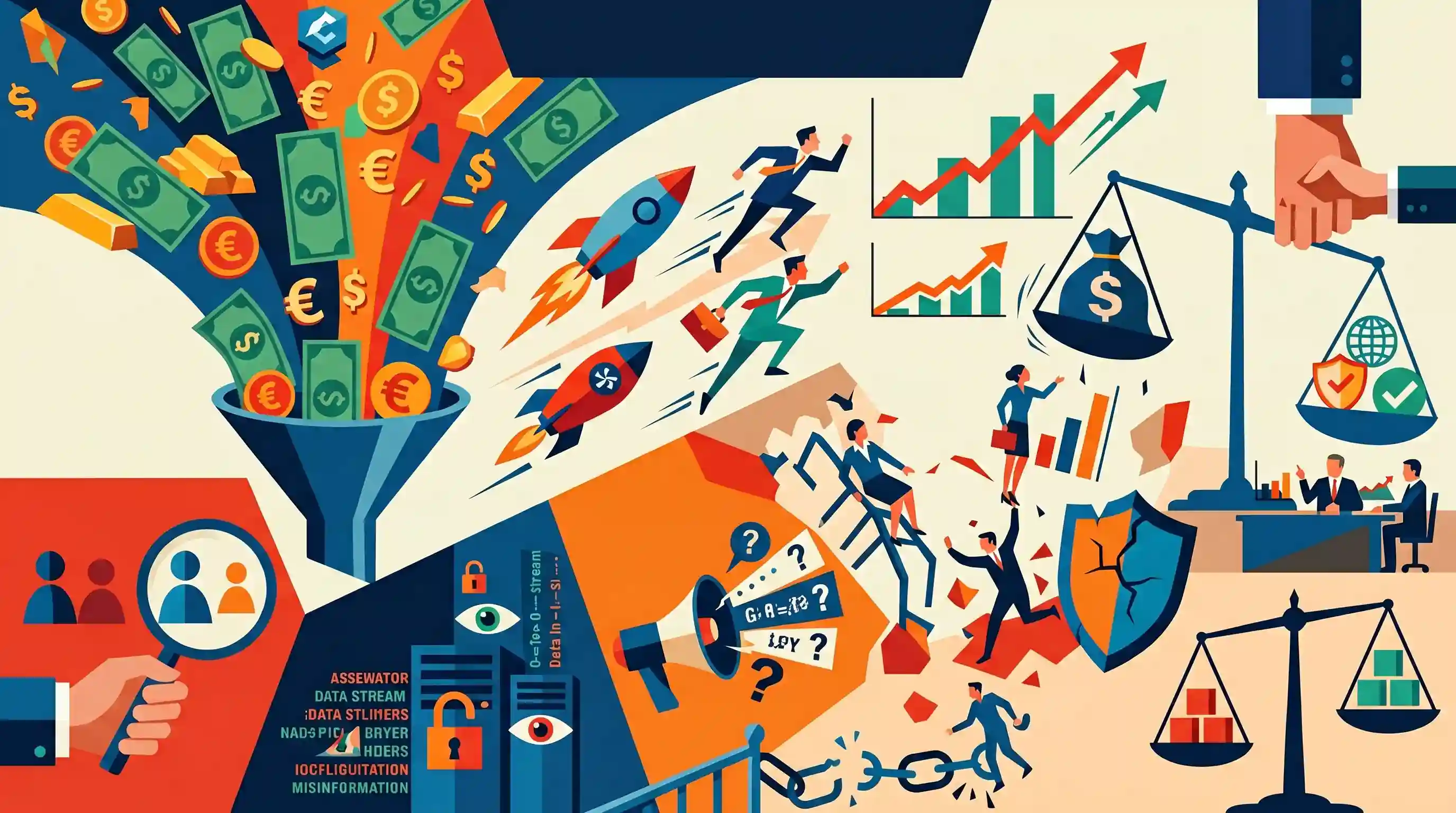
The article introduces the 'Inverse Law of AI,' a phenomenon where the massive influx of capital into artificial intelligence companies leads to a corresponding decline in corporate responsibility and safety standards. As tech giants engage in a fierce race to commercialize generative AI and maximize shareholder value, they increasingly deprioritize ethical considerations, often downsizing or eliminating their internal AI ethics teams. This profit-driven approach prioritizes rapid innovation and market dominance over the mitigation of critical risks such as algorithmic bias, data privacy breaches, and misinformation. The piece argues that self-regulation by the industry is insufficient and calls for robust external regulatory frameworks to ensure that AI development aligns with societal well-being and corporate accountability.
Key Points
- The 'Inverse Law of AI' suggests that as capital investment and valuations of AI companies increase, their commitment to ethical responsibility and safety proportionately decreases.
- Intense market competition and the race to commercialize generative AI compel tech giants to prioritize rapid deployment and profitability over rigorous safety testing and ethical alignment.
- Many leading AI companies have systematically downsized or disbanded their internal ethics and safety teams to accelerate product launches.
- The article highlights that self-regulation in the AI industry is failing, underscoring the urgent need for comprehensive government regulations to ensure corporate accountability.
- Unchecked AI development driven purely by capital poses significant societal risks, including algorithmic bias, data privacy violations, and the unchecked spread of misinformation.
Important Terms
Big Tech

A term describing the world's largest and most dominant technology companies (such as Google, Amazon, Microsoft, and Meta) that wield significant influence over digital markets, data privacy, and global information flow.
UPSC context
GS Paper III (Economy/IT) and IV (Ethics); tests understanding of market monopolies, data sovereignty, and corporate influence on democratic processes.
Inverse Law of AI
A conceptual phenomenon where massive capital investment in artificial intelligence leads to a decline in corporate responsibility and safety standards as firms prioritize speed and market dominance over ethical safeguards.
UPSC context
GS Paper IV (Ethics); tests the ability to analyze the conflict between profit-driven innovation and public welfare in emerging technologies.
Generative AI (GenAI)
A branch of AI capable of creating new content (text, images, code) by learning patterns from existing data, raising concerns regarding misinformation, intellectual property, and social impact.
UPSC context
GS Paper III (Science & Technology); essential for understanding current IT developments and their diverse applications or risks in everyday life.
Algorithmic Bias
Systematic and repeatable errors in computer systems that create unfair outcomes, such as privileging one demographic over another, often stemming from biased training data or flawed algorithmic design.
UPSC context
GS Paper III and IV; tests understanding of technology's socio-economic effects and the ethical imperative for fairness in automated decision-making.
Corporate Governance
The system of rules, practices, and processes by which a company is directed and controlled, balancing the interests of stakeholders, management, customers, and society.
UPSC context
GS Paper IV (Ethics) and Paper II (Governance); fundamental for questions on business ethics, accountability, and the role of boards in risk management.
Responsible AI
The framework for developing and deploying AI systems with transparency, accountability, and fairness, ensuring that technological advancements align with human rights and societal well-being.
UPSC context
GS Paper III (S&T) and Paper IV; relates to global and national policy frameworks like NITI Aayog's "AI for All" strategy.
Prelims Trap
"The Bletchley Declaration on AI safety is a legally binding international treaty administered by the UN."
It is a voluntary, non-binding political declaration signed by countries including India, the US, and China to foster collaboration, not a UN treaty.
Static Concepts Connected
How does the EU AI Act's regulatory framework differ from India's current AI policy?
- EU AI Act: Categorizes AI into four tiers (unacceptable to minimal risk) with strict, legally binding compliance mandates for high-risk systems.
- India's Approach: Pro-innovation and currently non-statutory, relying on NITI Aayog's #AIforAll framework, ethical guidelines, and the upcoming IndiaAI mission.
- Data Protection: India presently addresses AI-related privacy harms indirectly through the consent framework of the Digital Personal Data Protection (DPDP) Act, 2023.
What constitutes 'Algorithmic Bias' in the context of Artificial Intelligence?
- Definition: Systematic and repeatable errors in an AI model that create unfair outcomes, disproportionately disadvantaging specific demographics or groups.
- Root Causes: Arises from skewed, unrepresentative historical training data or the unconscious prejudices of the human developers programming the model.
- Real-world Impact: Leads to discriminatory outcomes in critical, high-stakes sectors like recruitment, predictive policing, and credit scoring.
Cross-Topic Patterns
Shareholder Capitalism vs. Tech Ethics
The systemic downsizing of AI ethics teams perfectly illustrates the GS-IV conflict where shareholder wealth maximization overrides stakeholder well-being and corporate social responsibility.
Gen-AI Scraping & Privacy Laws
Unchecked AI data-mining tests the limitations of India's DPDP Act, specifically challenging the principles of purpose limitation, explicit consent, and the right to be forgotten.

Expect a 2026 Mains GS-IV question linking Big Tech's profit motive to the failure of AI self-regulation and the need for state oversight.
Linked PYQs · 4
Linked PYQs · 4
- 2024MainsGS4
ABC Incorporated is a technological company named which is the second largest worldwide, situated in the Third World. You are the Chief Executive Officer and the majority shareholder of this company. The fast technological improvements have raised worries among environmental activists, regulatory authorities, and the general public over the sustainability of this scenario. You confront substantial issues about the business's environmental footprint. In 2023, your organization had a significant increase of 48% in greenhouse gas emissions compared to the levels recorded in 2019. The significant rise in energy consumption is mainly due to the surging energy requirements of your data centers, fuelled by the exponential expansion of Artificial Intelligence (AI). AI-powered services need much more computational resources and electrical energy compared to conventional online activities, notwithstanding their notable gains. The technology's proliferation has led to a growing concern over the environmental repercussions, resulting in an increase in warnings. Al models, especially those used in extensive machine learning and data processing, exhibit much greater energy consumption than conventional computer tasks, with an exponential increase. Although there is already a commitment and goal to achieve net zero emissions by 2030, the challenge of lowering emissions seems overwhelming as the integration of Al continues to increase. To achieve this goal, substantial investments in renewable energy use would be necessary. The difficulty is exacerbated by the competitive environment of the technology sector, where rapid innovation is essential for preserving market standing and shareholders' worth. To achieve a balance between innovation, profitability and sustainability, a strategic move is necessary that is in line with both, business objectives and ethical obligations. (a) What is your immediate response to the challenges posed in the above case? (b) Discuss the ethical issues involved in the above case. (c) Your company has been identified to be penalized by technological giants. What logical and ethical arguments will you put forth to convince about its necessity? (d) Being a conscience being, what measures would you adopt to maintain balance between AI innovation and environmental footprint?
- 2024MainsGS4
The application of Artificial Intelligence as a dependable source of input for administrative rational decision-making is a debatable issue. Critically examine the statement from the ethical point of view.
- 2023MainsGS3
Introduce the concept of Artificial Intelligence (AI). How does Al help clinical diagnosis? Do you perceive any threat to privacy of the individual in the use of Al in healthcare?
- 2020PrelimsGS1
With the present state of development, Artificial Intelligence can effectively do which of the following? 1. Bring down electricity consumption in industrial units 2. Create meaningful short stories and songs 3. Disease diagnosis 4. Text-to-Speech Conversion 5. Wireless transmission of electrical energy Select the correct answer using the code given below:
