Neutrino Observatories and Mega Science Project Delays
Source:The Hindu ↗
Why It Matters
The article provides an excellent case study for GS3 (Science & Technology and Environment), illustrating the challenges of executing 'Big Science' projects in India. It demonstrates the real-world impact of environmental activism and EIA processes on scientific infrastructure, directly relevant to mains questions on project delays, governance, and India's standing in fundamental research compared to countries like China.
Summary
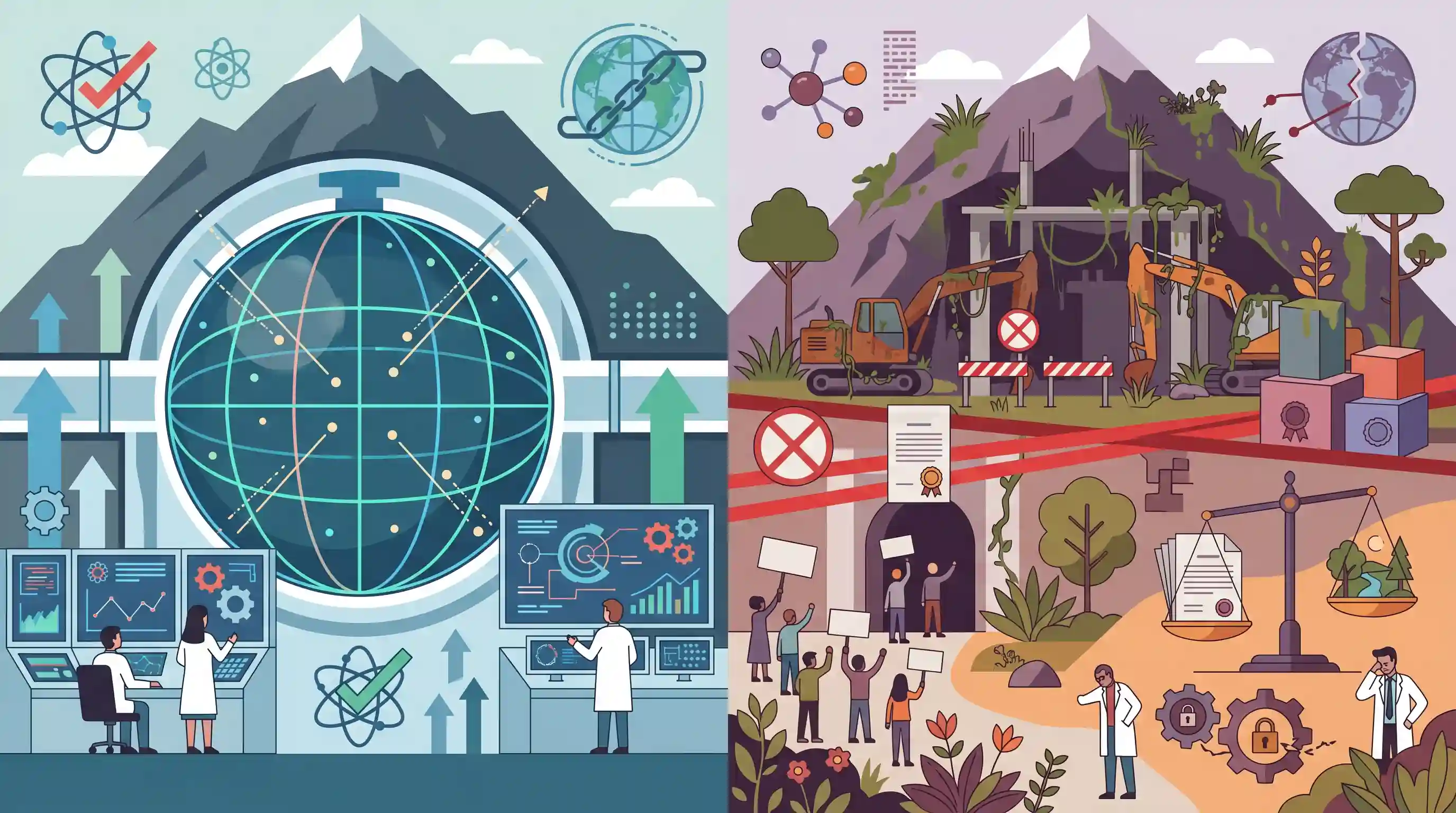
The article contrasts the successful execution of China’s Jiangmen Underground Neutrino Observatory (JUNO) with the stagnation of the India-based Neutrino Observatory (INO). While JUNO is set to make groundbreaking discoveries regarding neutrino mass, India's INO project has been paralyzed for decades due to environmental protests and regulatory roadblocks in Tamil Nadu. This disparity underscores the systemic difficulties India faces in implementing mega science projects, particularly when balancing scientific advancement with environmental conservation and public consensus. The demise of INO represents a significant missed opportunity for Indian particle physics on the global stage.
Key Points
- China’s Jiangmen Underground Neutrino Observatory (JUNO) is nearing completion and will soon help determine the neutrino mass hierarchy, a fundamental physics mystery.
- In stark contrast, the India-based Neutrino Observatory (INO), planned in Tamil Nadu's Theni district, has been practically shelved after more than two decades of delays.
- The INO faced insurmountable hurdles due to environmental protests, concerns over the Western Ghats ecology, and prolonged delays in securing regulatory and environmental clearances.
- The diverging fates of INO and JUNO highlight systemic challenges in India regarding the execution of mega science projects, public consensus building, and the friction between scientific infrastructure and environmental activism.
- Neutrinos are highly abundant, weakly interacting elementary particles; studying them is crucial for advancing the Standard Model of particle physics.
Important Terms
India-based Neutrino Observatory (INO)

A stalled particle physics project in Theni, Tamil Nadu, designed to study atmospheric neutrinos in an underground laboratory to determine their mass and properties.
UPSC context
GS Paper 3: Science & Tech; mega-science projects, delays in scientific infrastructure, and federal-state governance challenges.
Jiangmen Underground Neutrino Observatory (JUNO)
China's massive underground liquid scintillator detector that became operational in 2025, aiming to solve the neutrino mass hierarchy problem and study cosmic neutrinos.
UPSC context
GS Paper 3: Science & Tech; global scientific competition and China's leadership in high-energy physics.
Environmental Impact Assessment (EIA)
A statutory process under the Environment Protection Act, 1986, to evaluate and mitigate the environmental consequences of a proposed development project before approval.
UPSC context
GS Paper 3: Environment; essential for balancing developmental goals with ecological preservation (e.g., INO and tiger corridors).
Standard Model of Particle Physics
The foundational theoretical framework in physics that describes all known elementary particles and three of the four fundamental forces (excluding gravity).
UPSC context
GS Paper 3: Science & Tech; testing fundamental theories and identifying 'new physics' (e.g., neutrino mass).
Neutrino Mass Hierarchy
The unresolved question of which of the three neutrino types is the heaviest, a discovery critical for understanding the early universe's evolution.
UPSC context
GS Paper 3: Science & Tech; specific focus on particle physics and the objectives of global neutrino experiments.
Prelims Trap
Neutrino observatories must be built deep underground to contain the dangerous radiation produced by neutrino collisions.
Observatories are built deep underground to use the earth's crust as a shield against background cosmic rays, not to contain radiation. Neutrinos are harmless and pass through matter.
Static Concepts Connected
What are neutrinos and why are they hard to detect?
- Basic properties: They are elementary particles that are electrically neutral, have near-zero mass, and interact very weakly with normal matter.
- Cosmic abundance: They are the second most abundant elementary particles in the universe, outnumbered only by photons.
- Underground shielding: Observatories require massive detectors deep underground to use rock as a filter, blocking out cosmic rays that would otherwise drown out faint neutrino signals.
How does environmental regulation govern mega-projects in the Western Ghats?
- Eco-Sensitive Zones (ESZ): Areas are notified under the Environment Protection Act 1986 to act as shock absorbers for protected wildlife, heavily regulating large construction and industrial operations.
- Key Committees: The Madhav Gadgil and Kasturirangan committees recommended varying degrees of developmental restrictions to protect the Ghats' fragile biodiversity from mega-projects.
Cross-Topic Patterns
Big Science vs. EIA mandates
The INO's stagnation mirrors hurdles faced by LIGO-India, highlighting systemic friction between statutory environmental protections in Eco-Sensitive Zones and the execution of strategic scientific infrastructure.
Standard Model's missing pieces
Determining neutrino mass hierarchy (JUNO's goal) directly addresses gaps in the classical Standard Model, linking this news to past UPSC Prelims questions on the Higgs Boson and fundamental forces.

Expect a 2026 Prelims question linking neutrino properties (charge, mass) to the specific need for deep-underground observatories.
Linked PYQs · 3
Linked PYQs · 3
- 2010PrelimsGS1
India-based Neutrino Observatory is included by the Planning Commission as a mega science project under the 11th Five-Year Plan. In this context, consider the following statements: 1. Neutrinos are chargeless elementary particles that travel close to the speed of light. 2. Neutrinos are created in nuclear reactions of beta decay. 3. Neutrinos have a negligible, but nonzero mass. 4. Trillions of Neutrinos pass through human body every second. Which of the statements given above are correct?
- 2024MainsGS3
What role do environmental NGOs and activists play in influencing Environmental Impact Assessment (EIA) outcomes for major projects in India? Cite four examples with all important details.
- 2013PrelimsGS1
The efforts to detect the existence of Higgs boson particle have become frequent news in the recent past. What is/are the importance/importances of discovering this particle?
