Summary Revision of Electoral Rolls and Procedural Flaws
Source:The Hindu ↗
Why It Matters
The integrity of the electoral roll is the bedrock of free and fair elections. Errors such as voter suppression or bogus entries directly violate Article 326 (adult suffrage) and are heavily tested in UPSC under the Representation of the People Acts (1950 & 1951) and electoral reforms.
Summary
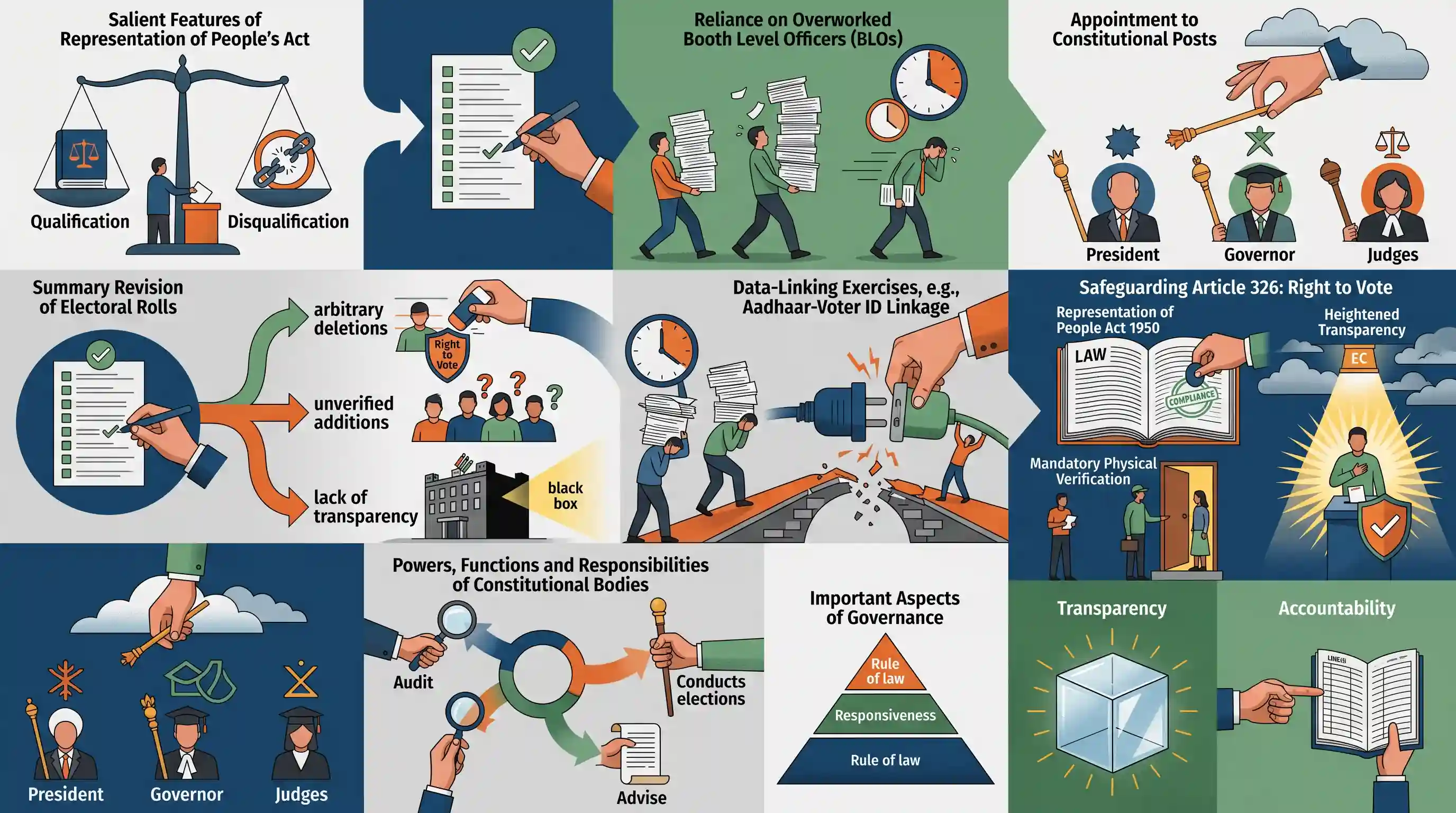
The article critically examines the systemic and procedural flaws in the Summary Revision of electoral rolls conducted by the Election Commission of India. While updating voter lists is crucial for democracy, the process is frequently marred by arbitrary deletions, unverified additions, and a lack of transparency, often resulting in genuine voters being denied their franchise. The reliance on overworked Booth Level Officers (BLOs) and controversial data-linking exercises, such as the Aadhaar-Voter ID linkage, have exacerbated exclusion errors. The author calls for rigorous compliance with the Representation of the People Act, 1950, mandatory physical verification before deletions, and heightened transparency by the ECI to safeguard the constitutional right to vote under Article 326.
Key Points
- The Summary Revision of electoral rolls is a statutory exercise mandated by the Representation of the People Act, 1950 to update voter lists by adding eligible citizens and removing deceased or shifted voters.
- A major infirmity in the process is the arbitrary deletion of genuine voters without adequate door-to-door verification by Booth Level Officers (BLOs), leading to mass disenfranchisement.
- Efforts to sanitize the rolls through data integration, such as linking Aadhaar with Electoral Photo Identity Cards (EPIC), have sparked concerns over exclusion errors and privacy violations.
- The Election Commission of India (ECI) is urged to enforce stricter procedural safeguards, ensure transparency in the publication of draft rolls, and provide robust grievance redressal mechanisms to protect universal adult suffrage.
Important Terms
Representation of the People Act, 1950

A legal framework providing for the allocation of seats, delimitation of constituencies, voter qualifications, and the preparation/revision of electoral rolls.
UPSC context
GS II: Salient features of the RPA; tests understanding of the structural foundations of Indian elections.
Representation of the People Act, 1951
Legislation governing the actual conduct of elections, qualifications and disqualifications of members, administrative machinery, and the resolution of election disputes.
UPSC context
GS II: Salient features of RPA; tests knowledge of election procedures and candidate eligibility.
Election Commission of India (ECI)
An autonomous constitutional authority established under Article 324 to administer election processes for Parliament, State Legislatures, and the offices of President and Vice-President.
UPSC context
GS II: Constitutional bodies and their powers; tests knowledge of electoral oversight and integrity.
Article 326
A constitutional provision establishing universal adult suffrage, granting every citizen aged 18 and above the right to vote unless disqualified by law.
UPSC context
GS II: Constitutional provisions and rights; tests understanding of the legal basis for democratic participation.
Booth Level Officer (BLO)
A grass-roots representative of the ECI, typically a local government employee, responsible for field verification and maintaining accurate electoral rolls at the booth level.
UPSC context
GS II: Governance and electoral processes; tests awareness of administrative machinery in grassroots democracy.
Summary Revision
The periodic process of updating electoral rolls through claims and objections to include new voters and delete ineligible ones before an election.
UPSC context
GS II: Governance, transparency, and accountability; tests knowledge of procedural measures to ensure voter inclusion.
Prelims Trap
"The Representation of the People Act, 1951 governs the preparation and revision of electoral rolls."
The preparation, summary revision, and maintenance of electoral rolls are governed by the RPA 1950. The RPA 1951 deals with the actual conduct of elections.
Static Concepts Connected
Is the Right to Vote in India a Constitutional or Statutory right?
- Constitutional Basis: Article 326 guarantees universal adult suffrage, making the 'Right to Vote' fundamentally a Constitutional Right (as definitively established by UPSC's 2017 official Prelims answer key).
- Statutory Mechanism: The RPA 1950 operationalizes this constitutional right by defining exact voter qualifications, criteria for disqualifications (e.g., non-residence, unsound mind), and the mechanics of electoral rolls.
What is the division of scope between RPA 1950 and RPA 1951?
- RPA 1950: Focuses on pre-election structural mechanics: allocation of seats, delimitation of constituencies, and the preparation, revision, and updating of electoral rolls.
- RPA 1951: Focuses on election execution: the actual conduct of polls, qualifications/disqualifications of MPs/MLAs, defining corrupt practices, and post-election dispute resolution.
Cross-Topic Patterns
Electoral Rolls & Right to Privacy
The Aadhaar-Voter ID linkage debate connects the Election Laws (Amendment) Act, 2021 directly to the K.S. Puttaswamy judgment's proportionality test and concerns over mass algorithmic exclusion.
ECI Autonomy & Institutional Trust
Debates over arbitrary voter deletions merge into larger GS2 themes regarding the Election Commission's independence, especially following the controversial CEC and ECs (Appointment, Conditions of Service and Term of Office) Act, 2023.

RPA 1950 vs 1951 distinctions paired with the 2021 Amendment (four qualifying dates for voters) is highly probable in a 2026 Prelims MCQ.
Linked PYQs · 5
Linked PYQs · 5
- 2017PrelimsGS1
Right to vote and to be elected in India is a
- 2020PrelimsGS1
Consider the following statements: 1. According to the Constitution of India, a person who is eligible to vote can be made a minister in a State for six months even if he/she is not a member of the Legislature of that State. 2. According to the Representation of People Act, 1951, a person convicted of a criminal offence and sentenced to imprisonment for five years is permanently disqualified from contesting an election even after his release from prison. Which of the statements given above is/are correct?
- 2024MainsGS2
Examine the need for electoral reforms as suggested by various committees with particular reference to "one nation one election" principle.
- 2022MainsGS2
Discuss the role of the Election Commission of India in the light of the evolution of the Model Code of Conduct.
- 2019MainsGS2
On what grounds a people's representative can be disqualified under the Representation of Peoples Act, 1951? Also mention the remedies available to such person against his disqualification.
