Spatial AI Data Training Poses Automation Risk to Informal Workers
Source:The Hindu ↗
Why It Matters
It exposes a crucial blind spot in the AI debate, showing that automation threatens not just white-collar professionals but also the vast informal workforce. It also highlights the ethical paradox of vulnerable populations training the AI that may displace them.
Summary
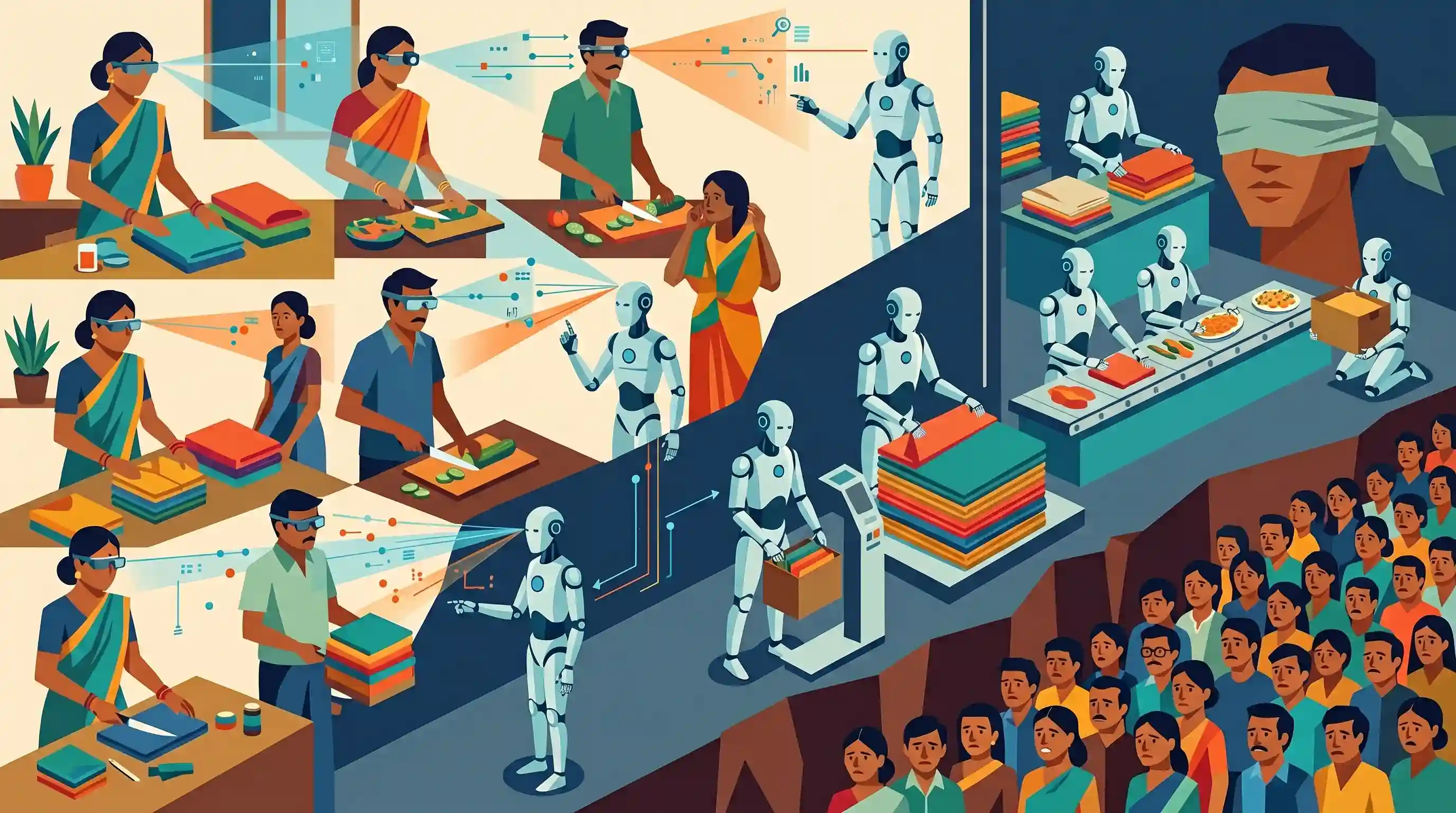
A growing number of informal workers and housewives in India are taking up digital gig work to train 'spatial AI' systems. By wearing head-mounted cameras and smart glasses, they generate 'egocentric data'—first-person footage of mundane physical tasks like folding clothes or slicing vegetables—to teach humanoid robots how to navigate the real world. While this creates temporary employment, NITI Aayog has highlighted a critical blind spot in AI policy: the technology threatens to automate the physical labor of India's 490 million informal workers, raising serious long-term socioeconomic concerns.
Key Points
- Thousands of Indian informal workers, housewives, and gig workers are being paid to record first-person 'egocentric data' of themselves performing manual, mundane tasks like cooking or folding clothes.
- This footage is being used to train spatial AI models that enable humanoid robots to copy human movements and navigate real-world environments.
- NITI Aayog has warned that discussions around AI automation disproportionately focus on white-collar jobs, neglecting the severe threat spatial AI poses to India's 490 million informal workers.
- India is cementing its position as a global hub for cheap AI data annotation and creation, acting as a middleman for Fortune 500 tech companies.
- While data annotation provides temporary digital employment, workers are inadvertently accelerating the development of the very robotic systems that could replace their manual livelihoods.
Important Terms
NITI Aayog

India's premier policy think tank providing strategic advice and coordinating the national roadmap for Artificial Intelligence to ensure inclusive growth.
UPSC context
GS Paper III (Economy/Governance). Essential for understanding state-led technology policy and development planning.
Informal Sector
The segment of the economy operating without formal government regulation or social security, currently comprising approximately 90% of the Indian workforce.
UPSC context
GS Paper III (Economy). Fundamental for analyzing labor market vulnerability and the socioeconomic risks of automation.
Egocentric Data
First-person perspective video or image data captured through wearables (like smart glasses) used to teach AI robots how to perform physical tasks.
UPSC context
GS Paper III (Science & Tech). Represents the intersection of manual labor and advanced AI training paradigms.
Spatial AI
Artificial Intelligence designed to perceive, understand, and navigate 3D environments, enabling robots to interact naturally with the physical world.
UPSC context
GS Paper III (S&T). Relevant to emerging technologies in robotics and their potential to replace physical manual labor.
Gig Economy
A labor market characterized by short-term contracts or freelance work facilitated by digital platforms, often lacking traditional employment benefits.
UPSC context
GS Paper III (Economy/Employment). Tests the ability to analyze new forms of labor, worker rights, and digital platforms.
Indian Institute for Human Settlements (IIHS)
A Bengaluru-based national education and research institution focusing on the challenges of urban transformation and labor in India.
UPSC context
GS Paper I (Social Issues). Recognizes scholarly bodies contributing to policy debates on labor and urbanization.
Digital ShramSetu
A proposed national mission by NITI Aayog to formalize and empower India’s informal workers using AI-driven skilling and digital identities.
UPSC context
GS Paper II/III (Governance/Employment). A key term for questions on digital public infrastructure and social security.
Prelims Trap
"Egocentric data refers to user profiling data collected by social media platforms for targeted advertising."
It actually refers to first-person physical recordings (like head-mounted camera footage) used to train spatial AI and humanoid robots on manual tasks, not psychological profiling.
Static Concepts Connected
How is the Gig Economy recognized under India's current labour frameworks?
- Legal definition: The Code on Social Security (2020) defines it as work outside traditional employer-employee relationships, covering both platform and non-platform workers.
- Social Security Fund: The Code mandates setting up a dedicated fund financed by platform aggregators (1-2% of turnover) for gig and platform workers' welfare.
- Ghost work: Invisible, piece-rate digital labor (like AI annotation) that often lacks formal contracts, leaving workers vulnerable to exploitation despite digital inclusion.
What distinguishes Spatial AI from Generative AI?
- Generative AI: Focuses on generating new digital content (text, images, code) using large language models, primarily threatening cognitive or white-collar jobs.
- Spatial AI: Uses computer vision and sensor data to navigate and interact with 3D physical environments, threatening manual, blue-collar, and informal jobs.
- Egocentric Data: First-person perspective data (from smart glasses/cameras) used exclusively to teach Spatial AI how human bodies interact with physical objects.
Cross-Topic Patterns
AI automation vs. Demographic Dividend
Spatial AI's threat to India's 490 million informal workers directly connects GS3 tech advancements to GS2 poverty, inequality, and the potential failure to harness India's demographic dividend.
Ghost Work and Labour Codes
AI data annotation creates temporary 'ghost work' that highlights the regulatory vacuum in digital gig labour, stressing the need to fully implement the Code on Social Security 2020.

Expect a GS3 Mains question contrasting Generative AI's impact on cognitive jobs with Spatial AI's threat to India's informal workforce.
Linked PYQs · 5
Linked PYQs · 5
- 2023MainsGS3
Introduce the concept of Artificial Intelligence (AI). How does Al help clinical diagnosis? Do you perceive any threat to privacy of the individual in the use of Al in healthcare?
- 2015MainsGS3
What are the areas of prohibitive labour that can be sustainably managed by robots ? Discuss the initiatives that can propel research in premier research institutes for substantive and gainful innovation.
- 2016MainsGS3
How globalization has led to the reduction of employment in the formal sector of the Indian economy? Is increased informalization detrimental to the development of the country?
- 2020PrelimsGS1
With the present state of development, Artificial Intelligence can effectively do which of the following? 1. Bring down electricity consumption in industrial units 2. Create meaningful short stories and songs 3. Disease diagnosis 4. Text-to-Speech Conversion 5. Wireless transmission of electrical energy Select the correct answer using the code given below:
- 2021MainsGS1
Examine the role of 'Gig Economy' in the process of empowerment of women in India.
