Blue Economy and Maritime Security in the Indian Ocean
Source:The Hindu ↗
Why It Matters
The Blue Economy is critical for India's future economic growth and strategic positioning in the Indo-Pacific. It intersects multiple UPSC syllabus areas: ocean resources (GS1), regional geopolitics and IORA/SAGAR (GS2), and maritime security and environmental conservation (GS3).
Summary
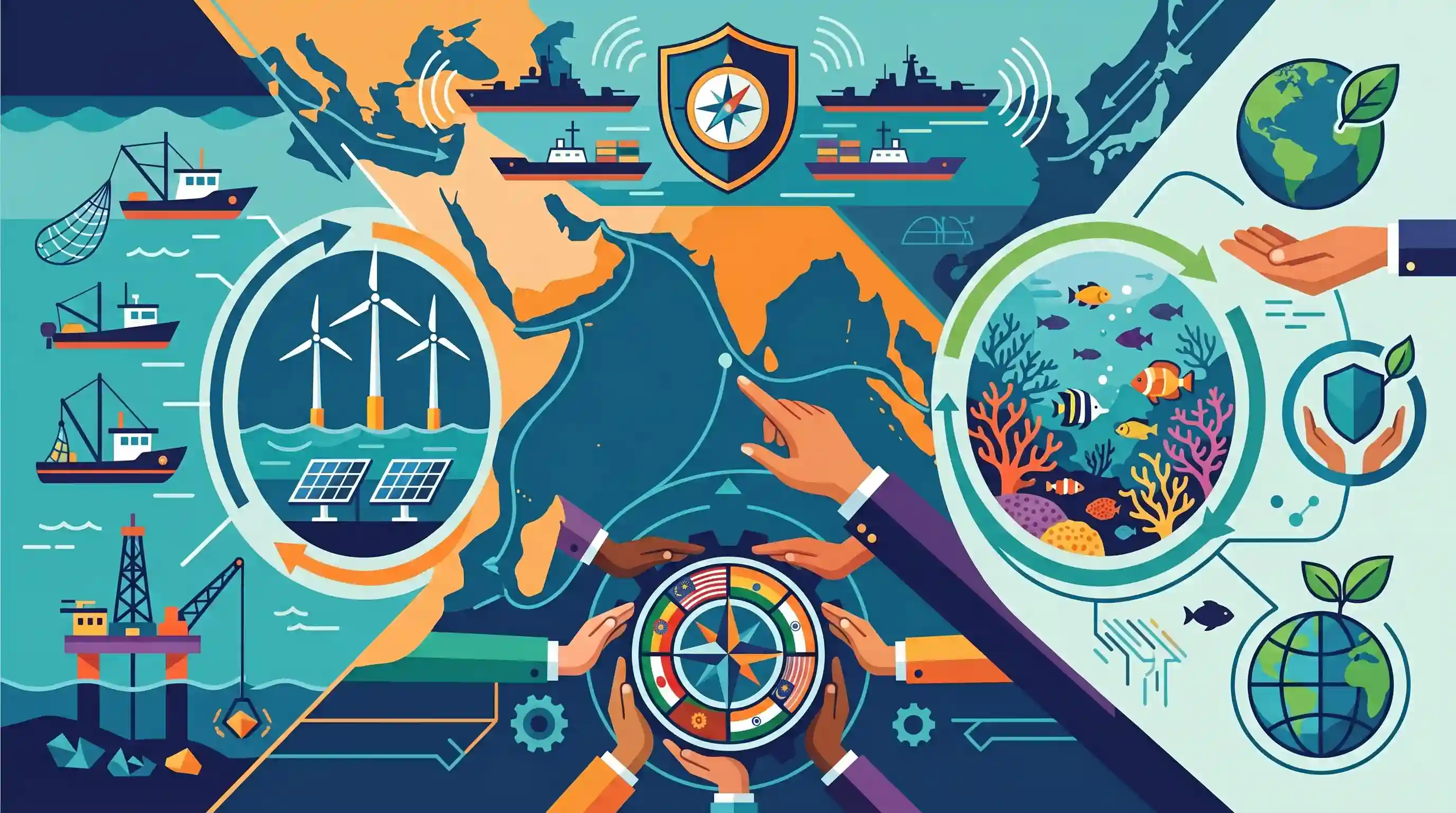
The article explores the immense potential of the Indian Ocean Region (IOR) as the cradle for a sustainable 'Blue Economy'. It underscores the need to harness marine resources—such as fisheries, renewable energy, and deep-sea minerals—while strictly preserving marine biodiversity and ecological balance. Furthermore, it highlights maritime security as a prerequisite for this economic model, given the strategic importance of the IOR's trade routes. India's leadership, guided by the SAGAR doctrine and platforms like IORA, is presented as crucial for fostering regional cooperation, countering geopolitical rivalries, and establishing a secure, prosperous, and sustainable maritime domain.
Key Points
- The Indian Ocean Region (IOR) is uniquely positioned to drive the global transition toward a Blue Economy, balancing economic growth with ocean health.
- Key economic drivers include sustainable fisheries, marine biotechnology, offshore renewable energy, and deep-sea mining for critical minerals like polymetallic nodules.
- Maritime security is a foundational requirement to protect Sea Lanes of Communication (SLOCs) and ensure uninterrupted global trade and energy flows.
- India seeks to act as a net security provider and regional leader in the IOR through its SAGAR initiative and active engagement in the Indian Ocean Rim Association (IORA).
- Realizing the Blue Economy's potential requires robust regional cooperation to mitigate the impacts of climate change, marine pollution, and overexploitation of resources.
Important Terms
Blue Economy

The sustainable use of ocean resources for economic growth, improved livelihoods, and jobs while preserving the health of marine ecosystems.
UPSC context
GS Paper III (Economy/Environment): Focuses on sustainable development and marine resource management.
SAGAR (Security and Growth for All in the Region)
India's strategic maritime vision (launched 2015) aimed at deepening economic and security cooperation with Indian Ocean neighbors through collective action and sustainable development.
UPSC context
GS Paper II (International Relations): Tests knowledge of India’s maritime doctrine and neighborhood policy.
Deep Ocean Mission
A flagship initiative of India's Ministry of Earth Sciences (2021) to explore deep-sea resources like polymetallic nodules and develop indigenous maritime technologies like submersibles.
UPSC context
GS Paper III (Science & Technology): Concerns indigenous technology and mineral resource security.
Indian Ocean Rim Association (IORA)
An intergovernmental organization of 23 states bordering the Indian Ocean, fostering regional cooperation in maritime security, trade facilitation, and fisheries management.
UPSC context
GS Paper II (International Relations): Crucial for regional groupings and Indian Ocean diplomacy.
United Nations Convention on the Law of the Sea (UNCLOS)
An international treaty (1982) establishing a legal framework for all marine activities, defining maritime zones like Territorial Seas and Exclusive Economic Zones (EEZ).
UPSC context
GS Paper II (International Relations): Tests understanding of international maritime law and global governance.
Prelims Trap
India enjoys sovereign rights over the Central Indian Ocean Basin for mining polymetallic nodules under its Deep Ocean Mission.
India holds 'exclusive exploration rights' granted by the International Seabed Authority (ISA), not sovereign ownership. The Central Indian Ocean Basin lies in international waters.
Static Concepts Connected
How are deep-sea mineral resources regulated globally?
- UNCLOS Framework: Under UNCLOS, the seabed and its resources beyond national jurisdiction are considered the 'common heritage of mankind'.
- Role of ISA: The Jamaica-based ISA organizes and controls all mineral-related activities in the international seabed area, granting exploration and mining contracts.
- India's ISA Contract: India holds a 15-year exploration contract for 75,000 sq. km in the Central Indian Ocean Basin to explore potato-sized lumps rich in manganese, nickel, and cobalt.
What is the Indian Ocean Rim Association (IORA)?
- Origin & Mandate: An inter-governmental organization formed in 1997, built on the principles of open regionalism to strengthen economic cooperation in the IOR.
- Membership Dynamics: It comprises 23 member states bordering the Indian Ocean. Crucially for Prelims, Pakistan and Myanmar are not members, while France (via Reunion) is.
- Blue Economy Focus: Recognized as a special focus area in 2014, covering sustainable fisheries, ocean renewable energy, seaports, and marine biotechnology.
Cross-Topic Patterns
Deep-sea mining + Critical Minerals
The push for a blue economy converges with India's critical minerals strategy, seeking oceanic alternatives (polymetallic nodules) to bypass terrestrial supply-chain dependencies on China for cobalt and nickel.
SAGAR doctrine + Net Security Provider
India's transition toward acting as a 'net security provider' explicitly links the Blue Economy to securing global SLOCs and countering the strategic encirclement often termed the String of Pearls.

A combined multi-statement Prelims question linking IORA's Blue Economy mandate, ISA's deep-sea mining rights, and SAGAR is highly likely.
Linked PYQs · 4
Linked PYQs · 4
- 2014MainsGS1
Critically evaluate the various resources of the oceans which can be harnessed to meet the resource crisis in the world.
- 2025MainsGS3
Why is maritime security vital to protect India's sea trade? Discuss maritime and coastal security challenges and the way forward.
- 2021PrelimsGS1
What is blue carbon?
- 2024MainsGS2
Discuss the geopolitical and geostrategic importance of Maldives for India with a focus on global trade and energy flows. Further also discuss how this relationship affects India's maritime security and regional stability amidst international competition ?
