Extreme Heat Stress Affects Mental Health of Rural Workers
Source:The Hindu ↗
Why It Matters
Highlights an emerging non-traditional health challenge—the mental health consequences of climate change—crucial for GS Paper 2 (Public Health policies for vulnerable populations) and GS Paper 3 (Impact of climate change).
Summary
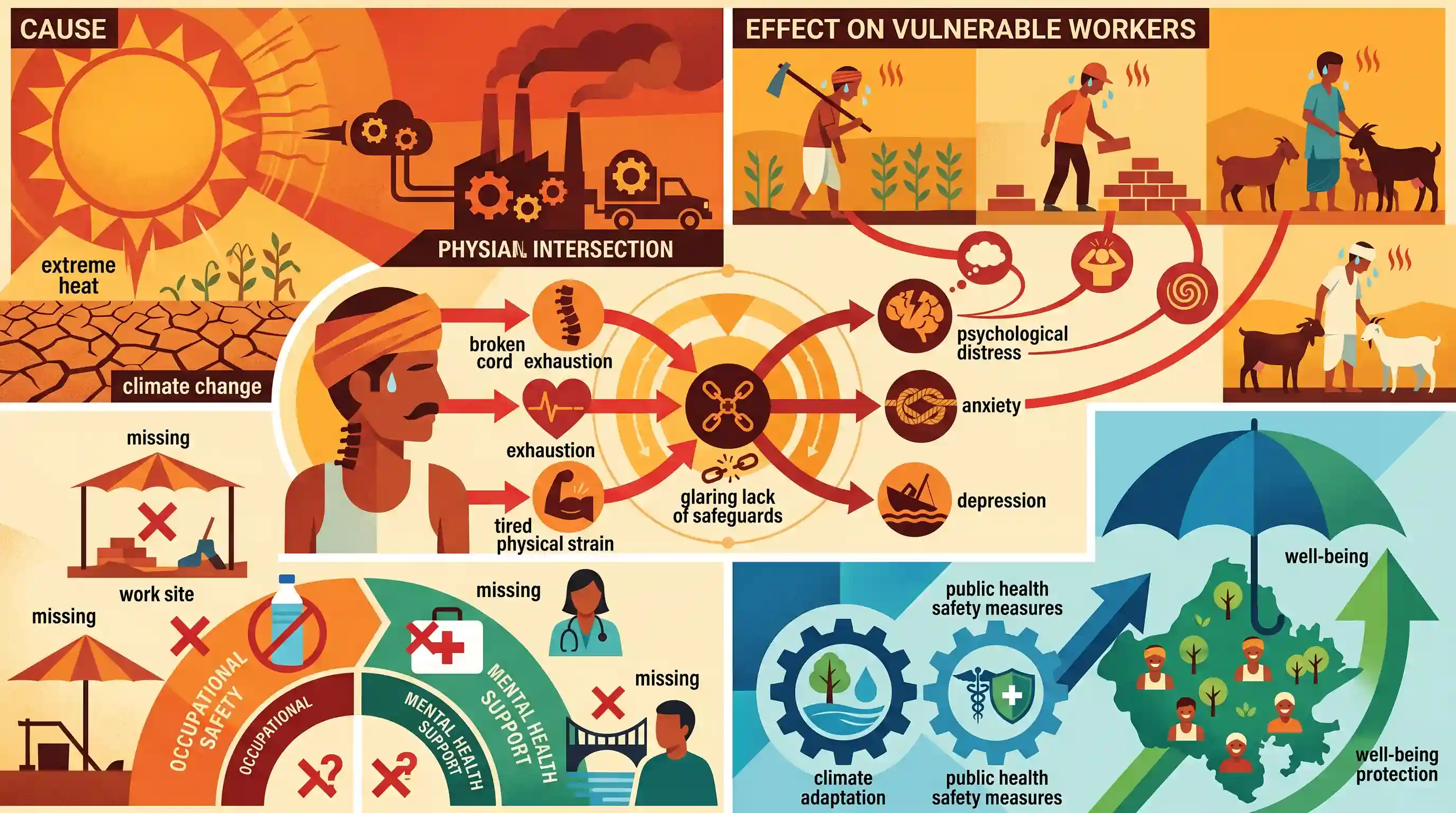
The article examines the severe impact of extreme heat stress on the mental health and overall well-being of rural workers in Rajasthan. As climate change increases the frequency and intensity of heatwaves, outdoor workers face aggravated physical exhaustion, which directly translates into psychological distress, anxiety, and depression. The findings highlight the critical intersection of climate change and public health, pointing to a glaring lack of occupational safeguards and mental health support for the unorganized sector. The piece underscores the urgent need for comprehensive policy interventions that integrate climate adaptation with localized health safety measures to protect vulnerable rural populations.
Key Points
- Rising temperatures and heat stress in Rajasthan are significantly impacting the mental health and cognitive functions of rural and agricultural workers.
- Constant exposure to extreme heat exacerbates physical exhaustion, leading to heightened anxiety, depression, and psychological distress among vulnerable outdoor workers.
- The lack of occupational safeguards, cooling interventions, and adequate primary healthcare in rural areas deepens the crisis for the unorganized sector.
- There is an urgent need for policies integrating climate change adaptation with occupational health safety and mental health support for marginalized communities.
Prelims Trap
Heat Action Plans (HAPs) are centrally formulated statutory documents drafted exclusively by the NDMA.
HAPs are highly decentralized. They are formulated at the state and municipal levels based on NDMA guidelines, not as centralized statutory mandates. Local adaptation is key.
Static Concepts Connected
How are heatwaves managed under the National Disaster Management framework?
- Heat Action Plans: States and cities must develop localized HAPs focusing on early warning systems, medical capacity building, and public awareness.
- Occupational safeguards: Guidelines recommend altering work hours for outdoor workers, providing cooling centers, and ensuring access to safe drinking water.
- Not a notified disaster: Heatwaves are not officially listed as a 'notified disaster' under the Disaster Management Act for SDRF funding by default, though states can use up to 10% of funds locally.
What mechanisms exist for unorganized sector social security and occupational safety?
- Code on Social Security: It mandates the creation of a National Social Security Board to recommend schemes for unorganized workers, including health, injury, and maternity benefits.
- e-Shram Portal: A national database (under the Ministry of Labour) designed to facilitate the delivery of social security schemes and track the demographics of unorganized workers.
Cross-Topic Patterns
Climate Change & Labor Productivity
The ILO projects massive working-hour losses due to heat stress. This links GS1 physical geography (heatwaves) directly with GS3 (economy) and the vulnerability of the unorganized workforce (GS2).
DMHP & Climate Anxiety
Integrating climate-induced distress into the District Mental Health Programme (DMHP) highlights the evolving nature of public healthcare infrastructure required for climate resilience in rural areas.

Expect a multi-statement question on NDMA heatwave guidelines and ILO's heat stress impacts on India's unorganized sector productivity.
Linked PYQs · 3
Linked PYQs · 3
- 2017MainsGS3
'Climate change' is a global problem. How India will be affected by climate change? How Himalayan and coastal states of India will be affected by climate change?
- 2022MainsGS3
The increase in life expectancy in the country has led to newer health challenges in the community. What are those challenges and what steps need to be taken to meet them?
- 2021MainsGS2
“Besides being a moral imperative of a Welfare State, primary health structure is a necessary precondition for sustainable development.” Analyze.
