Indus Waters Treaty Framework And Dispute Resolution Mechanisms
Source:The Hindu ↗
Why It Matters
The Indus Waters Treaty is widely cited as one of the world's most successful water-sharing agreements, having survived multiple wars. However, escalating hydro-politics, disputes over dam construction, and the complexities of international arbitration make it a highly probable topic for both Prelims (river geography) and Mains (bilateral relations and dispute resolution).
Summary
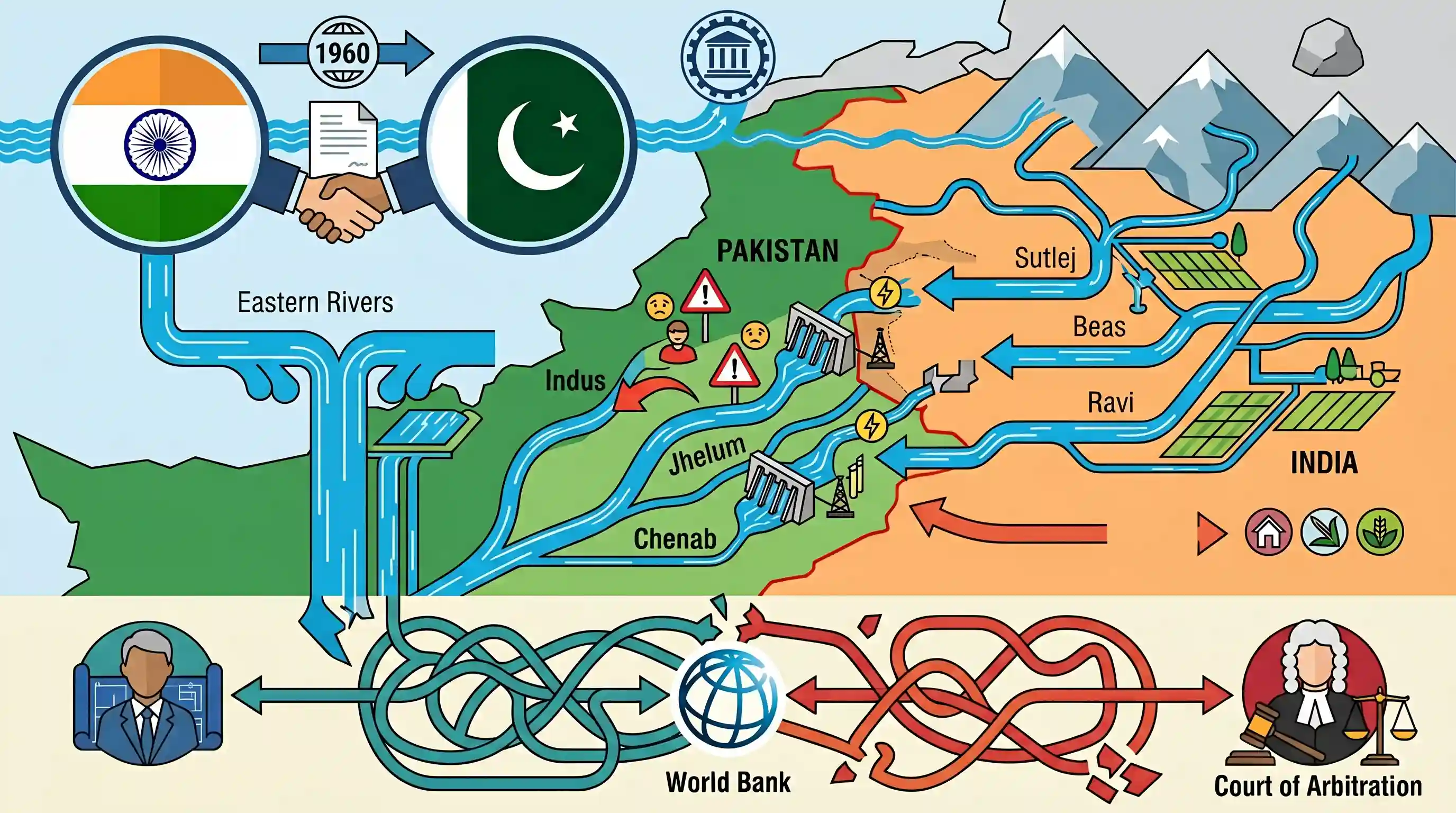
A profile of the Indus Waters Treaty, the 1960 water-distribution agreement between India and Pakistan brokered by the World Bank. The treaty provides a framework for sharing the Indus river system, allocating eastern rivers to India and western rivers to Pakistan. It highlights the treaty's dispute resolution mechanism and recent diplomatic friction, particularly concerning India's run-of-the-river hydroelectric projects on western rivers (such as Kishanganga and Ratle) and procedural disputes over arbitration.
Key Points
- The Indus Waters Treaty (1960) allocates the waters of three eastern rivers (Ravi, Beas, Sutlej) to India and three western rivers (Indus, Jhelum, Chenab) to Pakistan.
- The treaty was brokered by the World Bank and includes a multi-tiered dispute resolution mechanism involving the Permanent Indus Commission, a Neutral Expert, and a Court of Arbitration.
- India is granted the right to non-consumptive uses, including run-of-the-river hydroelectric projects, on the western rivers allocated to Pakistan.
- Ongoing disputes center around Indian hydroelectric projects like Kishanganga and Ratle, leading to parallel arbitration processes and Indian demands to modify the treaty.
Important Terms
Indus Waters Treaty

A 1960 water-distribution agreement between India and Pakistan, brokered by the World Bank, allocating the three eastern rivers to India and three western rivers to Pakistan.
UPSC context
GS Paper-II: International Relations (India-Pakistan bilateral agreements and transboundary water governance).
Permanent Indus Commission
A bilateral body comprising officials from India and Pakistan, mandated to meet annually to implement the treaty and resolve technical issues or 'questions.'
UPSC context
GS Paper-II: Important international/bilateral institutions and their role in dispute resolution.
Neutral Expert
The second tier of the treaty's dispute resolution mechanism, appointed by the World Bank to resolve technical 'differences' concerning project designs and specifications.
UPSC context
GS Paper-II: Mechanisms for settling international disputes and India's stance on treaty interpretation.
Court of Arbitration
An ad hoc arbitral tribunal (third-tier mechanism) for resolving 'disputes' involving legal interpretations of the treaty; currently a point of procedural friction between India and Pakistan.
UPSC context
GS Paper-II: Legal frameworks in international relations and sovereignty concerns in arbitration.
Run-of-the-river projects
Hydroelectric projects that generate power without large reservoirs, using the river's natural flow; permitted for India on western rivers under specific treaty conditions.
UPSC context
GS Paper-I: Geography (Water resources) and GS Paper-III: Infrastructure (Energy).
World Bank
The international financial institution that brokered the 1960 treaty and remains a signatory, fulfilling specific procedural roles in appointing experts or arbitrators.
UPSC context
GS Paper-II: Role of international organizations in bilateral mediation.
Prelims Trap
India is completely barred from constructing any hydroelectric projects on the Western rivers (Indus, Jhelum, Chenab).
False. The IWT explicitly grants India rights to non-consumptive uses on Western rivers, including run-of-the-river (RoR) hydroelectric projects, subject to strict design criteria.
Static Concepts Connected
How does the Indus Waters Treaty (1960) classify the basin rivers?
- Eastern Rivers: Ravi, Beas, and Sutlej are allocated to India for unrestricted, absolute use.
- Western Rivers: Indus, Jhelum, and Chenab are largely allocated to Pakistan.
- India's Western Rights: India is permitted non-consumptive uses (domestic, agricultural, and run-of-the-river hydro projects) on Western rivers.
What is the three-tiered dispute resolution mechanism under the IWT?
- Permanent Indus Commission: A bilateral body that meets regularly to handle initial 'questions' and data sharing.
- Neutral Expert: Appointed by the World Bank to resolve specific technical 'differences' (e.g., dam design).
- Court of Arbitration: Convened to handle systemic, formal legal 'disputes' regarding treaty interpretation.
Cross-Topic Patterns
Water diplomacy as a strategic lever
India's issuance of modification notices links cross-border terrorism to hydro-diplomacy, shifting the IWT from a purely technical water-sharing pact to a geopolitical leverage tool.
RoR projects vs. Himalayan ecology
Geopolitically allowed run-of-the-river projects like Kishanganga and Ratle directly intersect with Mains GS3 topics on fragile Himalayan glacial hydrology and carrying capacity limits.

Expect a 2026 Prelims statement testing the exact IWT dispute sequence (PIC -> Neutral Expert -> CoA) or India's rights on Western rivers.
Linked PYQs · 2
Linked PYQs · 2
- 2021PrelimsGS1
With reference to the Indus river system, of the following four rivers, three of them pour into one of them which joins the Indus direct. Among the following, which one is such river that joins the Indus direct?
- 2012MainsGS2
The situation today is far different to that prevalent fifty years back when the Indus Water Treaty was signed." Highlight the complexity of the current challenges on both sides of the border in this regard. Do you think that a review of the Treaty is in India's best interests?
