Multilateral climate frameworks and India disaster vulnerabilities
Source:The Hindu ↗
Why It Matters
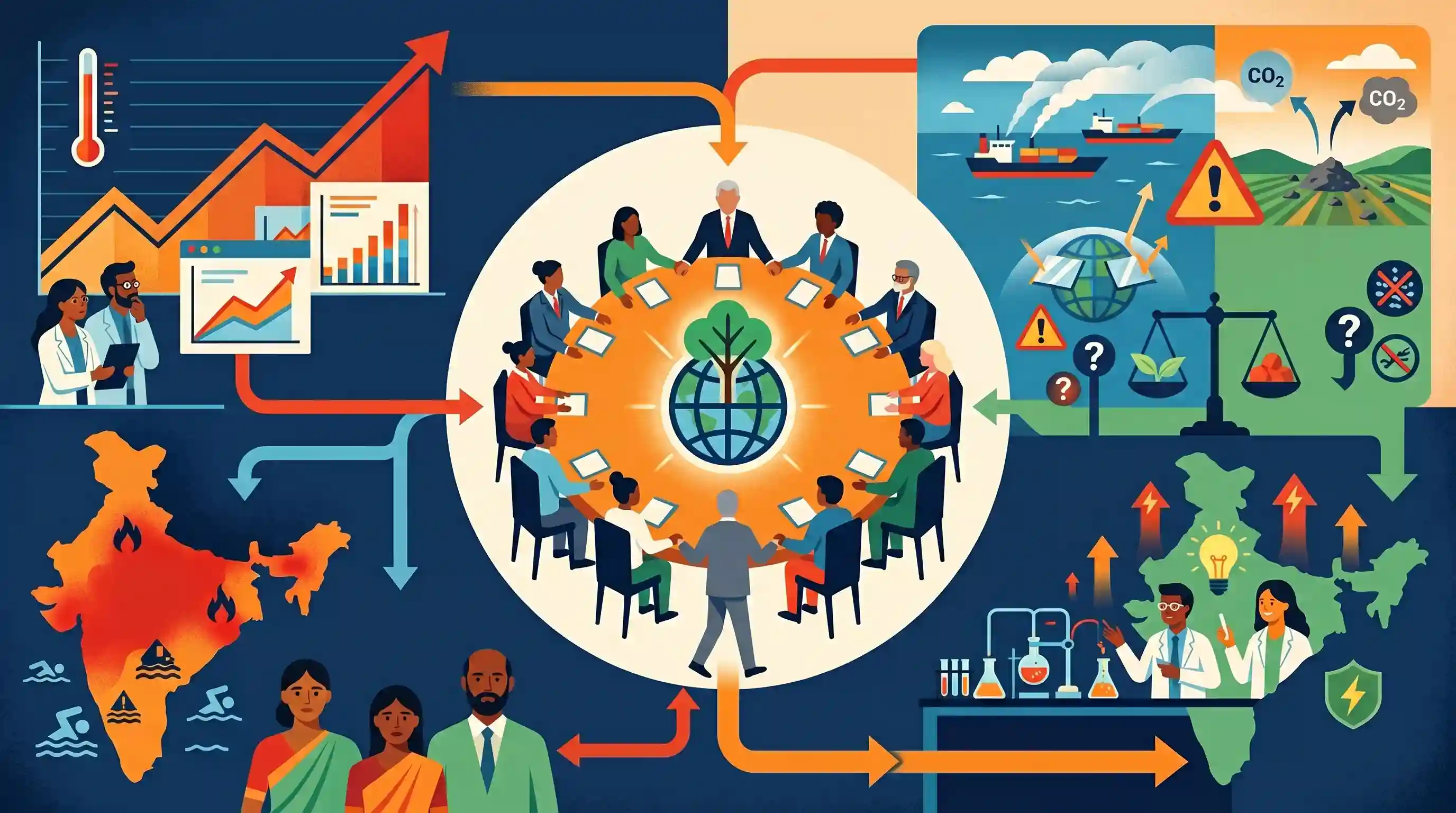
Highlights India's vulnerabilities to climate-induced hydro-meteorological disasters and discusses the effectiveness of technology, such as geoengineering, alongside the persistent necessity of a multilateral framework like the Paris Agreement.
Summary
At 'The Hindu Huddle 2025', climate experts emphasized that despite political shifts like the U.S. withdrawal from the Paris Agreement, multilateral climate regimes remain critical. The panel discussed the rapid pace of global warming, which is outpacing predictive models, and highlighted India's extreme vulnerability, noting that 75% of Indian districts are climate hotspots and 80% of the population faces risks from hydro-meteorological disasters. While technological interventions such as geoengineering and enhanced rock weathering (ERW) present potential solutions, experts cautioned against their unintended side-effects and stressed the need for economic alignment, pilot-scale research, and retaining scientific talent within India.
Key Points
- Multilateral frameworks for climate change action remain indispensable, overriding political disruptions like the U.S. withdrawal from the Paris Agreement.
- Global warming is accelerating faster than current climate models have anticipated, underscoring the urgent need for India to develop its own climate models.
- India faces severe climate risk, with three-quarters of its districts designated as hotspots and 80% of its population exposed to hydro-meteorological disasters.
- Emerging technologies like geoengineering and Enhanced Rock Weathering (ERW) offer promise but require rigorous, long-term pilot studies due to potential side-effects.
- Effective climate action must integrate economic strategies, framing the transition to clean energy as a national industrial policy.
- To lead in climate research and modeling, India must prevent the brain drain of its doctoral researchers to the United States.
Important Terms
Paris Agreement

A 2015 international treaty aiming to limit global warming to well below 2°C, preferably 1.5°C, through Nationally Determined Contributions (NDCs).
UPSC context
GS III (Environment); primary framework for international climate diplomacy and India's global environmental commitments.
Geoengineering
Deliberate large-scale manipulation of Earth's climate system, such as reflecting sunlight or removing CO2, to mitigate global warming.
UPSC context
GS III (Science & Technology/Environment); tests understanding of emerging mitigation technologies and their ethical/environmental risks.
Council on Energy, Environment and Water (CEEW)
An Indian climate think tank that provides research on energy, resource security, and climate risks, including district-level vulnerability mapping.
UPSC context
GS III (Environment); influential policy actor whose data informs India's domestic and international climate strategies.
TERI (The Energy and Resources Institute)
A premier Indian research institution focusing on sustainable development, energy efficiency, and climate resilience through policy and technology solutions.
UPSC context
GS III (Environment); central to India's energy transition research and global sustainable development summits.
Enhanced Rock Weathering (ERW)
A carbon removal technique that accelerates natural weathering by spreading ground silicate rocks (like basalt) on land to capture atmospheric CO2.
UPSC context
GS III (Environment); an emerging nature-based sequestration method relevant for achieving Net Zero targets.
Colossal Bioscience
A de-extinction biotechnology company using genetic engineering to reconstruct genomes of extinct species like the woolly mammoth or dodo.
UPSC context
GS III (Science & Tech); raises ethical questions regarding genetic engineering and biological "technofixes" for biodiversity loss.
Prelims Trap
Enhanced Rock Weathering (ERW) involves capturing CO2 directly from industrial smokestacks and injecting it underground.
ERW is a Carbon Dioxide Removal (CDR) technique that spreads crushed silicate rocks on soil to absorb atmospheric CO2, distinct from industrial CCS.
Static Concepts Connected
What is Enhanced Rock Weathering (ERW) and how does it sequester carbon?
- Mechanism: Spreading finely ground silicate rocks (like basalt) over agricultural land or oceans to accelerate natural geological weathering and absorb CO2.
- Chemical reaction: Atmospheric CO2 dissolved in rainwater reacts with the crushed rock, converting into stable bicarbonates that eventually wash into oceans for permanent storage.
- Ecological risks: Large-scale mining and grinding require massive energy, while widespread application could alter local soil chemistry and hydrology unpredictably.
What are the rules for withdrawal from the UNFCCC Paris Agreement?
- Article 28: A party may withdraw at any time after three years from the date the Agreement entered into force for that specific party.
- Timeline: Withdrawal takes effect one year after the deposit of the formal notification to the UN Depository.
- Regime survival: The agreement remains legally binding for remaining signatories; multilateral emission targets, climate finance mechanisms, and NDC frameworks continue to operate.
Cross-Topic Patterns
Geoengineering risks to the Indian Monsoon
Geoengineering interventions like solar radiation management could inadvertently alter global precipitation, posing a severe threat to the monsoon cycles that dictate India's agrarian economy.
Climate modeling as strategic sovereign tech
The call for indigenous climate models reflects a shift where hydro-meteorological forecasting is treated as critical national infrastructure, intersecting with space tech (ISRO) and supercomputing missions.

Expect a 2026 Prelims question distinguishing Carbon Dioxide Removal (ERW, ocean fertilization) from Solar Radiation Management techniques.
Linked PYQs · 4
Linked PYQs · 4
- 2025MainsGS3
Write a review on India's climate commitments under the Paris Agreement (2015) and mention how these have been further strengthened in COP26 (2021). In this direction, how has the first Nationally Determined Contribution intended by India been updated in 2022?
- 2022MainsGS3
Discuss global warming and mention its effects on the global climate. Explain the control measures to bring down the level of greenhouse gases which cause global warming, in the light of the Kyoto Protocol, 1997.
- 2019MainsGS3
Vulnerability is an essential element for defining disaster impacts and its threat to people. How and in what ways can vulnerability to disasters be characterized? Discuss different types of vulnerability with reference to disasters.
- 2024MainsGS3
Flooding in urban areas is an emerging climate-induced disaster. Discuss the causes of this disaster. Mention the features of two such major floods in the last two decades in India. Describe the policies and frameworks in India that aim at tackling such floods.
