Border Security and Federal Challenges in India
Source:The Hindu ↗
Why It Matters
The article touches upon multiple core UPSC syllabus areas: border management and national security (GS3), the impending federal friction over the delimitation of constituencies (GS2), and international environmental negotiations (GS3). Understanding the southern States' perspective on delimitation is particularly important for questions on federalism and representation.
Summary
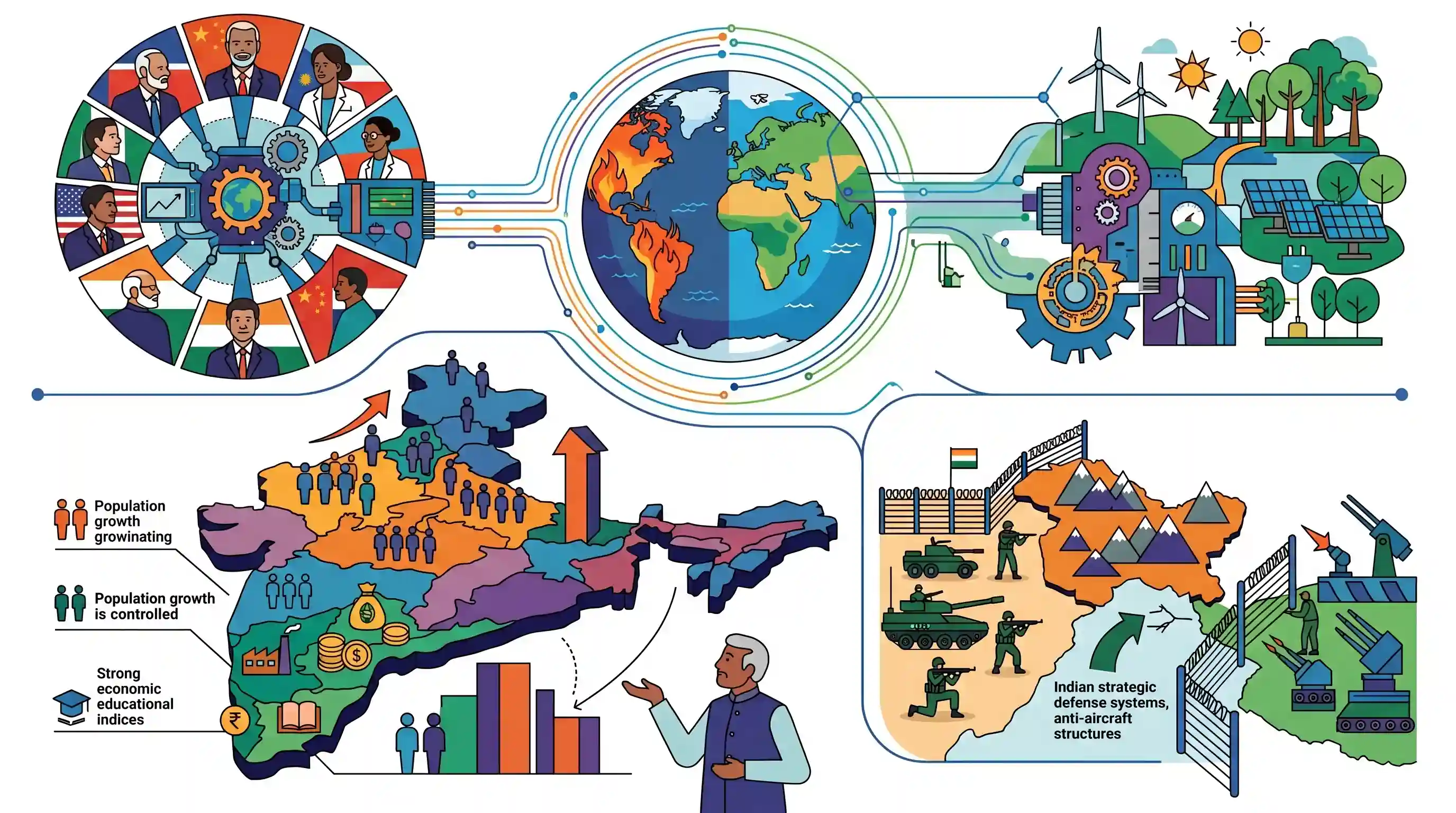
The fifth edition of 'The Hindu Huddle' 2025 in Bengaluru brought together experts and leaders to discuss critical issues spanning national security, federalism, and climate change. A major focus was on India's border threats, particularly military aggression from Pakistan, and the strategic responses required. The event also highlighted significant federal concerns as Telangana Chief Minister Revanth Reddy cautioned against a delimitation formula based purely on demographic changes, which could marginalise southern States despite their economic contributions and successful population control. Furthermore, discussions underscored the continuing relevance of multilateral frameworks in addressing climate change.
Key Points
- The fifth edition of The Hindu Huddle 2025 in Bengaluru commenced with a primary focus on India's border threats and national security challenges.
- Former National Security Adviser M.K. Narayanan and former UN Representative T.S. Tirumurti analysed India's response strategies to continuous military aggression and threats from Pakistan.
- Telangana Chief Minister Revanth Reddy highlighted concerns over the upcoming delimitation exercise, arguing that relying solely on demographics would unjustly penalise southern States for their successful population control measures while ignoring their significant economic contributions.
- The conclave also featured discussions on the importance of multilateral regimes in tackling global climate change.
Important Terms
Delimitation

The process of redrawing boundaries of Lok Sabha and State Assembly constituencies based on recent census data to ensure each seat represents an approximately equal number of voters.
UPSC context
GS Paper II: Elections and Representation of People Act; critical regarding the post-2026 seat freeze expiry and regional representation balance.
Delimitation Commission
A high-power statutory body whose orders have the force of law and cannot be challenged in any court, responsible for determining electoral boundaries.
UPSC context
GS Paper II: Constitutional and Statutory Bodies; tests knowledge of the body's non-justiciable powers and its role in democratic equity.
Article 82
A constitutional provision mandating that Parliament enact a Delimitation Act after every census to readjust seat allocation in the Lok Sabha.
UPSC context
GS Paper II: Indian Constitution and Legislature; fundamental for understanding the legal requirement for periodic readjustment of political representation.
Federalism
A constitutional system of power-sharing between the Union and States, currently tested by the "North-South divide" over population-based representation and economic contribution.
UPSC context
GS Paper II: Federal Structure; focuses on tensions between demographic performance and political power in a Union of States.
Multilateralism
A framework of international cooperation involving multiple nations to address global issues, such as climate change, through shared rules and multilateral institutions like the UNFCCC.
UPSC context
GS Paper II: International Relations; essential for topics on global groupings and agreements affecting India’s interests (e.g., Paris Agreement).
Border Management
The strategic and physical securing of national frontiers against external threats, including cross-border terrorism, infiltration, and conventional military aggression.
UPSC context
GS Paper III: Internal Security; covers security challenges in border areas and the nexus between organized crime and terrorism.
Prelims Trap
Delimitation Commission orders can be challenged in the Supreme Court on grounds of federal imbalance.
Under Article 329(a) of the Constitution, the validity of any law relating to the delimitation of constituencies cannot be called into question in any court.
Static Concepts Connected
How is the Delimitation Commission constituted and what are its powers?
- Constitutional basis: Appointed by the President of India under the provisions of the Delimitation Commission Act, following Article 82.
- Composition: Typically headed by a retired Supreme Court Judge, and includes the Chief Election Commissioner and respective State Election Commissioners.
- Legal immunity: Its orders have the force of law and are completely immune from judicial review by any court in India.
What are the core components of the Comprehensive Integrated Border Management System (CIBMS)?
- Core objective: Replaces conventional physical patrolling in difficult terrains with a robust 24x7x365 electronic surveillance grid.
- Tech deployment: Integrates thermal imagers, infrared cameras, laser alarms, ground sensors, and aerostats to detect border intrusions.
- Command and Control: Feeds real-time sensor data into a unified command and control center for rapid operational response by border guarding forces.
Cross-Topic Patterns
Delimitation + Fiscal Federalism
The political delimitation debate directly parallels fiscal friction seen during the 15th Finance Commission, which used a 12.5% 'Demographic Performance' weightage to reward states with lower fertility rates.
Proxy War + Drone Security
Traditional border management is failing against modern state-sponsored proxy tactics. This necessitates integrating anti-drone tech within the Comprehensive Integrated Border Management System (CIBMS) framework.

Post-2026 delimitation + demographic penalty on Southern states + 15th FC criteria is a highly probable GS2 Mains question for 2026.
Linked PYQs · 3
Linked PYQs · 3
- 2024MainsGS3
India has a long and troubled border with China and Pakistan fraught with contentious issues. Examine the conflicting issues and security challenges along the border. Also give out the development being undertaken in these areas under the Border Area Development Programme (BADP) and Border Infrastructure and Management (BIM) Scheme.
- 2020MainsGS3
Analyze internal security threats and transborder crimes along Myanmar, Bangladesh and Pakistan borders including Line of Control (LoC). Also discuss the role played by various security forces in this regard.
- 2022MainsGS3
Discuss global warming and mention its effects on the global climate. Explain the control measures to bring down the level of greenhouse gases which cause global warming, in the light of the Kyoto Protocol, 1997.
