India China Border Dispute and Strategic Status Quo at LAC
Source:The Hindu ↗
Why It Matters
The ongoing border dispute and economic relationship with China are central to India's foreign policy and national security. Understanding the nuances of this bilateral engagement is critical for both GS Paper 2 (International Relations) and GS Paper 3 (Border Security).
Summary
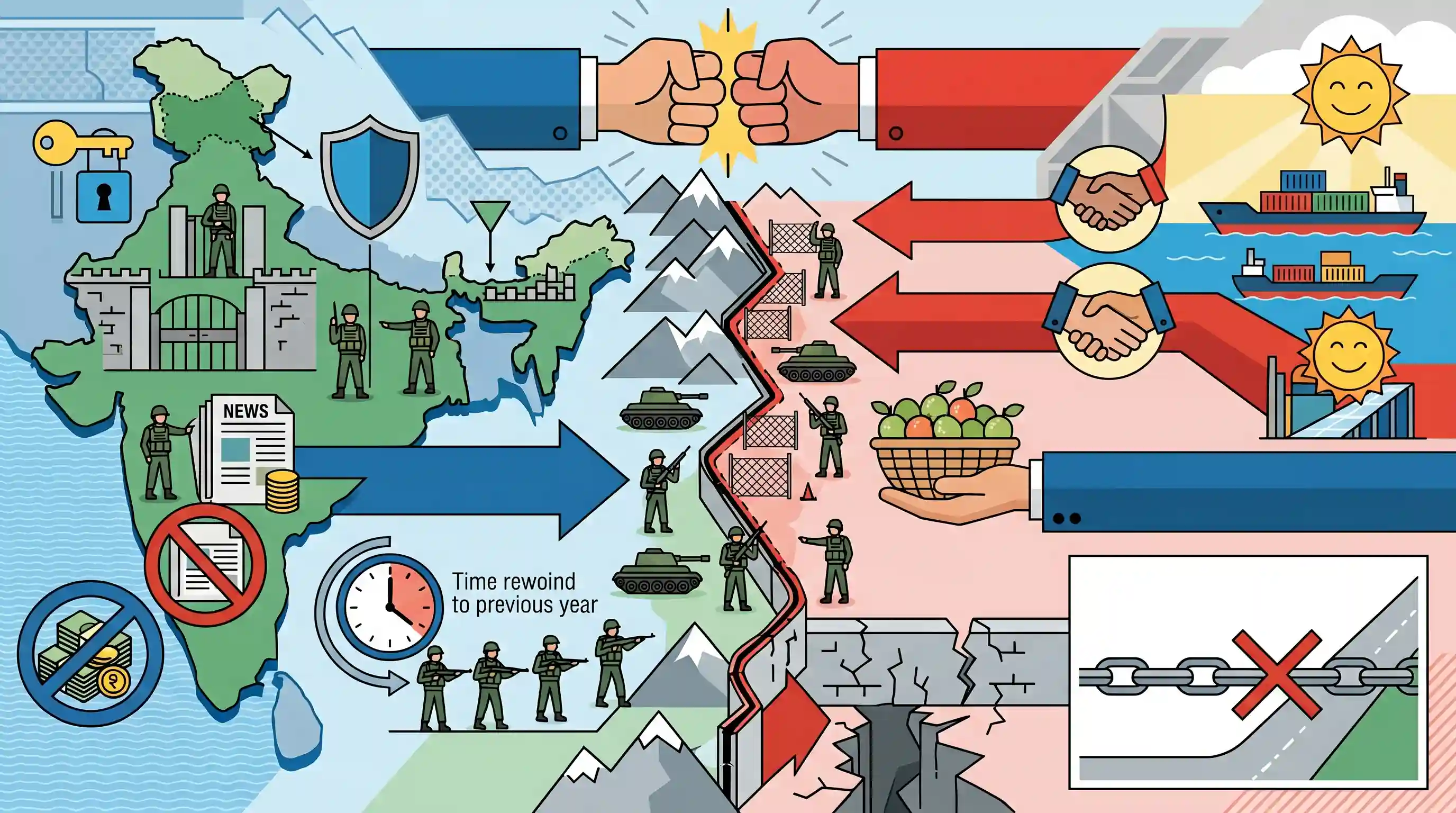
The article highlights the strategic impasse in India-China relations, arguing against China's attempts to normalize economic and diplomatic ties while keeping the border dispute unresolved. It emphasizes that conceding to China's 'early harvest' strategy without restoring the status quo at the Line of Actual Control (LAC) would undermine India's security interests and validate aggressive border tactics.
Key Points
- China's strategic push involves decoupling the border standoff from the broader bilateral relationship, aiming to normalize economic and diplomatic ties ('the harvest').
- India maintains that peace and tranquility at the Line of Actual Control (LAC) is a strict prerequisite for the resumption of normal bilateral relations.
- Accepting China's terms without a return to the pre-2020 status quo would effectively legitimize its territorial assertiveness and compromise India's long-term security.
- India faces a strategic imperative to reduce its economic and supply chain dependence on China by fostering alternative global partnerships (e.g., 'China Plus One' strategy).
Important Terms
Line of Actual Control (LAC)

The de facto boundary separating Indian and Chinese controlled territory. It is not legally defined or demarcated on the ground, leading to differing perceptions of its exact alignment across three sectors.
UPSC context
GS Paper II (International Relations); critical for understanding territorial sovereignty and border management challenges.
Border Peace and Tranquility Agreement (BPTA)
A landmark 1993 treaty where India and China pledged to respect the LAC and maintain peace through "minimal" troop levels and peaceful consultations, pending a final boundary settlement.
UPSC context
GS Paper II (Bilateral Relations); foundational for questions on the history of India-China diplomatic agreements.
Early Harvest Strategy
A diplomatic tactic to resolve "easier" issues first. Regarding borders, China proposes delimiting less contentious sectors (like Sikkim) while deferring harder disputes (like Ladakh) to a later stage.
UPSC context
GS Paper II (IR); tests understanding of negotiation tactics and their impact on long-term strategic interests.
Status Quo Ante
A Latin phrase meaning 'the state of affairs as they were before.' In border disputes, it refers to restoring military positions to their status prior to a specific confrontation or standoff.
UPSC context
GS Paper III (Security); central to India's demands for de-escalating the 2020 Ladakh standoff.
People's Liberation Army (PLA)
The unified military force of the People's Republic of China and the armed wing of the Chinese Communist Party, commanded by the Central Military Commission.
UPSC context
GS Paper III (External Security); essential for analyzing the nature of the military threat on India's borders.
Prelims Trap
The "Early Harvest Scheme" solely refers to preliminary tariff reductions under comprehensive Free Trade Agreements.
While often used in FTAs (like India-Thailand), in India-China geopolitics "early harvest" refers to Beijing's tactic of resolving easier border sectors first to force economic normalization, delaying complex disputes.
Static Concepts Connected
What are the core tenets of the 1993 Border Peace and Tranquility Agreement (BPTA)?
- Status Quo: Both sides agree to strictly respect and observe the Line of Actual Control (LAC), pending an ultimate boundary settlement.
- Force Limitation: Mutual agreement to keep military forces along the LAC to a minimum level compatible with friendly and good-neighbourly relations.
- Peaceful Resolution: Strict commitment to resolve the boundary question through peaceful negotiations, explicitly prohibiting the threat or use of force.
How does the LAC differ legally and militarily from the LoC?
- LoC Delineation: The LoC is legally binding and explicitly map-delineated by DGMOs following the 1972 Shimla Agreement between India and Pakistan.
- LAC Ambiguity: The LAC is an un-demarcated concept post-1962, featuring overlapping territorial claims, differing perceptions, and no mutually agreed-upon comprehensive map.
- Buffer Zones: Recent LAC crises have spawned temporary 'buffer zones' to prevent clashes, a concept not present on the heavily entrenched, fixed LoC.
Cross-Topic Patterns
SCRI & China Plus One Strategy
India's refusal to normalize ties without LAC resolution accelerates trade shifts like the trilateral Supply Chain Resilience Initiative (SCRI) to secure APIs and critical minerals away from China.
Border Infrastructure & Vibrant Villages
China's aggressive border tactics ('salami slicing') necessitate internal security upgrades, directly linking to India's Vibrant Villages Programme which counters Chinese 'Xiaokang' border settlements.

In 2026, expect a multi-statement Q linking the 1993 BPTA breakdown to structural shifts like the Supply Chain Resilience Initiative.
Linked PYQs · 3
Linked PYQs · 3
- 2024MainsGS2
‘The West is fostering India as an alternative to reduce dependence on China's supply chain and as a strategic ally to counter China's political and economic dominance.’ Explain this statement with examples.
- 2014MainsGS2
With respect to the South China sea, maritime territorial disputes and rising tension affirm the need for safeguarding maritime security to ensure freedom of navigation and over flight throughout the region. In this context, discuss the bilateral issues between India and China.
- 2024MainsGS3
India has a long and troubled border with China and Pakistan fraught with contentious issues. Examine the conflicting issues and security challenges along the border. Also give out the development being undertaken in these areas under the Border Area Development Programme (BADP) and Border Infrastructure and Management (BIM) Scheme.
