Green Chemistry and Decarbonization of Chemical Industries
Source:The Hindu ↗
Why It Matters
The 'greening' of heavy industries is central to India's net-zero targets and sustainable development. UPSC consistently asks questions about industrial pollution mitigation (e.g., river pollution) and the role of new technologies (like Green Hydrogen and Membrane Bioreactors) in solving environmental hazards.
Summary
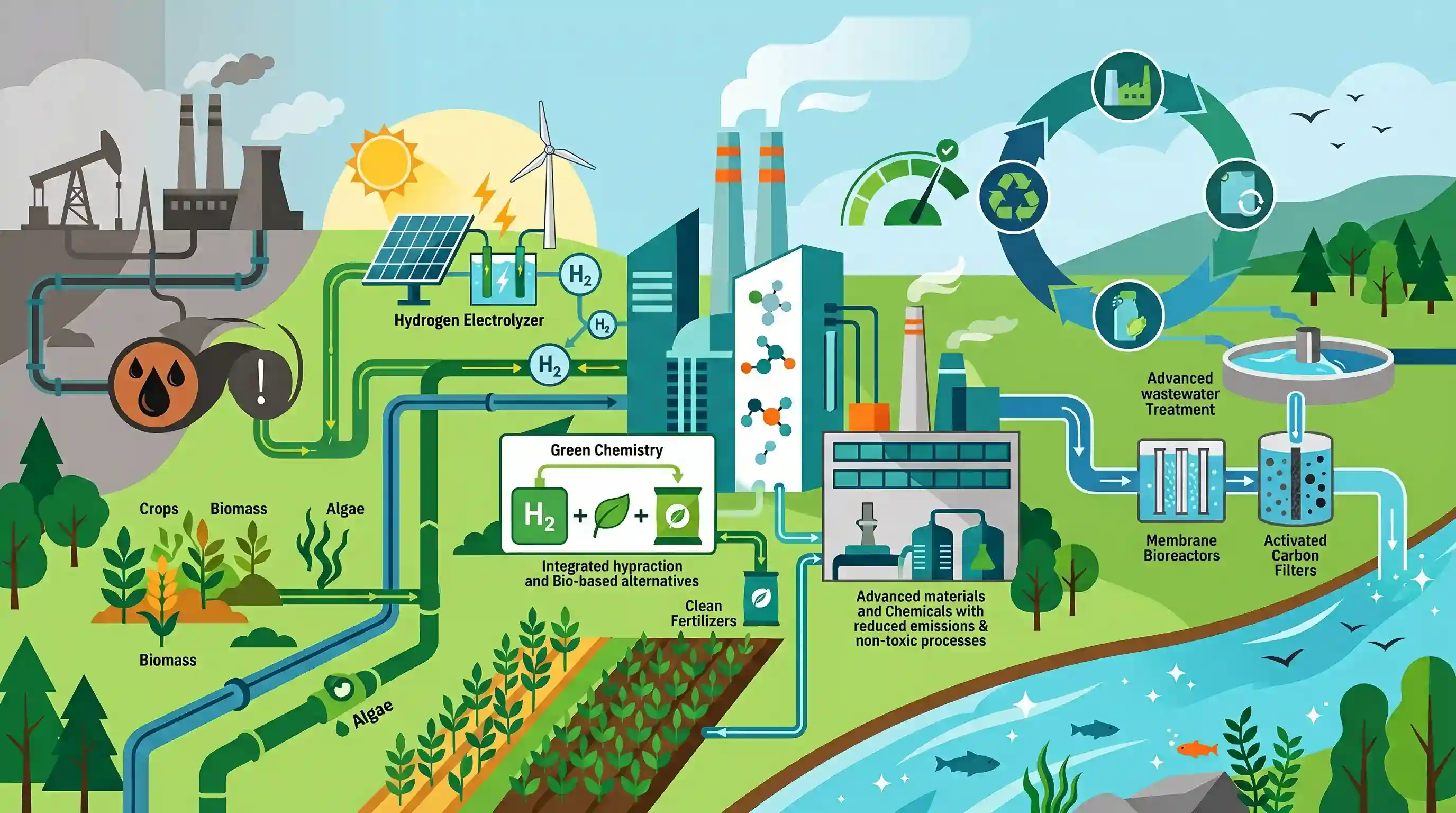
The article highlights the urgent need to transition the chemical industry toward sustainable, eco-friendly practices, commonly known as 'green chemistry'. This shift involves replacing fossil fuel feedstocks with renewable, bio-based alternatives and utilizing green hydrogen to decarbonize energy-intensive sub-sectors like fertilizers and petroleum refining. Furthermore, the adoption of circular economy principles and advanced wastewater treatment technologies (such as Membrane Bioreactors and activated carbon) is emphasized as critical for minimizing hazardous waste, reducing industrial river pollution, and meeting national climate goals.
Key Points
- The traditional chemical industry is highly carbon-intensive and a major source of toxic effluents, necessitating a transition toward sustainable manufacturing paradigms.
- Green chemistry principles focus on designing chemical products and processes that minimize or eliminate the generation of hazardous substances.
- Replacing fossil-based feedstocks with bio-based renewable alternatives and adopting green hydrogen is crucial for decarbonizing hard-to-abate sectors like fertilizers and refineries.
- Advanced effluent treatment technologies, such as Membrane Bioreactors and activated carbon adsorption, play a vital role in curbing industrial water pollution.
- Embracing a circular economy in the chemical sector facilitates resource recovery from waste, bridging the gap between industrial growth and environmental conservation.
Important Terms
National Green Hydrogen Mission

A 2023 initiative aiming to make India a global hub for green hydrogen production (5 MMT/annum by 2030), primarily to decarbonize heavy industries like fertilizers and petroleum refining.
UPSC context
GS Paper 3: Energy, Environment, and S&T; tests knowledge of decarbonization strategies and industrial sustainability.
Panchamrit (Climate Commitments)
India's five-point climate pledge from COP26, including targets for 500GW non-fossil energy, 50% renewable energy share, and reaching Net Zero emissions by 2070.
UPSC context
GS Paper 3: Environment; tests understanding of India's international climate obligations and national mitigation targets.
Green Chemistry
The design of chemical products and processes that minimize or eliminate the use and generation of hazardous substances, prioritizing waste prevention and renewable feedstocks at the molecular level.
UPSC context
GS Paper 3: Science & Technology and Environment; tests applications of sustainable chemistry in industrial pollution control.
Circular Economy
An economic model focused on closing resource loops through reuse, refurbishment, and recycling, moving away from the linear "take-make-dispose" industrial system to minimize waste.
UPSC context
GS Paper 3: Economy and Environment; tests resource efficiency and sustainable waste management policies.
Membrane Bioreactor (MBR)
An advanced wastewater treatment technology combining biological processes (activated sludge) with membrane filtration to produce high-quality effluent suitable for reuse in industrial or municipal applications.
UPSC context
GS Paper 3: S&T and Environmental Pollution; tests knowledge of efficient wastewater treatment and water conservation technologies.
Atom Economy
A metric in green chemistry representing the percentage of starting materials incorporated into the final product; higher economy signifies greater efficiency and less industrial waste.
UPSC context
GS Paper 3: Science & Technology; tests technical concepts of industrial efficiency and sustainable manufacturing.
Prelims Trap
"Atom economy refers to the economic viability of establishing nuclear power plants."
Atom economy is actually a core principle of green chemistry that maximizes the incorporation of raw materials into the final product, minimizing chemical waste.
Static Concepts Connected
How do different 'colors' of hydrogen differ in production?
- Grey Hydrogen: Produced from natural gas or methane using steam reforming without carbon capture; highly carbon-intensive.
- Blue Hydrogen: Produced from fossil fuels but integrates Carbon Capture, Utilization, and Storage (CCUS) to mitigate emissions.
- Green Hydrogen: Generated through the electrolysis of water using electricity entirely sourced from renewable energy.
What are Membrane Bioreactors (MBRs) in wastewater treatment?
- Mechanism: Combines a suspended growth biological treatment process (like activated sludge) with membrane filtration (microfiltration or ultrafiltration).
- Advantage: Produces exceptionally high-quality effluent suitable for reuse, making it crucial for treating toxic chemical and industrial wastewater.
Cross-Topic Patterns
Green Ammonia & Fertilizer Subsidy
Transitioning to green hydrogen for ammonia production links India's industrial decarbonization (Panchamrit) to agriculture economics, potentially reducing the massive fossil-based fertilizer subsidy bill.
Circular Economy & Statutory EPR
Green chemistry's focus on minimizing hazardous materials at the design stage mirrors the Extended Producer Responsibility (EPR) mandates in India's modern statutory Waste Management Rules.

Expect a 2026 Prelims question testing 'Atom Economy' and 'MBRs' as S&T applications, or Green Hydrogen's specific role in fertilizers.
Linked PYQs · 4
Linked PYQs · 4
- 2024MainsGS3
Industrial pollution of river water is a significant environmental issue in India. Discuss the various mitigation measures to deal with this problem and also the government's initiatives in this regard.
- 2023PrelimsGS1
Consider the following heavy industries: 1. Fertilizer plants 2. Oil refineries 3. Steel plants Green hydrogen is expected to play a significant role in decarbonizing how many of the above industries?
- 2025PrelimsGS1
Consider the following statements : Statement I: Activated carbon is a good and an attractive tool to remove pollutants from effluent streams and to remediate contaminants from various industries. Statement II : Activated carbon exhibits a large surface area and a strong potential for adsorbing heavy metals. Statement III : Activated carbon can be easily synthesized from environmental wastes with high carbon content. Which one of the following is correct in respect of the above statements?
- 2024PrelimsGS1
"Membrane Bioreactors" are often discussed in the context of:
