Ganitha Ganaka Programme Scaled Up to All Schools in Karnataka
Source:The Hindu ↗
Why It Matters
Provides a practical, low-cost case study for answers on improving foundational learning outcomes, implementing the NEP 2020, and bridging the digital divide in education using accessible tech like phone calls.
Summary
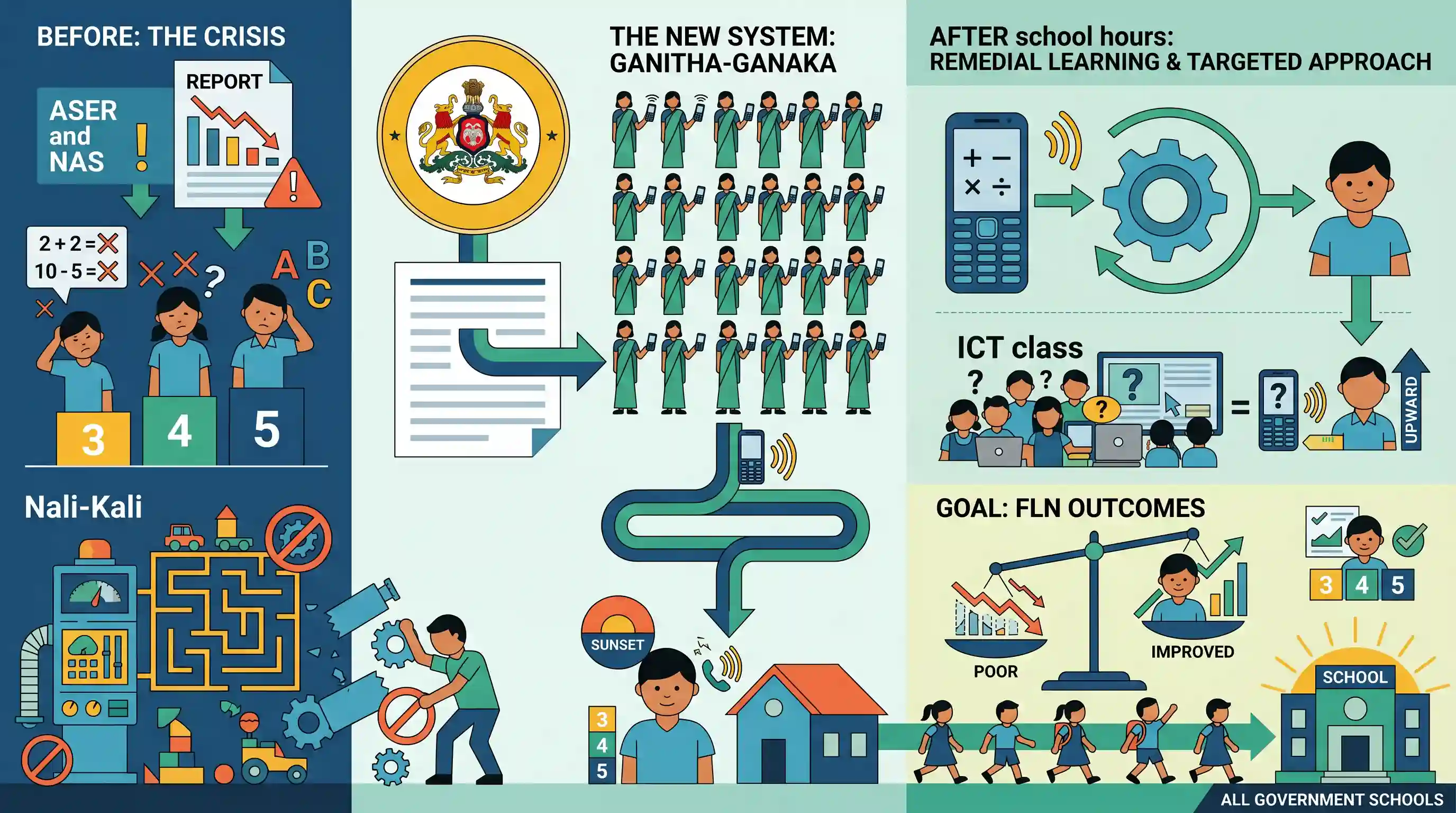
The Karnataka government is extending the 'Ganitha-Ganaka' programme—a remote tutoring initiative focused on primary school mathematics—to all government schools across the state. Replacing the ineffective 'Nali-Kali' scheme, this programme utilizes 75,000 teachers to deliver remedial education via phone calls after school hours to students in classes 3, 4, and 5. The move comes in response to poor foundational literacy and numeracy outcomes highlighted by ASER and NAS reports, highlighting a low-tech, targeted approach to boosting educational outcomes.
Key Points
- The Karnataka government is scaling up the 'Ganitha-Ganaka' remote tutoring programme to all government schools to strengthen foundational mathematics for classes 3, 4, and 5.
- The initiative provides remedial teaching via after-school phone calls, employing 75,000 selected teachers who receive an honorarium of ₹800 each.
- The decision follows the failure of the prior 'Nali-Kali' programme to deliver expected outcomes, as corroborated by data from ASER-Rural and the National Achievement Survey (NAS).
- The programme uses an accessible, low-tech intervention (phone calls) in partnership with NGOs and educational bodies like J-PAL South Asia and DSERT.
Important Terms
Ganitha-Ganaka programme

A Karnataka government remote tutoring initiative providing one-on-one mathematics support to primary students (grades 3-5) via after-school phone calls to improve numeracy.
UPSC context
GS Paper II: Social Justice/Education; focuses on technology-led remedial learning and achieving foundational numeracy.
Foundational Literacy and Numeracy (FLN)
The basic ability to read, write, and perform simple math (grades 1-3), identified by NEP 2020 as an 'urgent national mission' for lifelong learning.
UPSC context
GS Paper II: Education policy; central to NIPUN Bharat and National Education Policy (NEP) 2020.
Nali-Kali programme
A child-centered, activity-based learning system for grades 1-3 in Karnataka government schools, launched in 1995 but currently being phased out due to implementation gaps.
UPSC context
GS Paper II: Issues related to development and management of Social Sector/Services relating to Education.
Annual Status of Education Report (ASER)
A nationwide household-based survey by NGO Pratham that measures the schooling status and foundational learning levels of children in rural India.
UPSC context
GS Paper II/III: Education quality/Human Development; serves as a non-governmental benchmark for learning outcomes.
Samagra Shikshan Karnataka (SSK)
The state implementation wing of Samagra Shiksha, an overarching centrally sponsored scheme for school education from pre-school to class 12.
UPSC context
GS Paper II: Governance; critical for understanding the organizational structure of state-level education delivery.
Department of State Educational Research and Training (DSERT)
The academic wing of the Karnataka Education Department responsible for teacher training, curriculum development, and improving educational quality in schools.
UPSC context
GS Paper II: Institutional framework for education; relevant for teacher education and state-level academic leadership.
J-PAL South Asia
A global research center (Abdul Latif Jameel Poverty Action Lab) partnering with governments to use randomized evaluations for evidence-based policymaking in education.
UPSC context
GS Paper II: Governance/Social Justice; highlights the role of scientific evidence and international collaboration in public policy.
Prelims Trap
"ASER is a nationwide survey conducted by the Ministry of Education to assess school outcomes."
ASER is a citizen-led household survey facilitated by the NGO Pratham. The National Achievement Survey (NAS) is the official government assessment conducted by the Education Ministry.
Static Concepts Connected
How do ASER and NAS differ in assessing education outcomes?
- Conducting Body: ASER is conducted by NGO Pratham; NAS is administered by the Ministry of Education (with NCERT/CBSE).
- Methodology: ASER is a household-based survey (captures dropouts); NAS is a school-based assessment of enrolled students.
- Focus Area: ASER tests basic reading and arithmetic for ages 5-16; NAS evaluates competency-based learning outcomes for specific grades (3, 5, 8, 10).
What is the NIPUN Bharat Mission for Foundational Literacy?
- Objective: To ensure that every child achieves Foundational Literacy and Numeracy (FLN) by Grade 3.
- Target Year: The target to achieve universal foundational literacy and numeracy is set for 2026-27.
- Implementation: It is implemented under the Centrally Sponsored Scheme of Samagra Shiksha.
Cross-Topic Patterns
Low-Tech Ed Interventions & Digital Divide
While national policies push for DIKSHA and PM e-VIDYA, state-level low-tech solutions like phone-call tutoring highlight alternative approaches to bypassing rural internet inequality in GS2 governance answers.
Evidence-based Policy & RCTs in Governance
J-PAL's involvement showcases the growing trend of embedding Randomized Controlled Trials (RCTs) and rigorous monitoring in welfare schemes to scale up proven socio-economic interventions.

Expect a multi-statement Prelims question in 2026 contrasting ASER (household/NGO) and NAS (school/Govt) methodologies.
Linked PYQs · 3
Linked PYQs · 3
- 2020MainsGS2
National Education Policy 2020 is in conformity with the Sustainable Development Goal-4 (2030). It intends to restructure and reorient education system in India. Critically examine the statement.
- 2021MainsGS2
Has digital illiteracy, particularly in rural areas, coupled with lack of Information and Communication Technology (ICT) accessibility hindered socio-economic development? Examine with justification.
- 2022MainsGS2
The Right of Children to Free and Compulsory Education Act, 2009 remains inadequate in promoting incentive-based system for children's education without generating awareness about the importance of schooling. Analyse.
