Breakdown of Macroeconomic Forecasting and Global Recession Signals
Source:Indian Express ↗
Why It Matters
Understanding the reliability (or failure) of macroeconomic indicators is crucial for GS-3 Economics. It highlights the complexities central banks face when formulating monetary policy in an unpredictable global environment, directly relevant to UPSC questions on inflation management, recessions, and global economic spillovers.
Summary
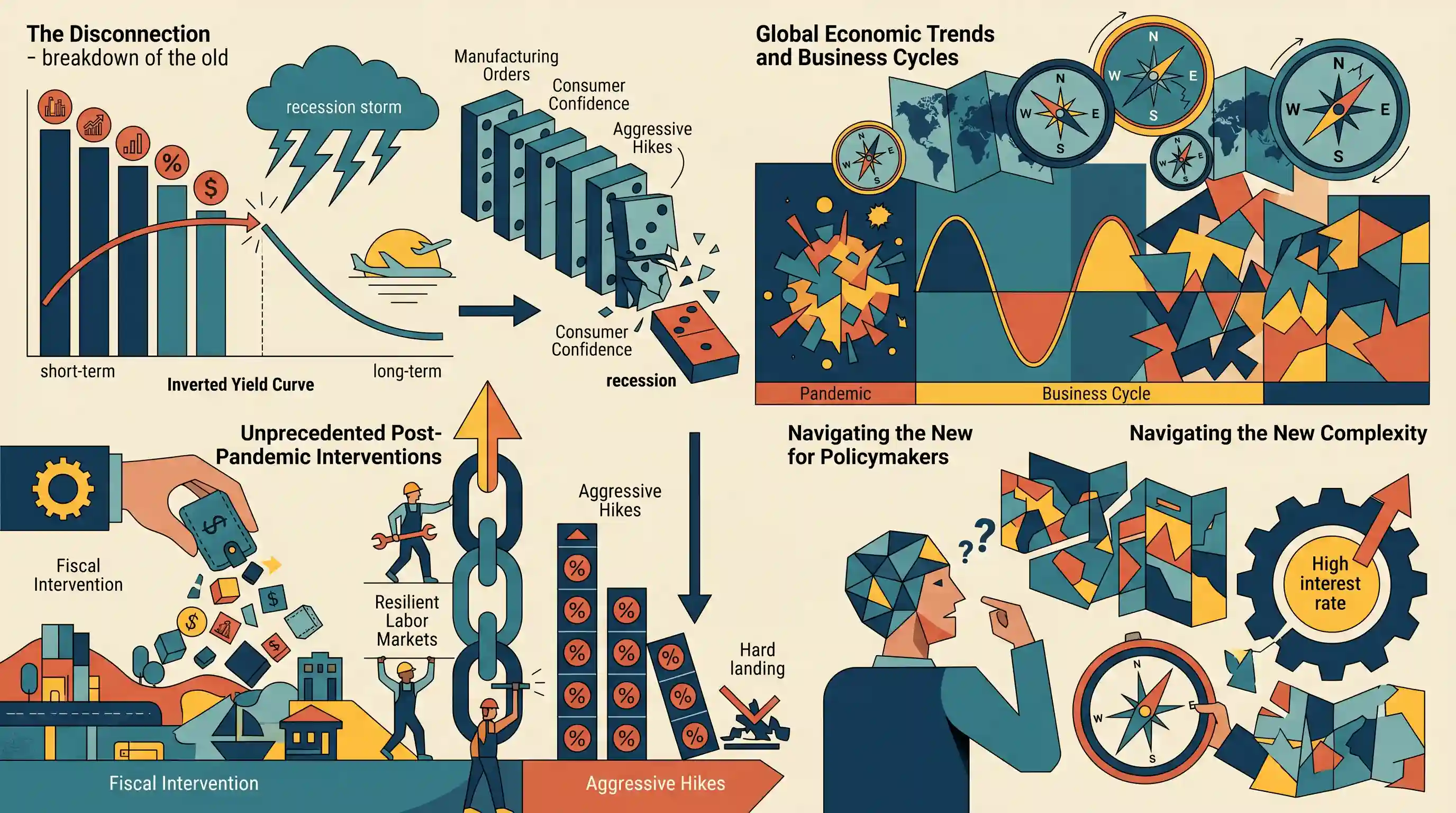
The article explores how traditional macroeconomic warning signals—such as the inverted yield curve and leading economic indices—have lost their predictive reliability in the post-pandemic era. Despite aggressive interest rate hikes by central banks globally aimed at curbing inflation, anticipated severe recessions have largely not materialized, pointing instead towards a 'soft landing'. This breakdown in economic forecasting is attributed to unprecedented structural shifts, massive fiscal interventions, and resilient labor markets. Consequently, policymakers face new complexities in managing business cycles and monetary policy when historical models no longer accurately reflect current economic realities.
Key Points
- Traditional macroeconomic indicators, such as the inverted yield curve or leading economic indices, have recently failed to reliably predict global recessions, breaking historical norms.
- The global economy's unexpected resilience despite aggressive interest rate hikes by central banks has challenged established monetary policy assumptions and recession models.
- Post-pandemic structural shifts, including massive fiscal stimulus, resilient consumer spending, and tight labor markets, have distorted standard economic warning signals.
- Policymakers and central banks face significant challenges in calibrating interest rates when standard forecasting models no longer provide accurate signals of impending economic downturns.
Important Terms
Reserve Bank of India (RBI)

The apex financial institution and regulatory body of India's banking system, responsible for issuing currency and maintaining monetary stability.
UPSC context
GS Paper III (Indian Economy); tests knowledge of the central bank's functions, tools, and regulatory role.
Monetary Policy
The process by which a central bank manages the money supply and interest rates to achieve goals like price stability and economic growth.
UPSC context
GS Paper III (Economy); focus on Repo rate, CRR, and the Monetary Policy Committee (MPC).
Inverted Yield Curve
A condition where short-term bond yields exceed long-term yields, traditionally viewed as a reliable precursor to an economic recession.
UPSC context
GS Paper III (Economy); relevant for understanding business cycles and technical indicators in Prelims.
Soft Landing
An economic scenario where a central bank successfully raises interest rates to curb inflation without causing a recession or high unemployment.
UPSC context
GS Paper III (Economy); tests comprehension of business cycle management and the effects of contractionary policy.
Fiscal Policy
The use of government spending, taxation, and borrowing to influence the level of economic activity and achieve macroeconomic stability.
UPSC context
GS Paper III (Government Budgeting); crucial for analyzing the Union Budget and fiscal deficit trends.
Central Banks
Independent or semi-independent national institutions that oversee a country’s monetary system, manage currency, and serve as the lender of last resort.
UPSC context
GS Paper III (Economy); relevant for comparative economic studies and global financial governance.
Prelims Trap
An inverted yield curve occurs when long-term government bonds offer higher yields than short-term bonds.
This describes a normal yield curve. An inverted curve happens when short-term rates are higher, reflecting investor pessimism and traditionally signaling a recession.
Static Concepts Connected
What is the difference between a soft landing and a hard landing?
- Soft Landing: Central banks raise rates to cool inflation without causing a recession or massive job losses.
- Hard Landing: Aggressive monetary tightening leads to a severe economic downturn, contraction in GDP, and high unemployment.
What do normal and inverted yield curves indicate about the broader economy?
- Normal Curve: Long-term bonds yield more than short-term ones; indicates expected economic growth and rising inflation.
- Inverted Curve: Short-term yields exceed long-term yields; traditionally a strong leading indicator of an upcoming economic recession.
Cross-Topic Patterns
Fiscal vs Monetary Policy Clash
Post-pandemic expansionary fiscal stimulus actively counteracted central banks' contractionary monetary policies, distorting traditional inflation-control models and preventing standard recessions.
US Fed Actions and RBI Policy
US economic resilience delays Fed rate cuts, forcing the RBI to balance imported inflation risks against domestic growth imperatives—a classic UPSC external sector theme.

Yield curve dynamics and 'soft landing' terminology are prime targets for a pair-matching or assertion-reason question in 2026.
Linked PYQs · 4
Linked PYQs · 4
- 2023PrelimsGS1
Consider the following statements: Statement-I: In the post-pandemic recent past, many Central Banks worldwide had carried out interest rate hikes. Statement-II: Central Banks generally assume that they have the ability to counteract the rising consumer prices via monetary policy means. Which one of the following is correct in respect of the above statements?
- 2021PrelimsGS1
Which among the following steps is most likely to be taken at the time of an economic recession?
- 2021PrelimsGS1
With reference to Indian economy, demand-pull inflation can be caused/ increased by which of the following? 1. Expansionary policies 2. Fiscal stimulus 3. Inflation-indexing wages 4. Higher purchasing power 5. Rising interest rates Select the correct answer using the code given below.
- 2024MainsGS3
What are the causes of persistent high food inflation in India? Comment on the effectiveness of the monetary policy of the RBI to control this type of inflation.
