NITI Aayog Roadmap for India Semiconductor Supply Chain Resilience
Source:The Hindu ↗
Why It Matters
Semiconductor self-reliance is a critical strategic priority for India, cutting across economic growth, digital infrastructure, and national security. The NITI Aayog report's roadmap directly relates to UPSC topics regarding industrial policy, the India Semiconductor Mission, and the geopolitical realignment of global supply chains.
Summary
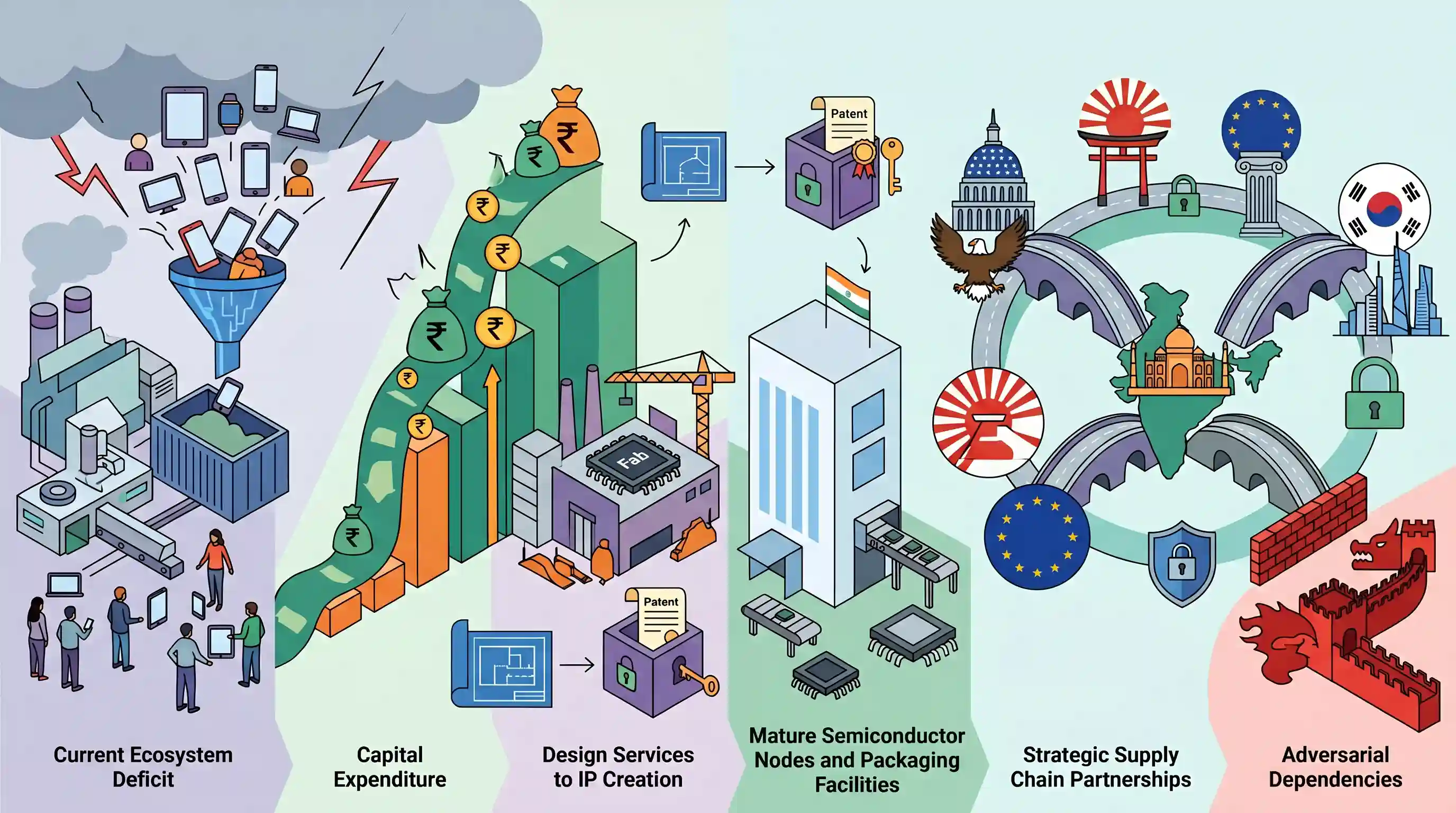
A recent NITI Aayog report outlines the long-term roadmap for India's semiconductor industry, acknowledging that the current ecosystem cannot fulfill domestic demand. Driven by geopolitical vulnerabilities and national security concerns, the government is prioritizing localized chip manufacturing. The report recommends focusing on mature semiconductor nodes and packaging facilities, backed by an estimated $45–60 billion capital expenditure over ten years. Furthermore, it emphasizes transitioning from design services to IP creation, while forging strategic supply chain partnerships with trusted nations like the US, Japan, EU, and South Korea, distancing from adversarial dependencies like China.
Key Points
- A NITI Aayog report states India's current semiconductor ecosystem is inadequate for domestic demand, requiring a decade-long, mission-mode commitment to build resilience.
- India should focus on producing mature nodes (28nm or higher) and expanding advanced packaging capabilities, rather than immediately pursuing frontier nodes like 2nm.
- The industry will require a massive capital expenditure of $45–60 billion over the next ten years.
- Currently dominant in semiconductor design services, India needs to transition towards becoming an Intellectual Property (IP) creator through deep R&D and materials science capabilities.
- Geopolitical realities drive this push: the aim is to build resilient supply chains with trusted partners (US, Japan, EU, South Korea) to mitigate risks of overdependence on Taiwan and strategic rivalry with China.
- India's first commercial chip fabrication plant is set to be operational by 2028 in Dholera, Gujarat, through a joint venture between Tata Electronics and Taiwan's PSMC.
Important Terms
India Semiconductor Mission (ISM)

The nodal agency under MeitY launched in 2021 to build a domestic semiconductor and display ecosystem through fiscal incentives (₹76,000 crore) and strategic planning.
UPSC context
GS Paper III: Industrial Policy/Science & Tech; core for questions on 'Atmanirbhar Bharat' and electronic indigenization.
NITI Aayog
India's premier policy think-tank that released the 2026 'Future of India’s Semiconductor Industry' roadmap, envisioning a $120–150 billion value chain by 2035.
UPSC context
GS Paper II: Governance; tests understanding of strategic long-term planning and the role of institutions in economic development.
Mature Semiconductor Nodes
Established manufacturing processes (typically 28nm or larger) used for cost-effective, reliable chips in automotive, industrial, and IoT sectors, rather than cutting-edge frontier chips.
UPSC context
GS Paper III: Science & Tech; crucial for discussing 'capital efficiency' and India's realistic entry point into global manufacturing.
Outsourced Semiconductor Assembly and Test (OSAT)
The final stages of semiconductor manufacturing involving assembly, testing, and packaging; identified as a core, less capital-intensive pillar for India’s immediate industrial growth.
UPSC context
GS Paper III: Economy/Industry; relates to India’s position in the Global Value Chain (GVC) and job creation in electronics.
Intellectual Property (IP) Creation
The shift from providing semiconductor design services to owning indigenous designs and architectures, allowing India to capture higher value and technological sovereignty.
UPSC context
GS Paper III: Science & Tech/IPR; focuses on the transition from a service-based to an innovation-led economy.
Ministry of Electronics and Information Technology (MeitY)
The central ministry responsible for IT policy and the digital economy; it serves as the administrative parent for the India Semiconductor Mission (ISM).
UPSC context
GS Paper II: Governance; the primary executive body for digital infrastructure and high-tech industrial schemes.
Supply Chain Resilience
The capacity of supply chains to withstand and recover from disruptions, achieved by India through 'trusted' partnerships (e.g., iCET with the US) to reduce adversarial dependencies.
UPSC context
GS Paper II: International Relations/Security; relevant for 'China Plus One' strategy and Indo-Pacific economic frameworks.
Prelims Trap
India's semiconductor roadmap prioritizes the immediate development of frontier nodes (like 2nm) to achieve global competitiveness.
The NITI Aayog roadmap actually recommends prioritizing "mature nodes" (28nm-65nm) and advanced packaging (OSAT), rather than immediately pursuing highly capital-intensive frontier nodes.
Static Concepts Connected
What is the difference between frontier nodes and mature nodes in semiconductors?
- Frontier nodes: Refer to sub-7nm chips (e.g., 2nm or 3nm) used in high-end smartphones and AI accelerators. They are highly complex and extremely capital-intensive to manufacture.
- Mature nodes: Refer to 28nm or higher (up to 65nm+). They are cheaper to produce and form the backbone of automotive electronics, IoT devices, and consumer appliances.
- India's strategy: India's immediate focus is on mastering mature nodes and "More-than-Moore" advanced packaging rather than directly competing in frontier nodes.
What is the structural mandate of the India Semiconductor Mission (ISM)?
- Nodal Agency: It is housed within the Digital India Corporation (DIC) under the Ministry of Electronics and Information Technology (MeitY).
- Ecosystem Funding: It serves as the focal point for the ₹76,000-crore incentive scheme to establish fabs, display fabs, ATMP (Assembly, Testing, Marking, and Packaging), and OSAT facilities.
- Focus on IP: Through the DLI scheme, ISM specifically aims to nurture fabless design startups to overcome India's historical lack of indigenous intellectual property (IP).
Cross-Topic Patterns
iCET and Quad Semiconductor Resilience
India's strategic push for "trusted partners" (US, Japan, South Korea) directly mirrors the objectives of the iCET and the Quad Semiconductor Supply Chain Initiative, shifting from simple trade to geotech alliances.
DLI vs PLI: The IP Creation Push
While PLI targets capital-heavy manufacturing, the NITI Aayog's emphasis on transitioning from design services to IP creation highlights the strategic importance of the Design Linked Incentive (DLI) scheme for fabless startups.

Expect a 2026 Prelims question testing the difference between mature and frontier nodes, alongside the specifics of India's DLI scheme.
Linked PYQs · 3
Linked PYQs · 3
- 2025MainsGS3
India aims to become a semiconductor manufacturing hub. What are the challenges faced by the semiconductor industry in India? Mention the salient features of the India Semiconductor Mission.
- 2024MainsGS2
‘The West is fostering India as an alternative to reduce dependence on China's supply chain and as a strategic ally to counter China's political and economic dominance.’ Explain this statement with examples.
- 2023MainsGS3
Faster economic growth requires increased share of the manufacturing sector in GDP, particularly of MSMEs. Comment on the present policies of the Government in this regard.
